Factories Under Fire - How Firestorm Labs Is Rewriting the Rules of Modern Warfare
In the wars of the 21st century, missiles don’t just target troops or hardware—they target supply chains. And those supply chains, stretched across oceans and reliant on centralized factories, are proving dangerously brittle.
Firestorm Labs is betting the future of warfare looks very different. Instead of shipping drones to the battlefield, the battlefield gets the factory.
This week, the San Diego–based defense technology company announced an $82 million Series B round, led by Washington Harbour Partners with participation from New Enterprise Associates, In‑Q‑Tel, Lockheed Martin Ventures, Booz Allen Ventures, and others, bringing total funding to $153 million. The funding marks a decisive transition from experimentation to scaled deployment—and a signal that the Pentagon and its partners are ready to rethink how weapons are built, delivered, and sustained.
At the center of Firestorm’s strategy is xCell, a containerized manufacturing platform that fits inside standard shipping containers and can be deployed to austere or contested environments. Inside, industrial‑grade 3D printers produce airframes and components for unmanned systems at the tactical edge, reducing dependence on long, vulnerable logistics chains.
The timing is not accidental. Recent conflicts, particularly in the Indo‑Pacific, have exposed how quickly traditional supply lines can be disrupted. The U.S. Department of Defense has formally designated contested logistics as one of its six Critical Technology Areas, elevating distributed manufacturing from novelty to national security priority.
Firestorm did not start out as a factory company. Originally a drone manufacturer, it pivoted after military customers began asking a blunt question: What happens when resupply becomes impossible? The answer was radical—move production forward, closer to the fight.
“Our Series B accelerates our move into scaled production,” said CEO Dan Magy, emphasizing that Firestorm is not following industry trends but redefining them by “moving the factory to the front lines”.
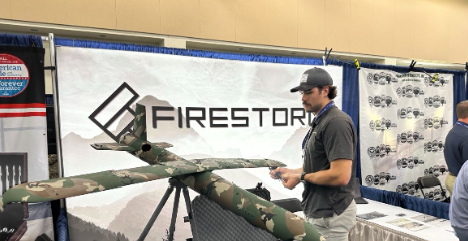
Unlike traditional defense platforms that are locked into fixed designs, Firestorm’s systems are configurable. The drones produced via xCell can be adapted for surveillance, electronic warfare, and lethal roles depending on mission needs, with deployment and use governed by standard military doctrine. The platform itself is designed as an open ecosystem, allowing partners to redesign their own systems for additive manufacturing and simplified field assembly.
This approach fundamentally reframes industrial capacity. Manufacturing is no longer a rear‑echelon activity—it becomes a frontline capability.
The Pentagon appears to agree. Firestorm has already conducted demonstrations with the U.S. Air Force and Army, and is now expanding fielding across operational theaters, including the Indo‑Pacific, where logistics challenges are most acute.
Investors see more than a single product. They see a new doctrine.
“Industrial capacity is no longer a background condition,” said Mina Faltas, founder and CIO of Washington Harbour Partners. “It’s a frontline requirement for national security”.
Firestorm’s growth reflects that urgency. The company has quadrupled its workforce from roughly 40 to more than 160 employees in the past year, scaling talent alongside demand.
If future conflicts are decided by speed, adaptability, and resilience, Firestorm’s bet is clear: the side that manufactures fastest—closest to the fight—wins.
And in an era where being mission‑capable inside the weapons engagement zone is what matters most, factories may soon be just as deployable as soldiers.