Everdrone E3 - The Drone That Races the Ambulance and Wins
When someone suffers a cardiac arrest, the difference between life and death is measured not in hours—but in minutes.
And in most cities, the system designed to save you is already too slow.
Traffic. Distance. Dispatch delays. Human reaction time.
Even the best ambulance systems are bound by physics.
Everdrone E3 challenges that reality—and quietly exposes a brutal truth: we’ve been solving the problem the wrong way.
Instead of making ambulances faster, Everdrone removes them from the equation.
The E3 is not just a drone. It is a time machine for emergencies.
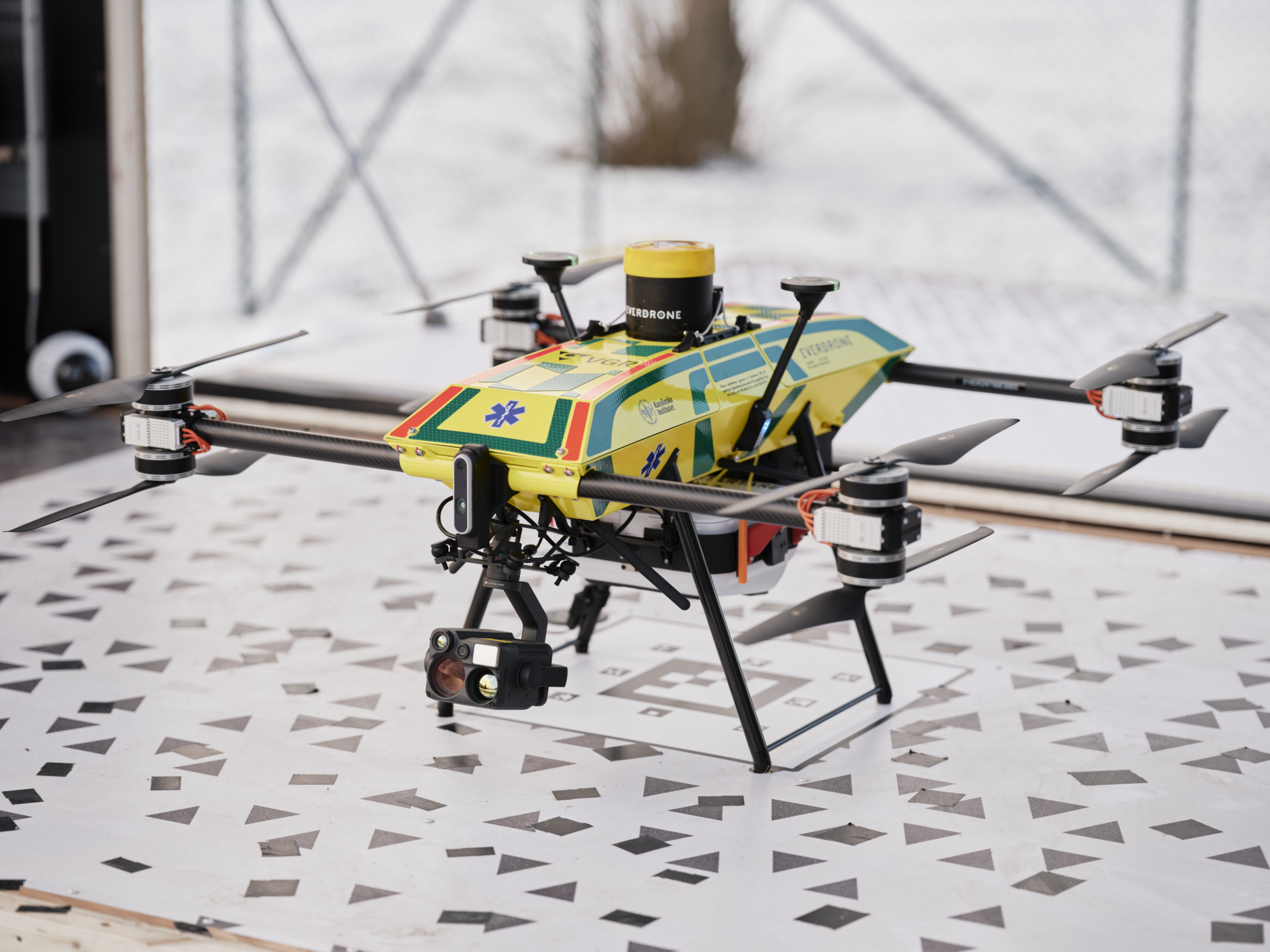
Designed specifically for autonomous AED (defibrillator) delivery, the E3 can reach a cardiac arrest victim significantly faster than traditional emergency services. In real-world tests, it has already beaten ambulances to the scene—sometimes by several minutes.
And in cardiac arrest, those minutes are everything.
Survival rates drop by roughly 10% for every minute without defibrillation.
Five minutes can decide everything.
Ten minutes often decide nothing.
So Everdrone didn’t build a better drone.
They built a system that attacks time itself.
At the center of that system is the E3 UAV—an H-8 octocopter engineered for speed, redundancy, and precision. With top speeds exceeding 100 km/h and the ability to carry an AED payload, it is optimized not for aerial photography or logistics, but for one single outcome:
Arrive first. Save life.
But the real innovation is not in the airframe.
It’s in the infrastructure.
Each drone is deployed from a Skybase—a distributed network of automated launch stations placed strategically across urban environments. These bases keep drones charged, pre-checked, and ready to launch within seconds.
When an emergency call is triggered, the system doesn’t wait.
It calculates a route instantly—factoring terrain, weather, and population density—and launches within about 15 seconds.
No human delay.
No hesitation.
No interpretation.
Just action.
And unlike traditional drone operations, these flight paths are not fixed corridors. They are dynamically generated in real time, avoiding crowded areas and minimizing risk on the ground—ensuring compliance with strict aviation safety frameworks like SORA.
This is where Everdrone’s thinking becomes fundamentally different.
They are not building drones for operators.
They are building autonomous medical infrastructure.
That shift changes everything.
Because infrastructure is not optional.
It becomes invisible—and essential.
To make this viable, the E3 is engineered with extreme redundancy. Dual battery systems ensure uninterrupted power. Multiple coaxial rotors allow the drone to continue flying even if a motor fails. Continuous system diagnostics monitor performance mid-flight, enabling automatic fail-safes when needed.
This is aviation-level reliability—compressed into an urban emergency tool.
But perhaps the most provocative aspect of Everdrone’s approach is not technological—it’s philosophical.
They are redefining responsibility.
Traditionally, survival depends on trained professionals arriving in time. Everdrone decentralizes that moment. By delivering an AED directly to bystanders, they shift the critical first action from specialists to civilians.
That’s uncomfortable.
But it’s also necessary.
Because the fastest responder is not the ambulance.
It’s the person already there.
Everdrone simply equips them—faster than anyone else can.
And in doing so, they reveal a future where emergency response is no longer a centralized service, but a distributed, autonomous system operating above the city.
Quiet. Invisible. Always ready.
Not replacing humans.
But beating time.