Europe’s Missile Factory Is Waking Up. Frankenburg Bets on Scale, Not Gold-Plated Weapons
Western defense procurement followed a familiar formula: build fewer weapons, make them more sophisticated, and accept rising costs as the price of military superiority.
That model is now under pressure.
The war in Ukraine has exposed a hard truth about modern conflict: wars of attrition are won not only by technological excellence but by production capacity. A missile that is too expensive to manufacture in large numbers risks becoming strategically irrelevant.
This is the challenge that a new generation of defense companies is trying to solve.
One of the most ambitious examples is Frankenburg Technologies, a European defense technology company that wants to fundamentally rethink missile production. Its latest partnerships with BAE Systems and Roxel UK suggest the company is moving from startup ambition toward industrial reality.
The agreements cover two of the most critical and technically demanding components of missile design: warheads and propulsion.
On the surface, these are supplier announcements.
In practice, they are a statement about the future of air defense.
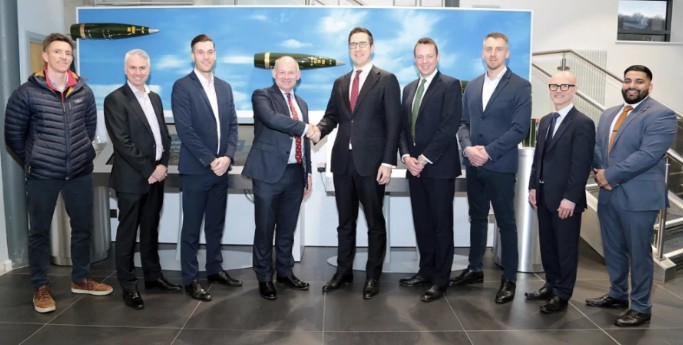
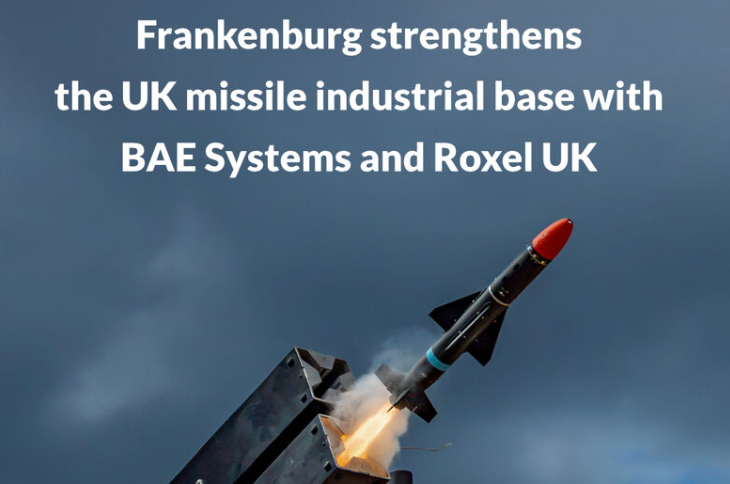
Frankenburg has selected BAE Systems’ BlackThorn modular warhead for integration into its compact Mark I air-defense missile, while simultaneously signing a five-year strategic cooperation agreement with Roxel UK covering rocket motor development, integration, and supply.
The significance extends beyond the components themselves.
Missiles are ultimately systems of systems. Success depends on how effectively propulsion, guidance, warhead design, manufacturing, logistics, and cost are optimized together. The strongest missile architecture is often not the one with the highest performance specifications, but the one that can be produced rapidly, reliably, and in large quantities when conflict erupts.
That lesson is being learned across NATO.
Stockpiles once considered sufficient have proven surprisingly vulnerable to high-intensity warfare. Production lines designed for peacetime efficiency struggle to meet wartime demand. Governments are increasingly searching for solutions that prioritize volume without sacrificing effectiveness.
This is where Frankenburg sees its opportunity.
Its Mark I missile is designed to intercept Class I to III drones while reducing interception costs by more than tenfold compared to traditional systems. Measuring only around 65 centimeters and weighing less than two kilograms, the missile is designed for deployment across multiple platforms and, crucially, for large-scale manufacturing.
The key word is affordability.
Defense companies often compete by promising maximum capability.
Frankenburg is attempting something different.
It is competing on economics.
That is a potentially disruptive proposition in a defense sector where the cost exchange ratio increasingly matters. Destroying a low-cost drone with an interceptor costing hundreds of thousands of dollars is mathematically unsustainable. The future belongs to systems capable of defeating mass attacks without bankrupting the defender.
The new partnerships address precisely that challenge.
BAE Systems brings decades of expertise in warhead engineering, fuzing technologies, energetic materials, and high-volume production. BlackThorn was selected not only for performance but also for its suitability for rapid and cost-efficient manufacturing.
Roxel UK contributes equally important capabilities.
Rocket motors remain one of the most specialized technologies in missile production. Their design influences performance, reliability, manufacturing complexity, and supply-chain resilience. By involving propulsion specialists early, Frankenburg aims to optimize not just how Mark I flies but how efficiently it can be produced.
The broader strategic dimension is equally important.
Europe is rapidly rediscovering the value of defense industrial sovereignty.
For years, efficiency-driven globalization encouraged dependence on complex international supply chains. Today, geopolitical uncertainty is pushing governments toward localized production and resilient industrial networks.
Frankenburg's plan to establish a FieldFoundry production site in the United Kingdom by 2027 aligns directly with that trend.
The company's recent selection under the UK Ministry of Defence's Low-Cost Air Defence Effectors Programme further suggests that affordable mass production is becoming a strategic priority rather than merely a procurement preference.
The central question facing Western militaries is no longer whether advanced weapons can be built.
They can.
The real question is whether they can be built fast enough, cheaply enough, and at sufficient scale to meet the demands of future conflicts.
Frankenburg's partnerships with BAE Systems and Roxel UK represent an attempt to answer that question before the next major security crisis arrives.
The age of boutique missile production may be ending.
The age of defense manufacturing at scale may have just begun.