Europe’s Defense Problem Was Never Money. It Was Coordination.
For years, Europe’s defense debate revolved around a familiar question:
Are European countries spending enough?
The answer increasingly became yes.
Defense budgets rose.
New rearmament plans emerged.
Factories expanded production.
Governments announced billions in additional investments.
Yet one uncomfortable problem remained.
Europe still struggled to transform spending into capability at the speed demanded by modern warfare.
The issue was never simply financial.
It was organizational.
And that may explain why the recent decision to strengthen the European Defence Agency (EDA) could prove more consequential than many weapons procurement announcements.
Because Europe is slowly beginning to understand a critical lesson from Ukraine:
The future of military power depends not only on what nations build, but on how quickly they learn, cooperate, procure, and adapt together.
The Fragmentation Trap
Europe possesses one of the world's largest combined economies.
It has world-class technology companies.
Leading research institutions.
Advanced aerospace industries.
Highly capable armed forces.
Yet for decades, Europe's defense ecosystem operated through a patchwork of national priorities, procurement systems, standards, and industrial interests.
The result has often been duplication.
Multiple programs pursuing similar objectives.
Parallel research efforts.
Fragmented procurement.
Competing industrial champions.
Complex interoperability challenges.
In peacetime, this inefficiency could be tolerated.
In an era of accelerated military competition, it becomes a strategic vulnerability.
The battlefield no longer moves according to bureaucratic schedules.
Technology evolves too quickly.
Threats adapt too rapidly.
Procurement cycles measured in decades increasingly compete against adversaries adapting in months.
The Innovation Gap
The war in Ukraine revealed another uncomfortable reality.
Europe excels at research.
It often struggles to operationalize that research.
Laboratories produce excellent concepts.
Universities generate advanced technologies.
Startups develop promising solutions.
Yet converting those innovations into deployable military capability remains slow.
This is where the transformation of HEDI into the Centre for European Defence Innovation (CEDI) becomes strategically important.
The challenge is no longer generating ideas.
Europe generates plenty.
The challenge is moving ideas from experimentation to operational deployment.
Rapidly.
Repeatedly.
At scale.
Innovation is no longer measured by patents.
It is measured by how fast solutions reach the battlefield.
Procurement Is Becoming a Strategic Capability
One of the most interesting developments is the creation of the new collaborative procurement centre.
Traditionally, procurement has been viewed as an administrative function.
Necessary.
Important.
But rarely strategic.
That perception is becoming outdated.
Modern warfare increasingly rewards speed.
The nations able to acquire, distribute, replace, and modify capabilities rapidly gain an operational advantage.
Procurement therefore becomes part of military capability itself.
The ability to purchase collaboratively may sound less exciting than hypersonic missiles or artificial intelligence.
Yet it may generate greater long-term impact.
Because fragmented purchasing creates fragmented capability.
And fragmented capability creates fragmented readiness.
Defense Is Becoming a Network
The most important aspect of the EDA expansion may be philosophical.
The traditional understanding of national defense remains largely platform-centric.
More tanks.
More ships.
More aircraft.
More missiles.
The emerging reality is different.
Military advantage increasingly emerges from networks.
Networks of sensors.
Networks of information.
Networks of industrial partnerships.
Networks of innovation.
Networks of procurement.
Networks of production.
The organizations capable of connecting these elements outperform those that optimize individual components in isolation.
This is precisely why strengthening a coordinating institution matters.
The future competition is not simply Germany versus France versus Poland.
It is Europe versus the pace of emerging threats.
Can Europe Learn Faster?
This remains the critical question.
The challenge facing Europe is not only increasing production.
Nor is it merely raising defense budgets.
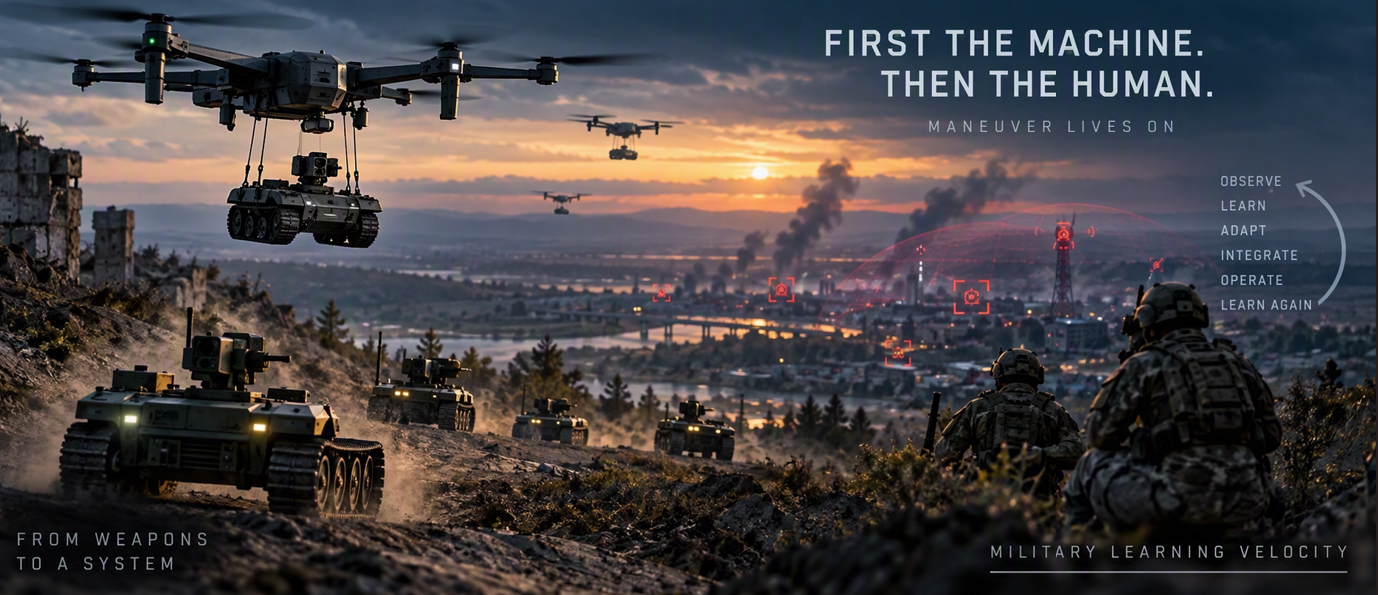
The real challenge is shortening the distance between innovation, procurement, capability development, and deployment.
Every major conflict demonstrates the same pattern.
New technologies emerge.
Countermeasures follow.
Adaptation becomes continuous.
The side that completes learning cycles fastest gains the advantage.
This is why Europe's real competition is not measured in budget totals.
It is measured in organizational speed.
How quickly can European states identify a requirement?
Develop a solution?
Procure it?
Scale production?
Deploy it operationally?
And improve it again?
The EDA's expansion suggests Europe is beginning to focus on exactly those questions.
The Real Test Begins Now
Growing from roughly 240 to nearly 300 personnel is not, by itself, a military revolution.
Creating a procurement centre does not automatically generate capability.
Rebranding an innovation hub does not guarantee faster innovation.
The real test will be execution.
Can Europe transform coordination into capability?
Can collaboration become faster than fragmentation?
Can innovation move faster than bureaucracy?
Can collective action move faster than emerging threats?
Those answers will determine whether Defense Readiness 2030 becomes a strategic turning point or simply another institutional reform.
Because Europe's greatest defense challenge may never have been a shortage of technology.
Or a shortage of money.
Or even a shortage of industrial capacity.
It may have been a shortage of mechanisms capable of turning all three into military power quickly enough.
And in modern warfare, speed is often the difference between readiness and irrelevance.