Can Drones Make It Rain? Silicon Valley’s Boldest Weather Experiment Just Claimed 19 Million Gallons
For years, the technology industry promised to disrupt transportation, communication, finance, and even space exploration.
Now it wants to disrupt the weather.
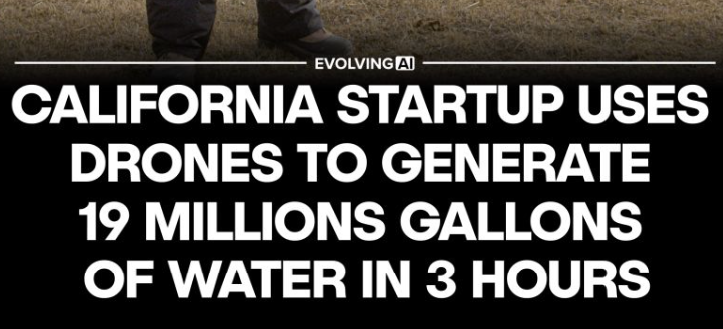
California startup Rainmaker claims its drone-based cloud-seeding system generated approximately 19 million gallons of additional precipitation in just three hours during a recent operation in Alaska.
If true, the implications are enormous.
Not only for agriculture.
Not only for drought-stricken regions.
But for the very idea that humanity can actively manage one of nature's most powerful forces.
The question is no longer whether technology can influence weather.
The question is whether it can do so accurately, economically, and responsibly at scale.
The Old Idea Behind a New Technology
Cloud seeding is not new.
The concept dates back to the 1940s when scientists discovered that substances such as silver iodide could encourage ice crystal formation inside suitable clouds.
The theory is relatively simple.
Certain clouds contain supercooled water droplets that can remain liquid below freezing temperatures.
Introduce microscopic particles that act as ice nuclei, and precipitation formation may accelerate.
What is new is the delivery system.
Traditionally, cloud-seeding operations relied on aircraft, ground generators, and relatively limited forecasting tools.
Rainmaker is attempting something very different.
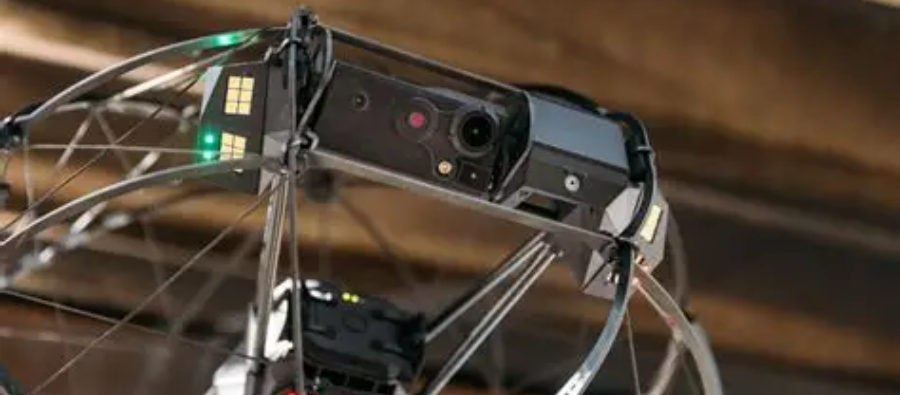
Instead of relying solely on pilots and meteorologists, the company combines drones, radar data, satellite observations, software automation, and advanced atmospheric modeling.
This isn't simply cloud seeding.
It's cloud seeding powered by algorithms.
AI Becomes a Weather Engineer
The most interesting part of Rainmaker's approach may not be the drones.
It's the software.
Finding a cloud is easy.
Finding the right cloud at the right moment is much harder.
The atmosphere is extraordinarily complex. Tiny changes in temperature, humidity, or wind conditions can dramatically alter precipitation outcomes.
Rainmaker says it uses sophisticated weather models to determine:
- Which clouds are suitable for seeding
- When conditions are optimal
- Where drones should operate
- How seeding should be conducted
- How much precipitation was likely enhanced
The company has also partnered with weather technology startup Atmo, whose AI-driven forecasting models reportedly help identify clouds with the greatest seeding potential.
This reflects a broader trend.
Artificial intelligence is increasingly moving beyond analyzing data and into influencing physical systems.
Energy grids.
Traffic networks.
Industrial processes.
And now potentially the weather itself.
The Number That Changes Everything
Nineteen million gallons.
That figure immediately attracts attention.
The challenge is verification.
Rainmaker states that the estimate comes from its own precipitation analysis.
That does not necessarily mean the conclusion is incorrect.
But weather science presents a unique problem.
No one can directly observe the alternate version of reality in which cloud seeding never occurred.
Scientists must instead estimate likely outcomes through models, observations, comparisons, and statistical methods.
This remains one of the most debated aspects of cloud-seeding research.
How much rain was produced naturally?
How much was enhanced?
And how certain can anyone actually be?
The bigger the claim, the more rigorous the validation must become.
Water Scarcity Is Creating New Incentives
Regardless of the precise number, the timing is important.
Water scarcity is becoming a growing challenge across many parts of the world.
Western regions of the United States continue to face periodic droughts, declining reservoir levels, and increasing competition for water resources.
Traditional infrastructure solutions are expensive, slow, and politically difficult.
Weather modification offers an appealing alternative.
If precipitation can be increased even modestly, the downstream impact on agriculture, water storage, hydroelectric generation, and ecosystem resilience could be significant.
The economic potential is enormous.
A relatively inexpensive drone mission that successfully increases rainfall could produce benefits worth millions of dollars.
That possibility explains why governments, utilities, agricultural interests, and investors continue to watch cloud-seeding technologies closely.
Who Owns the Rain?
Yet weather modification raises questions far beyond technology.
Who determines when clouds should be seeded?
Could increasing rainfall in one area reduce it elsewhere?
How should governments regulate artificial weather intervention?
What happens when different regions compete for the same atmospheric resources?
These questions sound futuristic.
They may become surprisingly practical if technologies like Rainmaker's continue to improve.
History suggests that once humans gain the ability to influence something valuable, governance rapidly becomes as important as innovation.
The Bigger Story
Perhaps the most fascinating aspect of this development is what it reveals about the modern technology industry.
For decades, Silicon Valley focused on digital systems.
Today, the frontier is increasingly physical.
Energy.
Defense.
Manufacturing.
Space.
Climate.
Water.
Rainmaker's experiment represents more than a cloud-seeding test.
It represents a growing belief that software, AI, and autonomous systems can influence the physical world in ways previously considered impossible.
Whether the company's 19-million-gallon claim ultimately withstands scientific scrutiny remains to be seen.
But one thing is already clear.
The future debate may no longer be whether humans can influence the weather.
It may be how much influence we should have.