Africa’s Drone War Isn’t Coming. It Has Already Started.
The most dangerous assumption about drone warfare in Africa may be that it has not yet reached scale.
Because scale might be the wrong metric.
Across Africa, armed non-state groups have not built anything resembling the industrial drone fleets seen in Ukraine. Yet inexpensive commercial UAVs are already changing how insurgents and militias see the battlefield, coordinate attacks and, in some cases, force supposedly stronger opponents to retreat.
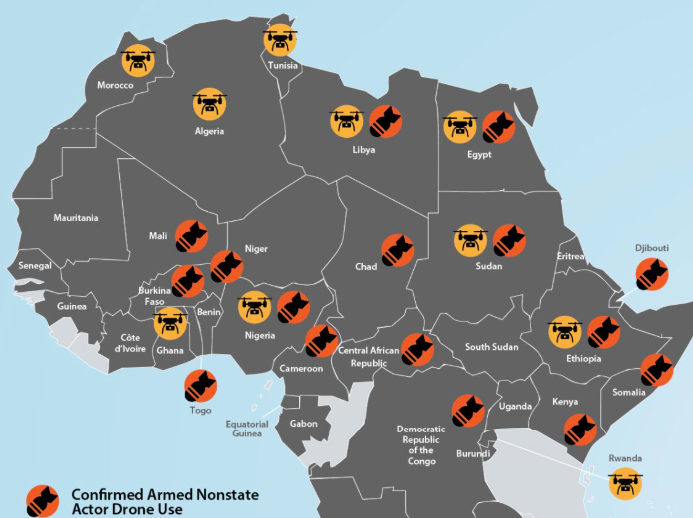
A new Lessons from Africa’s Drone Wars brief by Nate Allen of the Africa Center for Strategic Studies captures the shift. Armed non-state actors are now employing drones in at least 17 African countries, while armed forces in at least 40 African states have acquired drones. Eleven countries on the continent are producing military drones.
The revolution is not simply about turning quadcopters into flying bombs.
It starts with something simpler: seeing first.
Small drones allow armed groups to conduct intelligence, surveillance and reconnaissance, observe government positions and improve coordination of ground operations. The result is an asymmetric bargain. A relatively inexpensive commercial platform can make fighters on the ground substantially more informed and potentially more effective.
And occasionally, cheap technology can produce strategic consequences.
In April 2026, the Front de libération de l’Azawad used first-person-view drones during operations that forced Russian paramilitary forces to evacuate bases in Kidal, Mali, according to the Africa Center. Particularly striking was that Mali possessed sophisticated Bayraktar TB2 drones, yet those systems were unable to prevent the assault.
That should make defence planners uncomfortable.
For years, military drone procurement across Africa has frequently focused on larger, imported, long-endurance platforms. Yet Allen argues that African military capabilities remain concentrated on such imported systems while counter-UAS capabilities remain limited.
The threat is evolving differently.
Commercially available small drones can be modified, lost, replaced and modified again. New capabilities such as fibre-optic control and AI-enabled targeting are also becoming accessible to smaller actors at comparatively low cost.
This creates an uncomfortable reversal.
Professional militaries can possess expensive aircraft, imported UCAVs and vastly larger procurement budgets, while an insurgent organisation may enjoy the advantage of shorter adaptation cycles.
For governments, procurement can take years.
For an armed group, adaptation can take a trip to the electronics market, a workshop and another flight.
State support can amplify the danger further. Conflicts such as Sudan and eastern Democratic Republic of Congo demonstrate how armed actors can gain access to substantially more capable unmanned systems as external support, military-grade technology and conventional warfare intersect. Drone use is now evident across major African conflicts from Sudan and the Sahel to Somalia, the Lake Chad Basin and eastern DRC.
Yet drones should not become a technological explanation for every battlefield outcome.
That is precisely the point.
Counting drone strikes alone can underestimate their importance. A surveillance drone that identifies a vulnerable position may never fire a weapon. An FPV attack against the right vehicle, command post or defensive position may matter far more than dozens of unsuccessful missions.
The strategic question is not how many drones an armed group owns.
It is what the group can make happen with them.
That changes the counter-drone problem too.
The Africa Center for Strategic Studies recommends layered C-UAS defences, action against illicit drone supply chains and greater integration of small unmanned systems into forces designed for irregular warfare.
Africa’s governments therefore face an uncomfortable race.
They can keep buying bigger drones.
Or they can start building forces capable of surviving thousands of smaller innovations.
Because the next asymmetric revolution may not arrive as a sophisticated weapons platform.
It may arrive in a cardboard box.