A New “Molniya” Every Four Minutes. Inside Ukraine’s Drone War Against an Industrialized Air Threat
The future of warfare may not belong to missiles worth millions of dollars.
It may belong to disposable drones assembled from commercial parts in improvised workshops and launched from abandoned apartments, trenches, and makeshift shelters.
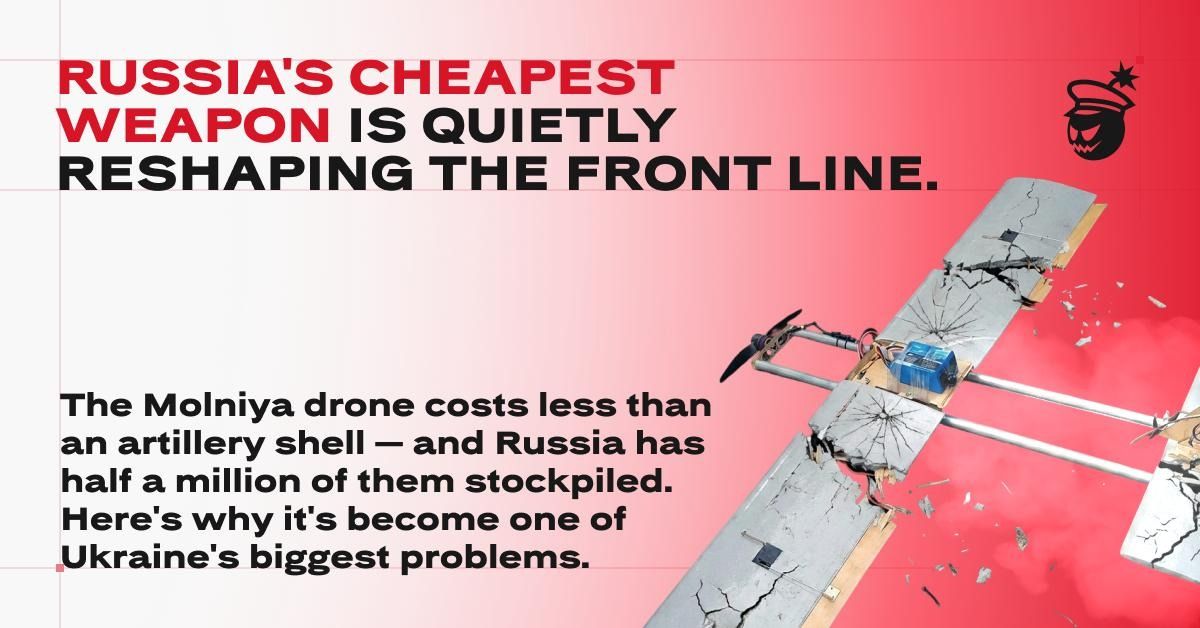
Across the frontlines of southern Ukraine, Russian Molniya drones have become one of the most disruptive weapons of the war. Cheap, easy to manufacture, and increasingly sophisticated, these attack drones are reshaping the battlefield by targeting logistics routes, defensive positions, shelters, vehicles, and frontline infrastructure.
Their greatest strength is not precision.
It is quantity.
According to Ukrainian operators fighting this threat, on the most active sectors of the front a new Molniya can appear in the sky every four minutes.
That pace is forcing Ukraine to rethink air defense from the ground up.
The Drone That Changed the Tactical Battlefield
Molniya drones are a study in brutal efficiency.
Built largely from commercially available Chinese components, featuring simple rectangular wings and modular construction, they can carry anti-tank mines, grenades, standard munitions, or improvised explosive payloads. Recent variants have added autonomous targeting functions, machine vision, logistics capabilities, and even remote mining systems.
Unlike expensive precision weapons, Molniyas are designed for scale.
Their mission is simple: overwhelm defenders through constant pressure.
Russian operators use them to hunt supply routes, destroy cover, attack positions, and make life near the front increasingly unbearable. Villages, tree lines, abandoned houses, and logistical hubs become targets in a campaign aimed at denying Ukrainian forces safe spaces to operate.
The strategy is proving effective.
Even a relatively small percentage of successful strikes can generate significant disruption when hundreds of drones are launched over time.
Ukraine's New Air Force: Interceptor Drone Pilots
To counter the threat, Ukraine has created a new category of frontline defenders.
Their weapons are not missiles.
They are drones hunting drones.
Among the most successful units is the interception division known as "Posipaky", part of Ukraine's air defense network. The unit has become famous for pioneering drone-on-drone combat and achieving thousands of successful interceptions.
The pilots operate in a world where seconds matter.
Using radar data, visual tracking systems, electronic intelligence, and real-time communications, teams launch interceptor drones toward incoming threats long before traditional air defense systems would engage.
The battlefield resembles an aerial chess match.
Operators race to locate targets, calculate trajectories, and intercept drones often flying at low altitudes, changing directions, and exploiting terrain features such as rivers, reservoirs, and coastlines.
The result is a continuous contest between hunters and hunters.
The Rise of the Interceptor Economy
One of the most remarkable developments is how quickly Ukraine's defense industry has responded.
Companies such as General Chereshnya have transformed the concept of tactical interceptor drones into a scalable solution.
Their AIR and AIR SPEED systems were initially developed to engage reconnaissance drones, but rapidly evolved into highly effective Molniya hunters.
The AIR interceptor can reach speeds exceeding 170 km/h and operate at significant altitudes, giving operators the capability to pursue incoming threats before they reach logistics hubs and defensive positions.
The faster AIR SPEED variant pushes performance even further, enabling engagements against higher-speed reconnaissance aircraft, loitering munitions, and other challenging aerial targets.
Yet the competition never stops.
Every improvement in Ukrainian interception capabilities is met by new Russian drone modifications.
Electronic warfare resistance, digital communications, autonomous navigation, and paired-flight tactics are continuously changing the rules of engagement.
The drone war has become an arms race measured not in years, but in weeks.
Why This Matters Beyond Ukraine
What is happening over Ukraine today offers a glimpse into the future of military operations worldwide.
The traditional model of air superiority was built around aircraft, missiles, and expensive defense systems. The drone age introduces a new equation where inexpensive autonomous systems can threaten infrastructure, logistics, and frontline operations at unprecedented scale.
The challenge is not simply destroying individual drones.
It is defeating mass.
The nation that learns how to produce, deploy, coordinate, and upgrade thousands of autonomous systems faster than its adversary gains a decisive advantage.
Ukraine's interceptor units demonstrate that the answer is not always a larger missile or a more expensive platform.
Sometimes the answer is another drone.
The War Above the War
Every day, while artillery duels and ground assaults capture headlines, a second conflict unfolds overhead.
Invisible to most observers, thousands of operators, engineers, programmers, and technicians are fighting for control of the low-altitude battlespace.
One side launches waves of cheap attack drones.
The other launches drones to destroy them.
The contest is relentless.
And as autonomous technologies continue to evolve, Ukraine's skies are becoming the world's most advanced laboratory for the future of warfare.
The lesson is increasingly clear:
The next air war may not be won by the side with the biggest aircraft.
It may be won by the side launching the next drone every four minutes.