A €7 Million Drone Deal That Shook Diplomacy between Russia and Japan
It was not a missile strike. It was not a sanctions package. It was a €7.3 million investment — and it was enough to summon Japan’s ambassador to the Russian Foreign Ministry.
That is how sharply the rules of modern conflict have changed.
When the Tokyo‑listed company Terra Drone announced a strategic investment in the Ukrainian startup Amazing Drones, Moscow responded with language usually reserved for overt hostile acts. Russia labelled the deal “openly unfriendly,” warned of damage to national security, and declared that relations with Tokyo had sunk to a historic low.
The message was unmistakable: industrial decisions are now strategic decisions.
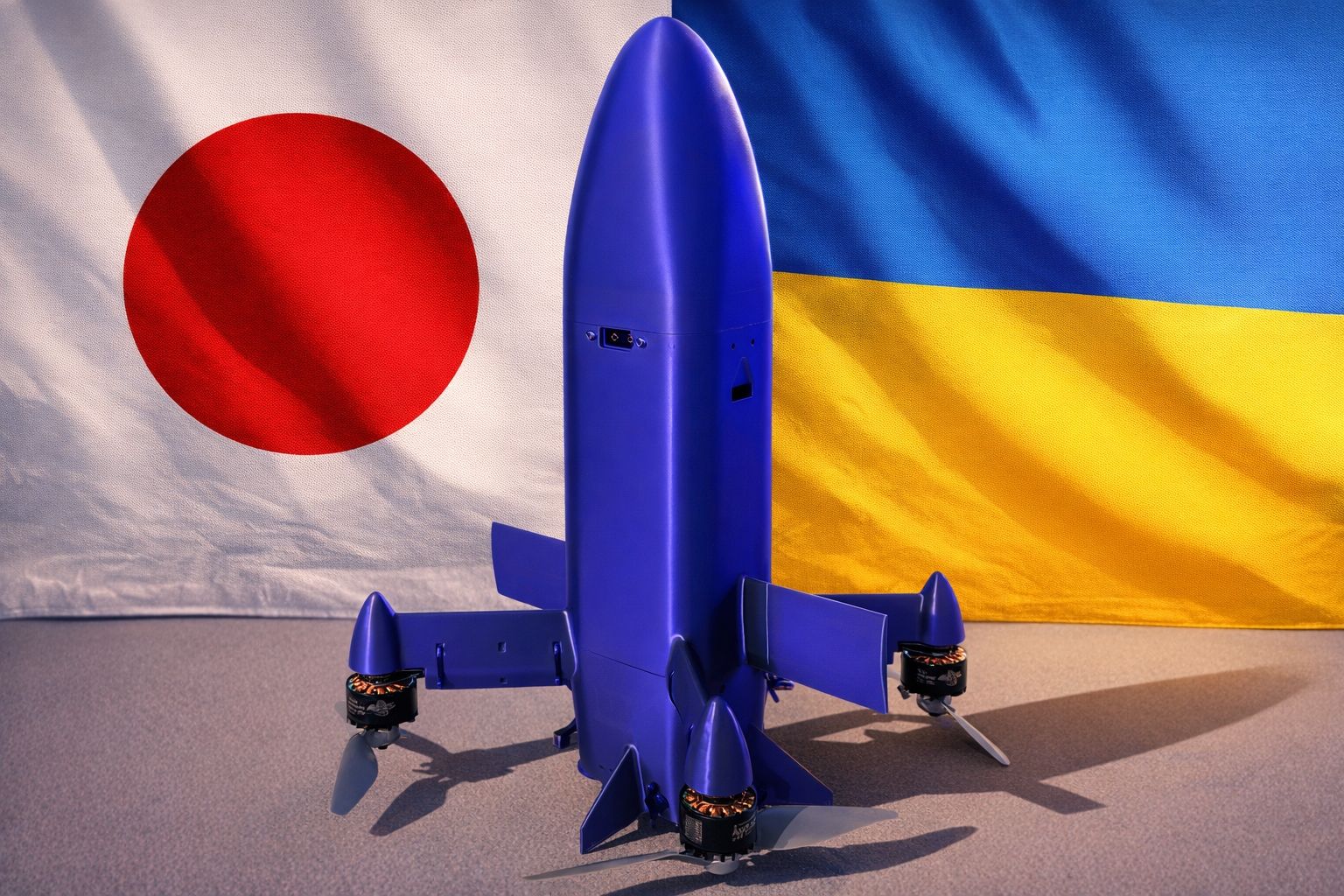
The partnership, formalised on March 31, brings together Terra Drone, Amazing Drones, and Ukraine’s defence innovation cluster Brave1. Its goal is the large‑scale production of the Terra A1 interceptor drone — a fast, short‑range system designed to counter Shahed, Geran‑2, and similar loitering munitions that have become a central tool of Russian air attacks.
Technically, the Terra A1 is unremarkable at first glance. A wedge‑shaped fuselage, four X‑configured propulsion units, short wings for lift and stability, and rear fins for control. Its quoted performance — up to 300 km/h speed, 32 km range, and around 15 minutes endurance — places it squarely within today’s fiercely competitive interceptor‑drone category.
Strategically, however, the system embodies something far more disruptive.
Terra Drone is not buying technology. It is buying experience.
“We are learning directly from Ukrainian engineers,” said Terra Drone CEO Toru Tokushige, who openly contrasts Ukraine’s wartime manufacturing logic with traditional industrial models. Large centralised factories, he argues, have become liabilities — easy targets for missiles and drones. Ukraine’s answer has been decentralisation: small, distributed production cells that can scale quickly and survive under constant threat.
Terra Drone has no intention of building major factories, either at home or abroad. Instead, it is studying the Ukrainian model of dispersed manufacturing — a system born not from theory, but necessity.
This is what rattled Moscow.
Far from being a purely commercial move, the investment connects Japan’s advanced industrial ecosystem to Ukraine’s battlefield‑hardened production knowledge. It signals a shift from arms transfers to industrial integration — a far more enduring form of support.
Russia’s reaction was immediate. The Japanese ambassador, Akira Muto, was summoned. The Foreign Ministry accused Tokyo of deliberately undermining Russian security. At the same time, markets delivered their own verdict: Terra Drone’s share price jumped 11.6 percent, its highest level since mid‑2025.
The contrast is striking.
To Moscow, the deal is escalation.
To investors, it is validation.
The broader battlefield context explains why. Ukraine’s interceptor‑drone sector is already crowded, with around twenty domestic manufacturers locked in rapid innovation cycles. Designs evolve in weeks. Performance improvements are measured in marginal gains that decide survival. EU programmes such as EU4UA are now funnelling funds to accelerate this arms race further.
In that environment, speed and production logic matter more than elegance.
Terra A1 is not being built to be perfect. It is being built to be replaceable. Its rapid acceleration — reaching 750 meters altitude in under half a minute during tests — reflects that philosophy: intercept fast, launch instantly, accept attrition.
This is modern air defence, scaled down and democratised.
Russia’s diplomatic response shows how unsettling this model has become. War is no longer only about tanks and aircraft. It is about supply chains, manufacturing layouts, engineering teams, and learning curves that move faster than missiles.
A €7 million investment once barely registered in international politics. Today, it can summon ambassadors.
Not because of its size — but because of what it enables.