500 Patriot Interceptors, $2.1 Billion — Ukraine Just Secured a Major Air-Defense Lifeline
Ukraine has received a major boost for its long-term air defense.
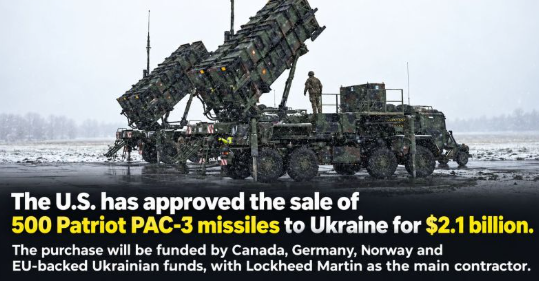
The U.S. State Department has approved a potential $2.1 billion sale of 500 Patriot PAC-3 Missile Segment Enhancement interceptors to Ukraine. The package also includes spare parts, logistics and program support, with Lockheed Martin named as the principal contractor.
The scale of the deal matters.
Patriot remains one of Ukraine’s most important defenses against ballistic missiles and other high-end aerial threats. Kyiv has repeatedly warned that interceptor shortages are becoming a critical problem as Russian attacks continue against cities, energy infrastructure and other targets.
The financing structure is just as significant.
The purchase is expected to be funded through contributions from Canada, Germany and Norway under the U.S. JUMPSTART program, combined with Ukrainian national funds supported by the European Union’s Ukraine Support Loan. According to the State Department, no U.S. funds are involved in financing the purchase.
That makes this more than a simple U.S.-Ukraine arms deal.
It is effectively a multinational air-defense package: American technology, European and Canadian financing, and Ukrainian operational demand coming together in one procurement effort.
The missile variant involved is also important.
The PAC-3 MSE is designed for high-end air and missile defense and is among the most advanced interceptors in the Patriot family. Ukraine relies on Patriot systems because they can engage threats that many other air-defense systems struggle to defeat, particularly ballistic missiles.
But there is one major limitation: approval does not mean immediate delivery.
The State Department notification did not provide a delivery schedule. Reuters reported that some of the missiles may still need to be manufactured and may not arrive for years, while Ukrainian President Volodymyr Zelenskyy has continued to press for faster access to interceptors already available in allied inventories.
That distinction is critical.
Ukraine’s air-defense problem exists now, not in the 2030s.
A long-term order of 500 interceptors strengthens future resilience, but it does not automatically solve short-term shortages. That means Kyiv still depends on accelerated transfers, allied stockpiles and quicker production while the larger contract moves through the procurement system.
The sale therefore highlights two very different realities of modern air defense.
The first is industrial scale.
Missile defense is no longer just about owning advanced systems. It is about having enough interceptors, enough production capacity and enough funding to sustain operations over months or years.
The second is coalition logistics.
Ukraine’s defense increasingly depends on a network in which one country provides the weapons, others provide financing, and multiple governments coordinate approvals, transfers and replenishment.
That system can be powerful, but it can also be slow.
The $2.1 billion Patriot package shows that Ukraine’s partners are willing to finance major long-term purchases. At the same time, it underlines the continuing challenge of converting political approval into missiles available on launchers when they are needed most.
For Lockheed Martin, the agreement also reinforces the strategic importance of PAC-3 production capacity. Demand for advanced air-defense interceptors is rising globally, and Ukraine is competing with U.S. and allied requirements for the same category of weapon.
The broader message is clear.
Air defense has become one of the central industrial problems of modern warfare.
Ukraine does not only need Patriot batteries.
It needs depth.
And 500 additional PAC-3 MSE interceptors could eventually provide exactly that.