What If the Missile Launcher Could Fly? COBRA Takes IRIS-T Into the Drone Age
Air defence has traditionally been built around a simple geometry.
The radar detects the threat. A ground-based launcher fires. The interceptor climbs toward its target.
But what happens when you put the launcher in the sky?
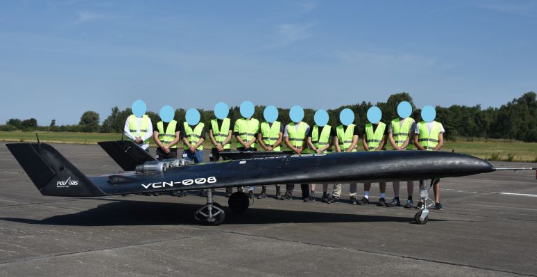
German space startup POLARIS has successfully completed the first flight of its COBRA prototype, a light uncrewed aircraft being developed together with Diehl Defence under the AirLAS — Airborne Launching and Strike System — project.
The first flight reportedly covered more than 20 kilometers and went smoothly, with additional flight testing planned over the coming months.
But COBRA is interesting for a reason far beyond another successful drone test.
With a take-off mass above 600 kg, the aircraft is primarily being designed to carry and launch IRIS-T air-to-air missiles for air-defence missions.
Essentially, it could become a flying uncrewed missile carrier.
Why put an air-defence missile on a drone?
Modern air defence faces an increasingly uncomfortable economic and geographic problem.
Threats can arrive from multiple directions, at different altitudes and over enormous areas. Cruise missiles and drones can exploit terrain and approach routes designed to avoid traditional defensive positions.
Ground-based air defence, no matter how capable, is constrained by geography.
Its launchers are located somewhere.
Its sensors have horizons.
Its missiles must spend energy climbing and traveling toward their targets.
An airborne interceptor platform changes that geometry.
Instead of forcing the missile to begin every engagement from the ground, a platform like COBRA could theoretically carry it closer to the altitude or area where an interception is required.
The concept is almost like moving a chess piece forward before the opponent makes the critical move.
Not a fighter. Not a conventional drone.
That makes COBRA difficult to place in the familiar categories of military aviation.
It isn't simply a reconnaissance UAV.
It isn't a traditional ground-based air-defence launcher.
And it isn't a crewed fighter carrying air-to-air missiles.
It occupies the space between them.
A relatively light uncrewed aircraft carrying a proven air-to-air interceptor could potentially provide another distributed layer within a larger air-defence network.
And removing the pilot fundamentally changes the design equation.
A conventional fighter must carry a cockpit, life-support equipment, pilot interfaces and multiple safety systems required for human operation.
An uncrewed missile carrier doesn't.
It can potentially be optimized much more aggressively around endurance, payload, cost and mission requirements.
The interceptor doesn't necessarily need a pilot anymore
For decades, putting an air-to-air missile into the sky generally meant putting an expensive combat aircraft—and a highly trained pilot—there with it.
Uncrewed systems challenge that assumption.
The aircraft can increasingly become a missile-delivery node inside a larger network.
Sensors elsewhere could detect and track threats. Command-and-control systems could build the engagement picture. An airborne platform could move into a useful position and provide the weapon.
In that architecture, the aircraft doesn't necessarily need to be the smartest or most expensive component.
It needs to be connected.
That could become increasingly relevant as militaries confront large numbers of relatively inexpensive aerial threats.
From spaceplane technology to air defence
There is another unusual aspect to the project.
POLARIS describes itself primarily as a space startup developing hypersonic spaceplanes intended to transform access to space.
COBRA represents a downscaled defense application derived from that broader aerospace work.
That illustrates how increasingly porous the boundary between commercial aerospace, space technology and defence is becoming.
Technologies developed for one purpose—flight controls, propulsion, lightweight structures, autonomous operation—can migrate into completely different applications.
And in COBRA's case, the result could be a new kind of air-defence architecture.
The aircraft has only completed its first flight. Much testing remains before a prototype concept can become a mature operational system.
But the direction is worth watching.
The next generation of air defence may not consist only of increasingly sophisticated missiles sitting inside increasingly sophisticated launchers.
The launchers themselves may start moving.
Some may drive.
Some may sail.
And increasingly, some may fly.
Because once the missile launcher becomes uncrewed, there is no fundamental reason it has to stay on the ground.