Ukraine’s Anti-Mavic Strategy: Replace the Drone, Keep the Pilot
For years, one company quietly became one of the most influential players in modern warfare without ever designing a military aircraft.
That company was DJI.
Its Mavic drones, originally built for photographers, filmmakers, and hobbyists, became the battlefield's universal language. From reconnaissance to artillery spotting, commercial quadcopters evolved into indispensable military tools.
And that created a strategic problem.
What happens when one of the world's most critical battlefield technologies depends heavily on a foreign commercial supplier?
Ukraine believes it has found an answer.
But not the answer many expected.
The goal is not merely to build a Ukrainian drone.
The goal is to build a Ukrainian drone that feels like a DJI.
That distinction may prove revolutionary.
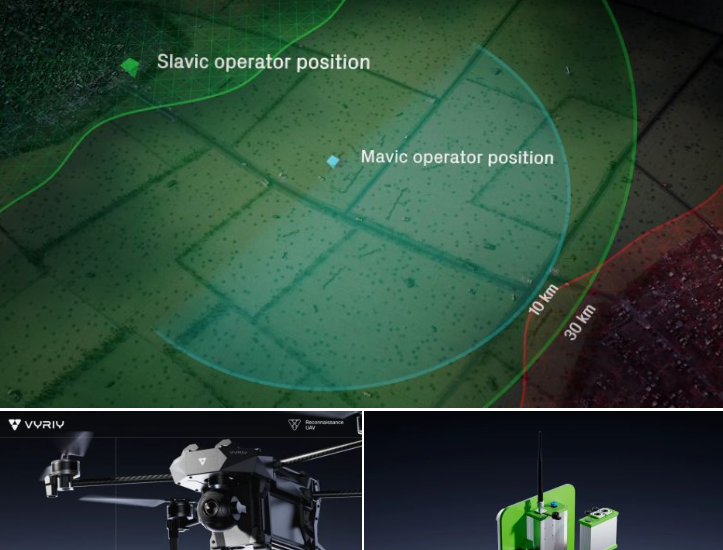
Enter SLAVIC, a tactical reconnaissance quadcopter developed by Vyriy Industries. On paper, the drone offers capabilities designed specifically for battlefield conditions rather than civilian photography.
Yet the most important feature may not be found in its range, endurance, sensors, or communications systems.
It's familiarity.
Unlike many military programs that force operators to learn entirely new interfaces, Vyriy made a deliberately unconventional decision: preserve the experience that soldiers already know.
According to the company, experienced DJI Mavic operators can transition to SLAVIC in as little as a single day.
That may sound insignificant.
It isn't.
The greatest bottleneck in modern warfare is often not hardware.
It's people.
A drone sitting in a warehouse has no military value.
A trained operator does.
Every hour spent retraining personnel is an hour not spent gathering intelligence, spotting targets, or supporting frontline operations.
Rather than forcing thousands of operators to adapt to a new system, Vyriy adapted the system to the operators.
That is a remarkably practical approach.
The result is a drone designed around battlefield realities rather than commercial convenience.
SLAVIC reportedly offers up to 90 minutes of endurance and an operating range of up to 30 kilometers.
More importantly, it addresses some of the vulnerabilities that have increasingly challenged commercial drones on the modern battlefield.
The platform can operate without GPS through optical positioning technologies and allows operators to select communication channels depending on local electronic warfare conditions and terrain.
Those capabilities matter because the battlefield is becoming increasingly hostile to navigation and communications systems.
Electronic warfare has transformed large areas of the front into zones where signals disappear, frequencies are jammed, and conventional assumptions no longer apply.
A drone designed specifically for those conditions starts with a significant advantage.
But perhaps the biggest operational benefit is distance.
Modern reconnaissance crews face a growing challenge as strike ranges continue expanding.
Drones can reach farther.
Artillery can fire farther.
Enemy surveillance can detect farther.
As a result, drone operators are often forced dangerously close to the frontline simply to achieve mission requirements.
SLAVIC's extended range seeks to reverse that trend.
The same reconnaissance mission can potentially be performed while crews remain farther from enemy fire, artillery, and drone attacks.
In military terms, that is not merely a technical improvement.
It is a survivability improvement.
The platform has reportedly already undergone combat testing with multiple Ukrainian units and entered serial production.
Yet one important reality remains.
Strategic independence does not happen overnight.
While SLAVIC represents a significant step toward reducing dependence on foreign commercial systems, some key components reportedly still originate outside Ukraine.
The main camera, for example, remains Chinese-made while efforts continue to develop domestic alternatives.
This observation highlights a broader truth about military technology.
Sovereignty is rarely achieved through a single breakthrough.
It is built component by component, subsystem by subsystem, generation by generation.
What makes SLAVIC particularly interesting is that it reflects a mature understanding of innovation.
Too many defense projects attempt to reinvent everything simultaneously.
Vyriy chose a different path.
Replace the dependency.
Keep the successful habits.
Preserve operator experience.
Improve battlefield performance.
Reduce training time.
Increase survivability.
It is not the most dramatic strategy.
But it may be the smartest.
Because winning technological independence is not about changing everything.
It is about changing only what needs to be changed.
And in the drone age, that could be the difference between building a product and building a battlefield standard.


.jpg)