The Soldier Becomes the Sensor: Why the Future of CBRN Defense Is Worn on the Body
For decades, military protection against chemical, biological, radiological, and nuclear threats followed a simple model.
Find the threat.
Measure the threat.
Protect against the threat.
The problem was always the same.
Detection systems remained scarce, specialized, and often deployed only after danger was suspected.
The battlefield has now changed.
And so has the sensor.
The next revolution in CBRN defense is no longer mounted on vehicles, installed in laboratories, or carried inside dedicated equipment cases.
It is being worn by individual soldiers.
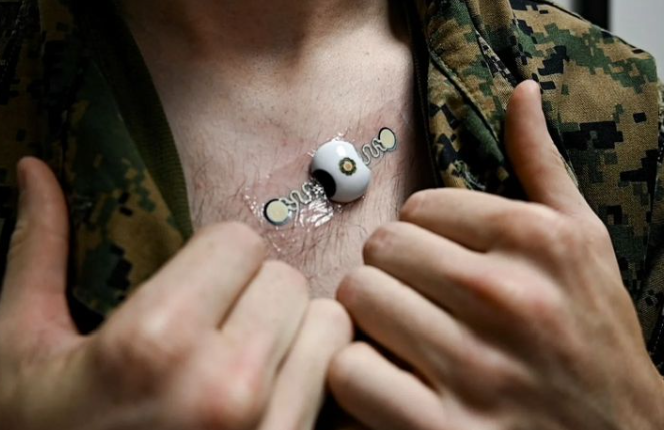
Quietly, one of the most transformative trends in military technology is emerging from the intersection of biotechnology, wearable health technology, artificial intelligence, and battlefield networking. The concept is deceptively simple: equip every soldier with sensors capable of monitoring environmental conditions, physiological responses, and potential indicators of hazardous exposure.
In effect, every service member becomes part of a distributed intelligence network.
The implications are enormous.
Modern military operations generate vast amounts of information on enemy movements, communications, and logistics. Yet one critical area has historically remained difficult to monitor in real time: the human body itself.
Wearable systems change that equation.
Instead of relying exclusively on external detectors, future military forces may continuously monitor the physical condition of deployed personnel, searching for subtle signals that reveal the presence of invisible threats long before traditional warning systems are triggered.
This shift matters because many hazards do not announce themselves immediately.
Nerve agents, toxic industrial chemicals, environmental contaminants, and biological agents can produce cumulative effects over time. Exposure levels too low to cause immediate symptoms may still create significant long-term health consequences.
Historically, these dangers often remained undetected until damage had already occurred.
The next generation of wearable technologies aims to close that gap.
Perhaps the most intriguing development is the search for biological indicators that reveal exposure before symptoms appear. Scientists increasingly focus on biomarkers that can be continuously measured through wearable systems. One example involves acetylcholinesterase activity, a critical indicator associated with nerve agent exposure.
Instead of detecting the chemical itself, future systems may detect its effect on the body.
That distinction represents a profound technological shift.
The battlefield sensor is no longer separate from the soldier.
The soldier becomes the sensor.
This convergence between biotechnology and defense technology could dramatically improve situational awareness. If hundreds or thousands of connected personnel simultaneously report physiological abnormalities, commanders gain something previously impossible:
A real-time map of biological and chemical risk.
Suddenly, invisible threats become visible.
Patterns emerge faster.
Responses accelerate.
Lives are saved.
But the true significance extends beyond CBRN defense.
Once military organizations possess large-scale physiological data from connected personnel, an entirely new layer of operational intelligence becomes possible.
Heat stress can be tracked across units.
Dehydration can be identified before performance declines.
Environmental hazards can be detected through collective biological responses.
Food and water contamination may become visible through distributed monitoring before conventional investigations uncover a problem.
The result is a radically expanded concept of battlefield awareness.
The military has long invested heavily in knowing where equipment is located, where adversaries are moving, and where logistical assets are positioned.
Soon it may know, in near real time, how every soldier is physically performing.
That capability could reshape force management as fundamentally as GPS transformed navigation.
The Pentagon clearly recognizes this potential.
Programs focused on wearable monitoring technologies continue receiving significant attention because they address a growing challenge facing modern armed forces: maximizing both survivability and readiness in increasingly complex operational environments.
The strategic value is obvious.
A healthier force is a more effective force.
A detectable threat is a manageable threat.
A connected force becomes an intelligent network.
Of course, major challenges remain. Accuracy, cybersecurity, data management, privacy concerns, operational reliability, and scalability must all be addressed. No military will base critical decisions on physiological data that cannot be trusted.
Yet the direction of travel appears unmistakable.
Defense technology is moving closer to the human body.
The next generation of military sensors may not sit on drones, satellites, ships, or vehicles.
They may sit on skin.
In the age of connected warfare, information dominance will increasingly depend not only on seeing the enemy.
But on understanding the human operating environment in real time.
The armies that master that capability may gain an advantage no previous generation possessed.
A battlefield that can feel itself.