The MoU Is Dead. What If Iran's Real Strategy Is Just Beginning?
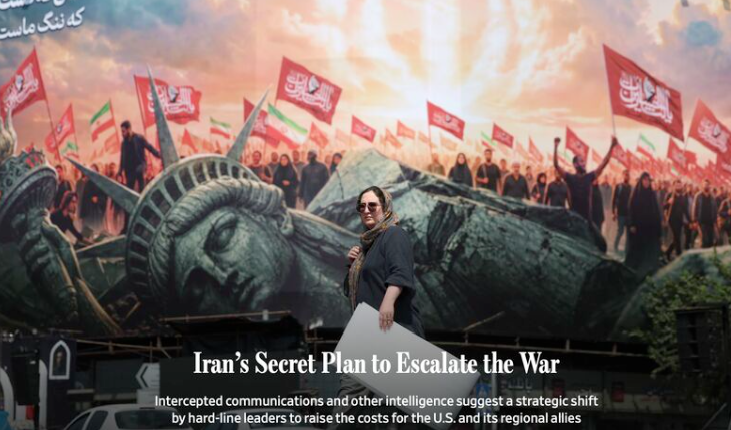
For months, the world has been asking a familiar question:
Will the war widen?
According to recent reporting citing Arab intelligence assessments, Iran's hard-line leadership may already have answered it.
And the answer appears to be: prepare.
Reports published by The Wall Street Journal and echoed by other regional and international outlets describe what intelligence officials characterize as a strategic shift inside Tehran. Rather than viewing recent negotiations and agreements with Washington as a pathway toward de-escalation, elements within Iran's leadership allegedly saw them as an opportunity to buy time, reorganize, and prepare for a potentially larger confrontation.
If accurate, that changes the entire conversation.
The debate is no longer whether diplomacy can stop a conflict.
The debate becomes whether diplomacy has merely delayed one.
From Deterrence to Cost Imposition
For decades, Iran's security doctrine has largely relied on deterrence.
The logic was straightforward: make any attack against Iran so costly that adversaries would think twice before launching one.
But recent intelligence assessments suggest something more ambitious may be emerging.
Arab intelligence officials reportedly collected communications indicating preparations for expanding the battlefield, including coordination with allied groups in Yemen and Iraq and discussions about increasing costs for the United States and its regional partners.
The most striking allegation is not that Iran is preparing to defend itself.
Every state does that.
The striking allegation is that Iranian leaders are increasingly discussing offensive operations on what they consider enemy territory.
That represents a very different strategic mindset.
Defense absorbs pressure.
Offense creates it.
The Gulf Is Watching Nervously
If there is one region paying close attention, it is the Persian Gulf.
According to reports, Gulf states have become increasingly concerned about the possibility that future escalation could extend beyond the traditional Iran-Israel confrontation and involve regional infrastructure, energy assets, shipping routes, or strategic facilities.
This concern is understandable.
The Gulf sits at the intersection of global energy markets, international shipping lanes, and military deployments.
Any disruption there would have consequences far beyond the Middle East.
Oil traders know it.
Governments know it.
Investors know it.
The question now is whether leaders can prevent the next escalation cycle from reaching that threshold.
The Expiration of Trust
Another notable development is the apparent collapse of confidence surrounding the June memorandum of understanding between Washington and Tehran.
Public statements from Iranian officials indicate that Tehran views alleged U.S. violations as rendering the agreement irrelevant, while some reports suggest key factions inside the Iranian establishment never expected the arrangement to produce lasting peace.
That may be the most dangerous element of the current crisis.
Wars are not caused solely by hostility.
They are often caused by the disappearance of trust.
When each side becomes convinced that the other is using negotiations merely to prepare for confrontation, diplomacy loses much of its stabilizing power.
And every military movement begins to look like preparation for something bigger.
A Region Entering Its Most Dangerous Phase?
None of this means a wider war is inevitable.
Intelligence assessments are not predictions.
Military preparations do not automatically become military operations.
And governments frequently use aggressive rhetoric for domestic, political, and strategic reasons.
But the emerging signals deserve attention.
If Tehran is indeed moving toward a doctrine focused on raising costs through offensive pressure rather than pure deterrence, the Middle East could be entering a new phase of strategic competition.
One in which every drone launch, maritime incident, missile test, cyberattack, or proxy action carries greater escalation risk than before.
The real danger may not be a dramatic declaration of war.
The real danger is something quieter.
A gradual normalization of escalation.
A series of calculated moves.
A widening battlefield.
And a region discovering, too late, that everyone was preparing for the next conflict while still talking about peace.