The Missile Defense Commander Is Becoming Software — Anduril Just Demonstrated What Comes Next
For decades, air defense has largely been a hardware story.
Better radar. Faster interceptors. Longer range. More capable missiles.
But the next decisive advantage may not be another missile at all.
It may be the software deciding which missile should fire.
At Valiant Shield 2026, Anduril demonstrated a prototype Battle Manager designed for the Guam Defense System. According to the company, the technology was demonstrated in an operationally relevant test environment less than six months after the U.S. Army awarded the development contract.
The interesting part is not another command screen.
It is what happens behind it.
One battlefield, many systems
Modern missile defense is inherently layered. Different sensors detect different threats, while different weapons cover different ranges, altitudes and directions.
Those assets may belong to different military services and operate through systems that were never originally designed to function as one machine.
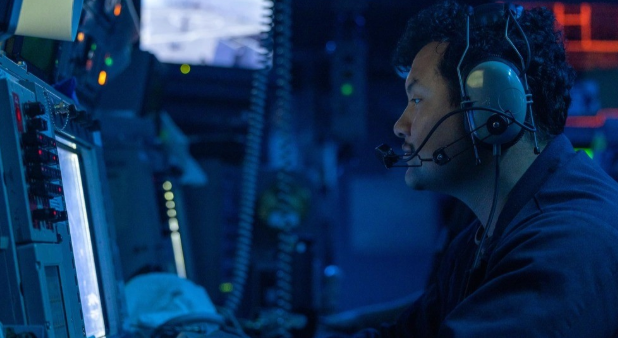
Anduril says its Battle Manager, powered by its Lattice software, integrated air-defense assets from the U.S. Army, Air Force, Navy and Missile Defense Agency during Valiant Shield.
Information from those systems was fused into a single joint track picture.
But displaying everything together is only the first step.
The software also assessed the available capacity of missile-defense systems and used real-time autonomous optimization to prioritize which asset should respond and when, taking interceptor inventories across air, land and sea into account.
That represents a potentially profound change.
From information overload to machine-speed decisions
Imagine multiple incoming threats.
One interceptor may be ideal for the first target—but it could also be the only available weapon capable of defeating a more dangerous target arriving seconds later.
Another launcher may have enough ammunition but be badly positioned.
A ship may have the right interceptor. A land battery may have a cheaper one. Multiple sensors may simultaneously be tracking the same object.
The problem is therefore not simply:
Can we shoot it down?
It is:
What should shoot what, when—and what must we save for whatever comes next?
Traditionally, solving that problem across separate systems can require humans to manually bridge information between platforms and command structures.
Software potentially changes the timescale.
Instead of merely presenting commanders with more data, the Battle Manager can generate recommendations based on the state of the entire defensive network.
According to Anduril, the Valiant Shield demonstration provided a common operating picture incorporating weapons status, interceptor inventories and shot recommendations.
In other words, command-and-control software is moving from showing the battlefield toward actively optimizing how the battlefield is fought.
Ammunition becomes part of the algorithm
This matters enormously in missile defense because interceptors are finite.
The best defensive response is not necessarily the fastest possible launch or the most powerful available weapon.
Every interceptor fired is one that cannot engage the next target.
During a large attack, preserving inventory can become almost as important as destroying the current threat.
That turns missile defense into a resource-allocation problem—and resource allocation is precisely the kind of problem software can continuously optimize.
Software that evolves during the exercise
Another revealing detail from Valiant Shield was the development process itself.
Anduril personnel worked alongside military operators during 11 days of training and testing against a simulated threat environment. Feedback from those operators allowed engineers, supported by Verity Integrated Systems, to make enhancements to the prototype on a daily basis.
That development model looks very different from the traditional image of defense procurement: build something for years, deliver it, then begin discovering how operators actually use it.
Instead, software can evolve while being tested.
The real weapon may be the network
Individual radars, launchers and interceptors will remain essential.
But their effectiveness increasingly depends on how intelligently they can operate together.
That may ultimately be the most important implication of Anduril’s experiment.
Future military advantage may not belong exclusively to whoever owns the best sensor or the longest-range interceptor.
It may belong to whoever can connect everything fastest, understand the entire battlespace and allocate limited weapons more intelligently than the opponent.
The missile is still the weapon.
But increasingly, software decides how powerful that weapon really is.