Avilus Grille - The Drone That Wants to Replace the Medevac Helicopter
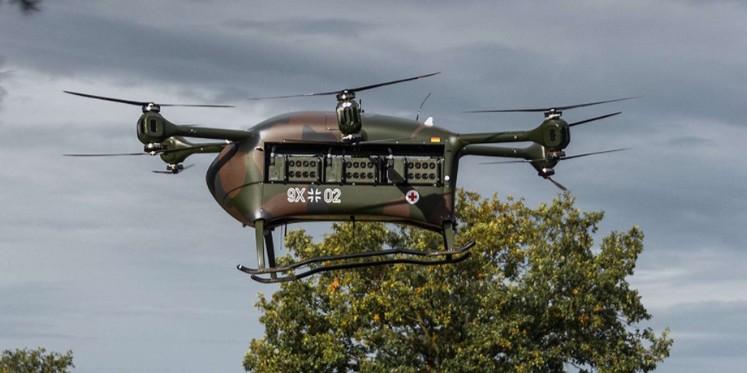
Deep inside the dense technical pages of this Avilus Grille dossier lies a quiet but radical proposition:
The future of battlefield medical evacuation may no longer need a helicopter.
Not a faster helicopter.
Not a cheaper helicopter.
Not a hybrid helicopter.
No helicopter at all.
Instead, Avilus is betting on something far more disruptive - a fully electric, multi-rotor unmanned aircraft designed from day one around one mission: getting a wounded soldier from point A to point B, safely, autonomously, and fast.
The Grille is not marketed as a drone that can carry a stretcher.
It is designed as a flying medical cabin that happens to be a drone.
That distinction matters.
Most UAV programs start with an airframe and then look for payloads. Avilus did the opposite. The team began with the medical cabin - its dimensions, shock resilience, patient access, lighting, vitals monitoring, communications, and stretcher integration - and then wrapped an aircraft around it.
This is a philosophical break from typical UAV development.
The result is a twelve-rotor, fully electric aircraft with a maximum takeoff weight around 750 kg, redundant motors, redundant batteries, redundant flight computers, redundant data links, redundant navigation sources, and a distributed architecture that assumes parts will fail.
And then keeps flying anyway.
Grille’s designers openly state that single points of failure were treated as unacceptable. If a motor fails, others compensate. If a battery pack is damaged, five more remain active. If GNSS is jammed or spoofed, inertial navigation continues independently. If a radio link drops, others remain.
This is not consumer-drone thinking.
It is aviation-grade systems engineering pushed into unmanned form.
One of the most striking aspects of the dossier is how conservative the software philosophy is. No neural networks. No black-box AI in the primary flight loop. The control logic is deterministic, heavily tested, and designed to behave predictably under extreme disturbance.
That choice runs counter to much of today’s marketing-driven “AI drone” narrative.
Avilus is signaling something important:
Reliability beats cleverness.
Speed beats novelty.
Certification beats hype.
Even Grille’s aerodynamics reveal a pragmatic mindset. The rotor arms are slightly canted and asymmetrical - not for aesthetics, but because the geometry improves yaw authority and control margins at high mass. Small geometric decisions compound into stability gains.
The aircraft’s battery architecture is equally pragmatic. Six modular battery packs distributed around the fuselage, each small enough for a single soldier to lift and swap. This avoids concentrating massive energy in one location and reduces fire propagation risk.
Thermal management is handled largely through passive airflow, not fans or liquid cooling. Again, fewer moving parts, fewer failure modes.
Every design choice whispers the same message:
This aircraft is expected to operate in mud, rain, snow, dust, vibration, and hostile electronic environments.
Grille’s mission concept is also telling.
“Load and fly.”
No field assembly.
No delicate ground handling.
No specialized tooling.
The entire system - aircraft, ground control station, spares, batteries - fits into a 20-foot container. The medical cabin is front-and-center, not a bolt-on accessory.
That containerization speaks to expeditionary warfare, not peacetime operations.
Another subtle but important theme in the text is that Grille is not framed as a replacement for medevac helicopters, at least not publicly.
Instead, it is positioned as filling gaps:
- High-risk extraction zones
- Forward areas without landing zones
- Situations where sending a crewed aircraft is unacceptable
- Operations under heavy air-defense or small-arms threat
But between the lines, the implications are larger.
If an unmanned system can autonomously evacuate wounded personnel:
- You remove aircrew risk.
- You reduce training pipelines.
- You simplify logistics.
- You enable distributed, disposable medevac capacity.
That is strategically explosive.
The dossier also reveals steady industrial maturity. Grille is now in its third generation. Earlier prototypes informed aerodynamics, propulsion, control laws, and mechanical architecture. Avilus claims production scaling potential into dozens of units per year without major workforce expansion.
That suggests a design approaching manufacturability, not perpetual prototyping.
Equally revealing is what the article does not promise.
No swarming.
No fully autonomous combat decision-making.
No “AI battlefield brain.”
Just a machine built to move a human body from danger to care.
In modern warfare, that is revolutionary enough.
Grille represents a broader trend quietly reshaping defense aerospace:
Uncrewed systems are no longer just sensors and shooters.
They are becoming logistics platforms.
Casualty evacuation platforms.
Sustainment platforms.
The unglamorous backbone of combat power.
If Avilus succeeds, historians may one day mark systems like Grille as the moment when helicopters stopped being the default answer to vertical lift in dangerous airspace.
Not because helicopters vanished.
But because they were no longer the only option.
And in war, the arrival of an alternative is often more disruptive than outright replacement.