The End of the Lone Drone: Quantum Systems Wants to Turn the Sea Into a Network
For years, military innovation has been obsessed with platforms.
A better drone.
A faster ship.
A quieter submarine.
A smarter sensor.
The question was always the same:
Which platform is superior?
Quantum Systems appears to be asking a different question.
What if the platform no longer matters?
What if the real military advantage comes from the network connecting multiple autonomous systems together?
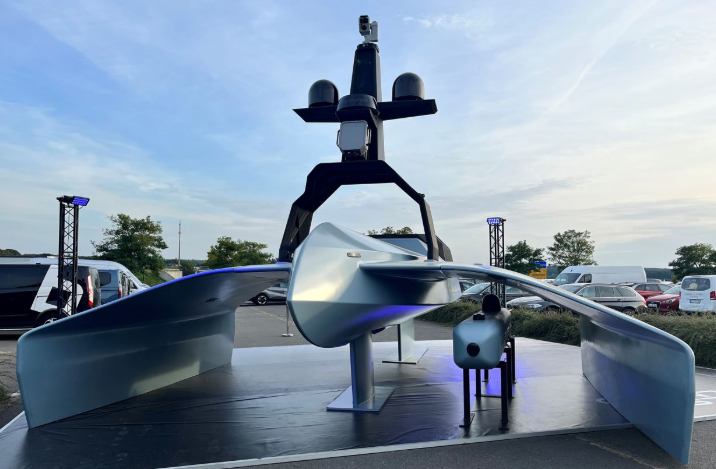
Its newly unveiled maritime platform, Seavex, may offer a glimpse of that future.
At first glance, Seavex looks like another addition to the rapidly growing world of Unmanned Surface Vehicles (USVs). The military industry has no shortage of autonomous boats promising surveillance, reconnaissance, and maritime security.
But Seavex is pursuing a far more ambitious vision.
It is designed not merely to operate on the sea.
It is designed to orchestrate the sea.
The Battle Is No Longer Platform Against Platform
Military organizations have traditionally built force structures around individual systems.
Ships perform one function.
Aircraft perform another.
Submarines operate in their own domain.
Each platform brings its own sensors, operators, logistics, and command chain.
This separation is increasingly becoming a liability.
Modern threats move too quickly.
Drones cross domains.
Autonomous systems operate simultaneously in the air, on the surface, and underwater.
Information travels faster than traditional command structures were designed to process.
The result is a growing realization that victory may increasingly depend on connecting systems rather than improving individual ones.
This is where Seavex becomes interesting.
Quantum Systems does not describe the platform primarily as a USV.
It describes it as an Autonomous Maritime Mission Hub.
That wording matters.
A hub is not a platform.
A hub is infrastructure.
A Floating Autonomous Base
The specifications are impressive but not revolutionary.
An 8.5-meter vessel.
Up to two months of autonomous endurance.
Fifteen-knot maximum speed.
Four hundred kilograms of payload.
What makes Seavex different is not its size or speed.
It is what happens around it.
The vessel can launch and recover aerial drones.
It can support underwater autonomous vehicles.
It can host sensors, communications systems, mission software, and processing power.
The platform effectively becomes a floating robotic base station.
In one scenario, Seavex detects suspicious activity through its own sensors.
A UAV launches to investigate beyond the ship's sensor horizon.
If underwater inspection becomes necessary, an autonomous underwater vehicle is deployed.
Sensor data returns to a common architecture.
The result is not one system.
It is a temporary autonomous task force assembled in real time.
The Sea Is Becoming Digital
This reflects a broader military transformation.
The future battlefield may be less about weapons and increasingly about architecture.
The most important military question used to be:
"What can my platform see?"
Tomorrow's question may be:
"What can my network know?"
Sensor fusion, autonomous coordination, and distributed operations are becoming decisive capabilities.
A vessel that can survive for two months at sea is useful.
A vessel capable of connecting dozens of autonomous systems into a single operational picture is potentially transformational.
The sea is becoming an information environment.
And information becomes most powerful when shared.
The Baltic Test Case
Seavex appears particularly suited to environments such as the Baltic Sea.
Not because it is fast.
Because it is persistent.
Modern maritime security increasingly revolves around infrastructure.
Pipelines.
Communication cables.
Energy installations.
Ports.
Offshore facilities.
The strategic challenge is maintaining awareness over huge areas continuously.
Traditional naval assets are expensive.
Crewed vessels consume resources.
Aircraft have limited endurance.
Autonomous maritime systems offer a different model.
Persistent presence at dramatically lower operational cost.
A network of autonomous platforms could watch areas that would previously require multiple ships and crews.
From Vehicle to Ecosystem
Perhaps the most important aspect of Seavex is what it says about the future of defense companies.
For decades, military manufacturers sold platforms.
Tomorrow's winners may sell ecosystems.
The value increasingly moves away from the physical vehicle and toward the software, artificial intelligence, connectivity, and operational integration surrounding it.
This mirrors what happened in the digital economy.
The most successful technology companies did not simply build hardware.
They built networks.
Military technology appears to be moving in the same direction.
The Future Is a Swarm of Systems
The most provocative aspect of Seavex is that it quietly challenges one of the oldest assumptions in naval history.
That ships are the center of maritime power.
Quantum Systems seems to be suggesting something different.
The future may not belong to the ship.
It may belong to the network.
A network of drones in the air.
Autonomous vessels on the surface.
Robotic systems underwater.
All exchanging information continuously.
All coordinated through software.
All capable of adapting in real time.
In that future, Seavex is not really a boat.
It is a node.
And nodes are often more important than platforms.
Because the next maritime revolution may not be about building a better ship.
It may be about teaching thousands of autonomous systems to operate as one.