The End of Jamming? Ukraine’s Fiber-Optic Drones Are Rewriting the Rules of the Drone War
For years, electronic warfare was considered the ultimate antidote to drones.
If a drone depended on radio signals, it could be jammed. If it could be jammed, it could be stopped.
That assumption is now being challenged on the battlefields of Ukraine.
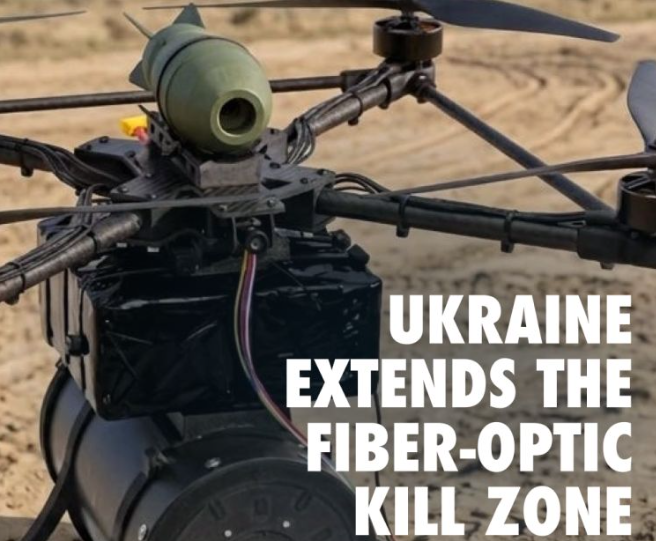
The Ukrainian Ministry of Defense has officially codified the Deadliner Q15-30, a fiber-optic FPV drone developed by Stellarion. On paper, its specifications are impressive: a payload of up to three kilograms, a range of 30 kilometers, flight endurance exceeding 30 minutes, speeds reaching 110 km/h, and the ability to carry both daytime and thermal imaging systems.
But the real breakthrough is not its speed, payload, or range.
It is the cable.
Unlike traditional FPV drones that rely on radio-frequency communication, the Deadliner Q15-30 remains physically connected to its operator through a fiber-optic link. As the drone flies, it unwinds a thin optical cable behind it, maintaining direct communication throughout the mission.
The result is potentially game-changing.
Conventional electronic warfare systems designed to disrupt radio signals become largely ineffective. The video feed remains stable, the command link remains intact, and operators can continue controlling the aircraft even in heavily contested electromagnetic environments.
For military planners worldwide, this development carries strategic implications far beyond Ukraine.
The war has evolved into the largest real-world laboratory for drone warfare ever seen. Every innovation triggers a countermeasure. Every countermeasure triggers a new innovation. It is an arms race measured not in years but in weeks.
Radio-controlled drones transformed the battlefield.
Electronic warfare systems responded.
Fiber-optic drones have now emerged as the next move in that cycle.
The significance of Ukraine's decision to codify the system should not be underestimated. Military technology often passes through three phases: experimentation, validation, and institutional adoption. Codification signals that the technology has crossed an important threshold.
It is no longer an experimental capability.
It is becoming a procurement capability.
Through platforms such as BRAVE1 and DOT-Chain, military units can now formally acquire the system, accelerating deployment and scaling across operational units.
That transition reflects a broader transformation underway inside Ukraine's defense ecosystem.
Innovation is increasingly happening from the battlefield upward rather than from headquarters downward. Frontline requirements generate rapid technological responses. Companies develop solutions. Soldiers test them under combat conditions. Successful systems are rapidly integrated into procurement pipelines.
The speed is remarkable.
While traditional defense procurement cycles can span years, Ukraine has demonstrated how urgent operational necessity can compress innovation into months.
Yet fiber-optic drones are not a silver bullet.
Their physical connection introduces new limitations. Range remains constrained by cable length. Maneuverability can be affected by terrain and obstacles. Logistics become more complex. Every technological breakthrough brings its own engineering challenges.
Still, the emergence of these systems highlights a deeper trend.
The future of warfare is becoming less about platforms and more about adaptation.
The dominant military advantage may no longer belong to the force with the largest inventory or the most expensive equipment. Instead, it may belong to the side capable of evolving fastest in response to changing battlefield conditions.
Ukraine has repeatedly demonstrated this ability.
From maritime drones in the Black Sea to AI-enabled targeting systems and now fiber-optic FPV platforms, the country continues to innovate under extraordinary pressure.
For defense organizations across Europe, NATO, and beyond, the lesson is becoming impossible to ignore.
The drone war is no longer simply a contest between aircraft and air defenses.
It has become a contest between innovation cycles.
And with fiber-optic drones entering the battlefield, one of electronic warfare's most powerful advantages may no longer be guaranteed.
The next chapter of drone warfare has already begun.
And this time, it is connected by a wire.