Switzerland Didn't Just Buy a Missile System. It Bought a Seat in Europe's Air Defence Future.

For decades, Switzerland's security strategy was defined by neutrality.
Today, it is increasingly defined by interoperability.
That shift was visible during the recent visit of senior representatives from the Swiss Armed Forces and armasuisse to Diehl Defence in Röthenbach, where discussions focused on ground-based air defence, counter-drone systems, and the progress of the Swiss IRIS-T SLM program.
On the surface, the visit looked like a routine industrial briefing.
In reality, it reflects something much larger happening across Europe.
Air defence is becoming the continent's most urgent military capability race.
The Return of Air Defence
For years, European militaries invested heavily in expeditionary operations, counterinsurgency missions, and overseas deployments.
Air defence often became a secondary concern.
That era is over.
The proliferation of cruise missiles, ballistic missiles, loitering munitions, and increasingly sophisticated drones has fundamentally changed military planning.
Suddenly, every critical asset requires protection.
Military headquarters.
Infrastructure.
Logistics hubs.
Industrial facilities.
Airfields.
Energy networks.
Entire cities.
The challenge facing Europe is no longer whether air defence matters.
It is whether enough air defence can be fielded quickly enough.
IRIS-T SLM Is More Than a Procurement Program
Switzerland's decision to procure the medium-range ground-based air defence system IRIS-T SLM after joining the European Sky Shield Initiative (ESSI) represents more than the acquisition of a weapon system.
It reflects a broader European trend.
Historically, many countries bought national systems, operated them independently, and integrated them only partially with allies.
Today's threat environment demands a different model.
Shared architectures.
Shared data.
Shared warning networks.
Shared defensive layers.
The value of an air defence system increasingly depends not only on its missile but on the network surrounding it.
Modern air defence has become a systems-of-systems challenge.
Counter-Drone Is Becoming the New Air Defence
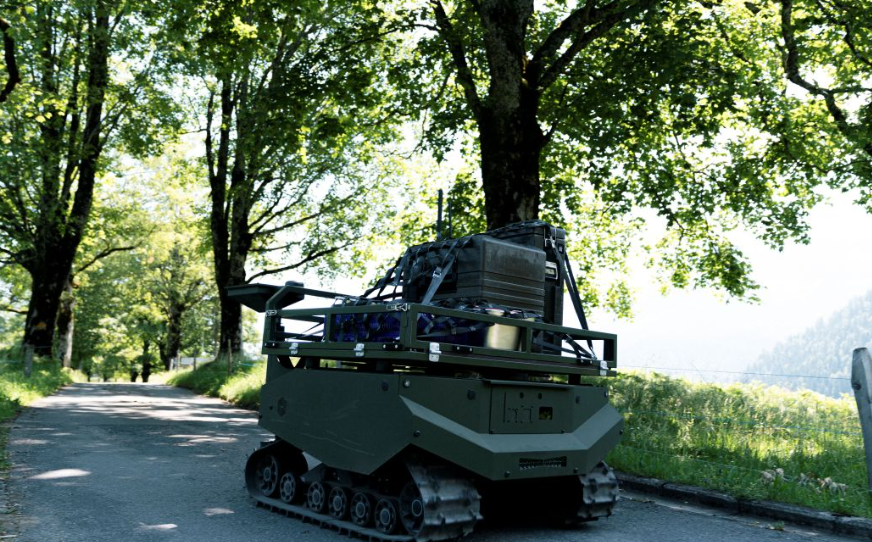
One of the most revealing aspects of the visit was the interest in emerging counter-UAV capabilities, including the highly mobile GARMR C-UAV system and the eMissile CICADA concept presented by Diehl Defence.
This reflects one of the most significant shifts in military thinking.
Ten years ago, air defence meant intercepting aircraft.
Today, it increasingly means stopping drones.
Not one drone.
Hundreds.
Potentially thousands.
Small, inexpensive unmanned systems have fundamentally changed the economics of warfare.
A drone costing a few thousand euros can threaten equipment worth millions.
That challenge is forcing defence companies to rethink interception entirely.
The future of air defence will require cheaper interceptors, automated target management, AI-supported prioritization, and high-volume engagement capacity.
The age of missile-only air defence is ending.
The age of layered air defence is beginning.
European Defence Integration Is Becoming Reality
The Swiss engagement with IRIS-T SLM also highlights another emerging trend.
European defence cooperation is becoming increasingly capability-driven rather than politically symbolic.
Initiatives such as ESSI are no longer merely declarations of intent.
They are becoming procurement mechanisms.
The countries participating are making concrete investments, selecting systems, integrating doctrines, and creating operational frameworks.
That matters because modern air defence works best at scale.
Threats do not stop at national borders.
Neither should sensor coverage, warning networks, or defensive architectures.
Every additional participant strengthens the overall system.
The Bigger Story
The most interesting aspect of this visit is not who attended.
It is what the discussions reveal about the future battlefield.
Future conflicts will be increasingly dominated by:
- Missile defence
- Counter-drone systems
- Networked sensors
- Integrated command structures
- Multi-layered air protection
Countries capable of building these ecosystems will enjoy significant strategic advantages.
Those relying on isolated systems may struggle.
Switzerland's IRIS-T SLM program therefore represents something larger than modernization.
It reflects an understanding that security in the modern era is increasingly collective, connected, and digital.
Europe's air defence architecture is being built today.
And every new participant strengthens the shield.