Russia's Amur Gas Chemical Complex $10 Billion Question: What Happens When Industrial Giants Fail?
Modern industrial projects are built to project confidence.
Towering pipelines, massive reactors, automated control systems, and billions of dollars in investment are designed to communicate one message to the world: strength.
That is why explosions at strategic industrial facilities always attract attention far beyond the immediate incident.
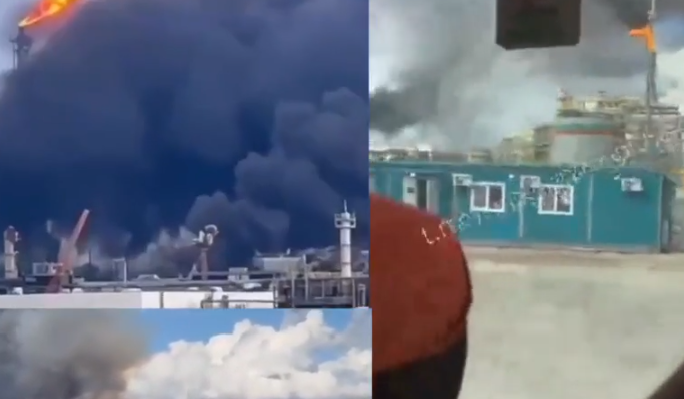
The deadly explosion and fire at Russia's Amur Gas Chemical Complex is not just another industrial accident. It is a reminder that the world's largest and most ambitious projects remain vulnerable to the oldest enemy in engineering: failure.
And failure rarely arrives with warning.
The Amur Gas Chemical Complex is no ordinary facility. Backed by Russian petrochemical giant SIBUR and China's Sinopec, the project represents one of the largest investments in Russia's chemical industry in decades. Designed to produce millions of tonnes of polyethylene and polypropylene annually, it is intended to become a cornerstone of Eurasian petrochemical production and a symbol of industrial modernization.
Instead, headlines are now focused on an explosion, a fatality, dozens of injuries, and uncomfortable questions about what went wrong.
Official investigations remain ongoing, and no definitive cause has been established.
That matters.
Because in the immediate aftermath of major industrial incidents, speculation often spreads faster than facts. Claims regarding equipment quality, replacement parts, production pressures, management decisions, or technical failures may eventually prove true, partially true, or entirely false. Until investigators publish verified findings, responsible analysis requires caution.
But caution should not prevent larger questions from being asked.
Industrial accidents rarely emerge from a single point of failure.
They are often the visible outcome of multiple issues intersecting simultaneously: engineering complexity, human factors, maintenance practices, operational pressure, supply chain challenges, commissioning risks, and organizational culture.
When projects exceed $10 billion in value, complexity becomes unavoidable.
Every valve matters.
Every sensor matters.
Every inspection matters.
Every delayed maintenance task matters.
This is especially true during commissioning phases. Bringing large industrial systems online is often among the most dangerous stages of any project. New equipment is tested under real conditions, operational parameters are adjusted, and thousands of interconnected systems begin working together for the first time.
The difference between routine operation and catastrophe can sometimes be measured in seconds.
The consequences extend beyond the plant itself.
Industrial facilities like Amur are not isolated assets. They sit at the center of supply chains, export strategies, employment networks, and national industrial policy. A major disruption can affect customers, transportation systems, investors, insurers, contractors, and governments.
In today's interconnected economy, industrial resilience has become a strategic capability.
Nations increasingly compete not only through military power and technological innovation, but through their ability to build, operate, and maintain critical infrastructure safely and efficiently.
That challenge is becoming harder.
Facilities are growing larger.
Technology is becoming more sophisticated.
Global supply chains are becoming more complicated.
Workforces face increasing specialization demands.
And geopolitical pressures often place additional burdens on industrial operators.
As a result, the margin for error continues to shrink.
The Amur incident therefore serves as a reminder of an often-overlooked reality: industrial power is not measured by what can be built.
It is measured by what can be operated reliably, safely, and sustainably over decades.
That distinction matters.
Anyone can announce a mega-project.
Far fewer can execute one flawlessly.
As investigators determine the facts surrounding the explosion, industry leaders around the world will be watching closely. The lessons emerging from incidents like these frequently influence future design standards, maintenance procedures, safety protocols, and operational practices.
That is how progress often works in complex industries.
Painfully.
Incrementally.
And usually after something goes wrong.
For now, one fact remains undeniable.
A facility intended to symbolize industrial ambition has become a reminder of industrial vulnerability.
And in an age obsessed with scale, speed, and production targets, that may be the most important lesson of all.
Because the true measure of an industrial giant is not how impressive it looks when operating.
It's how resilient it proves to be when everything goes wrong.