Robots Get a “Prompt Stack” - Why π0.7 Feels Like an LLM Breakthrough and an LLM Warning
Robotics has long suffered from an uncomfortable truth: the more impressive the demo, the narrower the training funnel behind it. A robot folds one shirt beautifully—because it has folded that shirt (or something very close to it) a thousand times in data.
Physical Intelligence’s π0.7 argues for a different path: treat robotic behavior less like a single monolithic skill and more like a composable vocabulary—something that can be rearranged into new “sentences” of action. PI explicitly frames this as the missing ingredient in physical AI: language models generalize by composition; robot models mostly don’t.
What π0.7 changes is not just the model, but the training recipe—and that matters, because in 2026 the frontier is increasingly about recipes. PI’s paper describes π0.7 as a steerable vision‑language‑action (VLA) model that can be “precisely” guided using a prompt that includes multiple modalities, not only a high-level instruction.
The training prompt is the real product. π0.7 ingests:
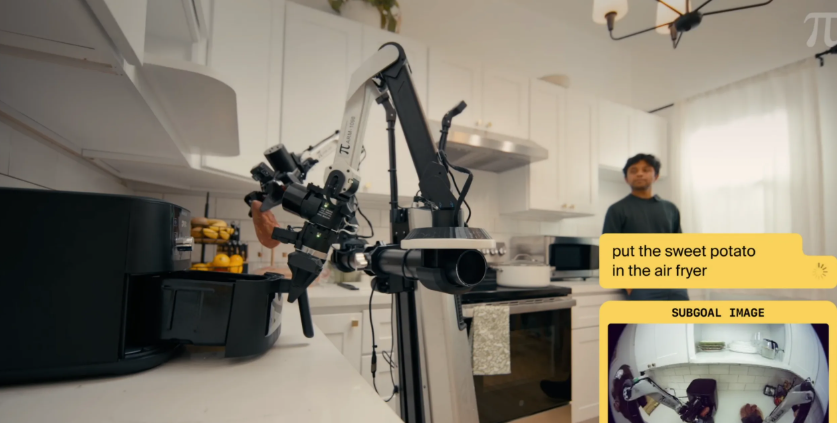
- Subtask instructions in natural language (intermediate steps like “open the fridge door”), enabling step‑by‑step verbal coaching at inference time.
- Subgoal images, including multi‑view targets that depict what “success” should look like after a step—useful when language is ambiguous about grasp geometry or scene configuration.
- Episode metadata such as execution speed and a human‑annotated overall quality score (1–5), plus mistake labels, so the model can learn from failures and suboptimal runs without degrading its best behavior.
- Control‑mode labels (e.g., joint vs end‑effector control) to reduce ambiguity across heterogeneous data sources.
This is PI’s bet: with enough context, the model doesn’t average across conflicting demonstrations—it learns which “style” to execute when asked.
Under the hood, π0.7 combines a large backbone with a memory-style encoder and a 860M‑parameter action expert responsible for generating motor behavior; PI reports the overall system at roughly ~5B parameters, initialized from Gemma 3. The paper’s emphasis is telling: it doesn’t sell architecture novelty as the breakthrough. It sells conditioning—a robotic analogue of chain‑of‑thought and prompt expansion.
If this sounds like language‑model history repeating, that’s because it is.
PI explicitly positions π0.7 as showing capabilities beyond prior VLAs: “out‑of‑the‑box” performance on dexterous tasks, stronger language following, and—most importantly—cross‑embodiment transfer, where a task can be performed on a robot that didn’t train on that task. The implication is huge: if robots can generalize across hardware and tasks, deployment becomes less like custom engineering and more like software rollout.
But here’s where the story turns—because robotics is importing not only LLM strengths, but also LLM weaknesses.
The moment you rely on broad, mixed‑quality datasets, you inherit the same “evaluation crisis” that haunts language models: what exactly counts as generalization? PI’s paper openly discusses training on diverse sources—including imperfect runs and non‑robot data—and then steering the system via prompts. That creates a new ambiguity: is the model truly composing skills… or is it being prompted into a narrow corridor that happens to work?
And then comes the most familiar question in modern AI: data contamination.
PI’s ecosystem already intersects with large public robot datasets: its open tooling explicitly references training VLAs on the full DROID dataset (a major RLDS-format robotics dataset) and notes that PI’s own robots differ from widely used platforms like DROID—an acknowledgment of how messy cross-dataset transfer can be. As robotics adopts web-scale habits, disputes about whether a “new” behavior resembles an existing dataset episode become inevitable—because the training data is no longer small enough to audit by hand.
So π0.7 is exciting for the same reason it’s unsettling: it signals that robotics is moving from task-specific imitation to foundation-model scaling laws. That is the path to robots that can be instructed, corrected, and redeployed—without rewriting the control stack each time.
But it also signals that robotics is about to inherit the full modern AI debate: benchmarks, leakage, prompt sensitivity, and the uncomfortable gap between “works in a demo” and “works in the world.”
π0.7 may be a turning point. Or it may be the moment robotics becomes—at last—an AI field with all the same arguments.
.jpg)