Rheinmetall's €500M+ Medical Station. The Most Important German Defense Contract Isn't a Weapon. It's a Lifeline.
When defense budgets make headlines, the spotlight usually falls on tanks, missiles, fighter jets, and drones.
The assumption is understandable. Weapons win battles.
Or do they?
A growing body of evidence from Ukraine suggests something equally decisive:
The ability to save lives may be just as strategically important as the ability to take them.
That is why Rheinmetall's latest contract with the Bundeswehr deserves far more attention than it is receiving.
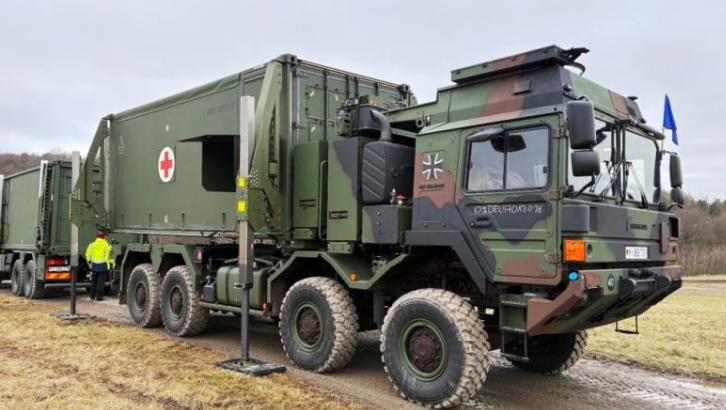
The German defense giant has secured a call-off order worth more than €500 million for 149 additional mobile rescue stations, making it the largest single award ever received by Rheinmetall Project Solutions.
At first glance, the announcement sounds less dramatic than a missile-defense program or fighter aircraft purchase.
But that perception misses a critical reality.
Modern warfare is increasingly becoming a race against time.
Not only the time needed to detect threats.
Not only the time needed to launch counterattacks.
But the time needed to keep wounded soldiers alive.
Military planners know a brutal truth: casualty survival rates often depend less on the severity of injuries than on how quickly treatment can begin.
Minutes matter.
Sometimes seconds matter.
And in a battlefield increasingly dominated by drones, precision artillery, and long-range strike systems, medical facilities themselves have become targets.
Large, static field hospitals are no longer guaranteed sanctuaries.
They are signatures.
They are detectable.
And they are vulnerable.
The Ukraine war has exposed this challenge more clearly than any conflict in recent decades.
Medical support must move faster.
Deploy faster.
Disappear faster.
And remain operational under constant threat.
That is precisely the logic behind Rheinmetall's modular rescue stations.
Designed to be rapidly deployable and assembled by just four soldiers, the systems provide emergency medical capability that can move alongside combat operations rather than lag behind them.
The concept may sound simple.
Its implications are not.
Historically, military procurement has prioritized platforms that deliver offensive capability.
The logic of deterrence rewards visible firepower.
Medical infrastructure, by contrast, often remains hidden in budget discussions despite its immense operational value.
Yet every military commander understands the connection between survivability and combat effectiveness.
Soldiers fight differently when they believe they can be rescued.
Units perform differently when evacuation systems function.
Force resilience is not only measured by how many weapons an army possesses.
It is measured by how effectively an army recovers from losses.
This is why Rheinmetall's contract is strategically significant.
Not because it adds another combat system.
Because it strengthens the human infrastructure behind combat power.
The figures themselves are telling.
The July order raises the planned fleet to 165 systems, with a total gross value exceeding €600 million.
Production is expected to begin in the first quarter of 2027.
That scale signals more than procurement.
It signals doctrine.
The Bundeswehr is institutionalizing lessons learned from observing the largest land war Europe has witnessed since 1945.
And one of those lessons is impossible to ignore:
The side that treats wounded personnel fastest saves more lives.
The side that saves more lives preserves more combat power.
In that sense, battlefield medicine is no longer merely a support function.
It is a combat multiplier.
This development also reflects a broader transformation underway across European defense.
For decades, logistics, sustainment, medical support, and resilience often attracted less public attention than frontline weapon systems.
The return of large-scale warfare has changed that calculus.
Governments are increasingly recognizing that military effectiveness depends upon an ecosystem rather than individual platforms.
A tank is only effective if it can be repaired.
A soldier is only effective if medical support exists.
An army is only effective if it can absorb losses and continue fighting.
Resilience is becoming a military capability in its own right.
And resilience is expensive.
Yet it may deliver greater strategic returns than another headline-grabbing weapons purchase.
That is why this contract matters beyond Rheinmetall's balance sheet.
It represents a shift in thinking.
A recognition that future wars will not be won solely by superior firepower.
They will be won by the ability to sustain people under extreme conditions.
The most powerful military innovation is not always the one that destroys targets.
Sometimes it is the one that keeps soldiers alive long enough to return home.
And in an age defined by drones, precision strikes, and attrition warfare, that may be the most important capability of all.