Project Vision - German 550 MWh Electric Cruise Ship That Could Kill the Smokestack Era
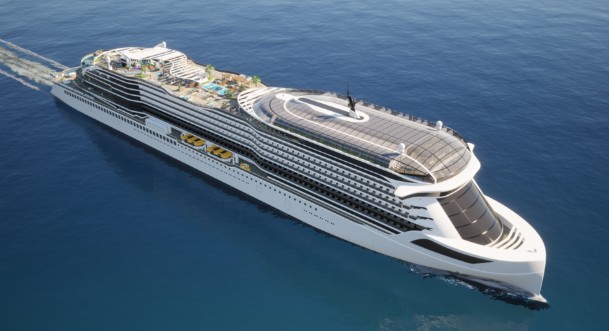
The cruise industry—long associated with towering smokestacks and heavy fuel oil—is facing a potential turning point. With its bold Project Vision, Meyer Werft is proposing what could become the world’s largest fully electric cruise ship. If realized, it would not only redefine maritime engineering but also challenge the environmental footprint of one of the most scrutinized sectors in global tourism.
At first glance, the announcement appears almost contradictory. On one hand, Project Vision is described as a “concept study,” leaving room for uncertainty. On the other, the ship’s specifications are strikingly concrete: 275 meters in length, capacity for nearly 1,900 passengers, and a gross tonnage of 82,000. These are not abstract ambitions—they are near-operational parameters.
But the real headline is hidden below deck.
The vessel is designed around a massive battery system with a capacity of 550 megawatt-hours. To put that into perspective, this is more than double the capacity of Germany’s largest stationary battery storage system. On a global scale, such a ship would rank among the top energy storage installations—not just in maritime applications, but across all sectors.
This raises a fundamental question: can a cruise ship really run on electricity alone?
Technically, the answer is yes—with caveats. The propulsion system is based on two high-power electric motors delivering a combined output of 24 megawatts. This is comparable to conventional cruise ships of similar size, suggesting that performance would not be compromised.
The challenge lies in energy management.
Depending on speed, the ship’s power consumption ranges between 6 and 27 megawatts. At a cruising speed of 12 knots (around 22 km/h), Meyer Werft estimates a range of approximately 570 nautical miles—just over 1,000 kilometers. This is enough to cover many typical European routes, such as Barcelona to Rome or Venice to Corfu.
In other words, the concept is not designed for transatlantic voyages. It is optimized for regional cruising—where electrification is most feasible.
Charging, often the Achilles’ heel of electric mobility, appears less problematic in this context. Unlike road transport, maritime infrastructure already supports high-capacity power connections. Many ports are equipped with shore power systems capable of delivering tens of megawatts, originally designed to supply docked ships with electricity and reduce emissions at berth.
Project Vision leverages this existing infrastructure. With a charging capacity of up to 40 megawatts (2 × 20 MW), the ship could recharge during typical port stays of around 10 hours. By 2030, more than 100 European ports are expected to offer the necessary grid connections.
Still, the scale is unprecedented.
While electric ferries and smaller vessels are becoming increasingly common, their battery capacities are measured in tens of megawatt-hours—not hundreds. Project Vision represents a leap of nearly an order of magnitude. It is not an incremental improvement; it is a structural shift.
This ambition reflects broader pressures on the cruise industry. Environmental concerns, particularly around emissions and air quality, have intensified in recent years. Cruise ships are often compared to floating cities, consuming vast amounts of energy even when stationary. Electrification offers a pathway to reduce both operational emissions and local pollution.
Yet realism is essential.
Battery technology, while advancing rapidly, still faces limitations in energy density, weight, and lifecycle costs. A 550 MWh system is not just large—it is heavy, expensive, and complex to integrate. Questions remain about long-term durability, maintenance, and economic viability.
There is also a strategic dimension. By positioning itself at the forefront of electric shipbuilding, Meyer Werft is not just responding to current demand—it is shaping future expectations. If Project Vision succeeds, it could set a new standard for cruise ship design and accelerate the industry’s transition toward cleaner propulsion systems.
If it fails, it will still provide valuable lessons about the limits of electrification at sea.
Either way, the message is clear: the era of unquestioned reliance on fossil fuels in maritime tourism is coming to an end. The question is no longer whether the industry will change—but how fast.
Project Vision may not be the final answer. But it is a powerful signal of where the future is heading.

.jpg)