Operational Experimentation Campaign 2026 (OPEX 261 PT) by European Defence Agency - News & Feedbacks
The battlefield is no longer defined by weapons.
It is defined by infrastructure.
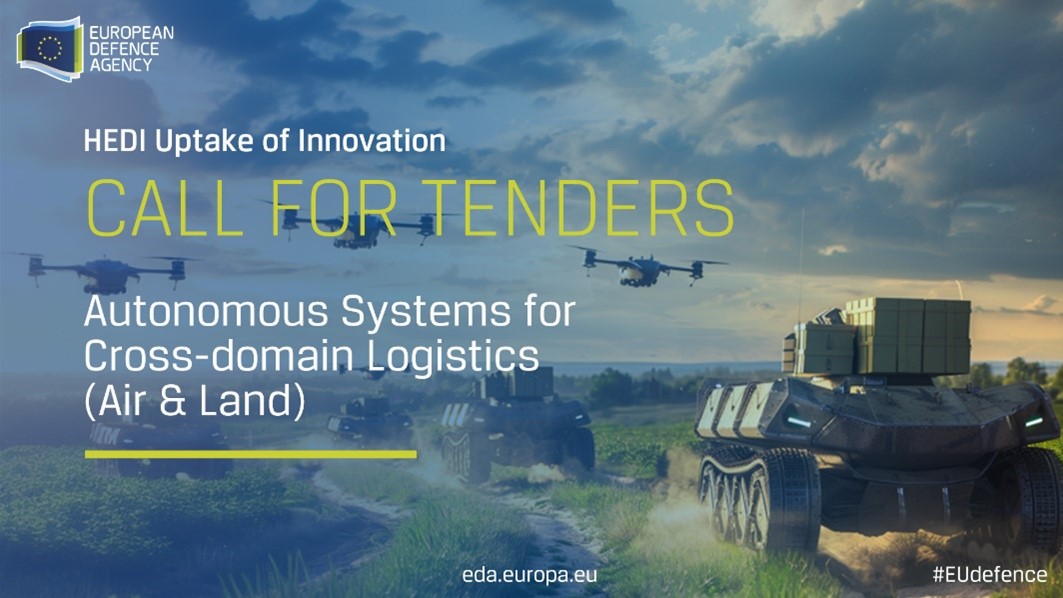
On 17 March 2026, the European Defence Agency (EDA), through its Hub for European Defence Innovation (HEDI), is not just hosting another information session. It is signaling something bigger — a structural shift in how military capability is built.
At the center of this shift is the Operational Experimentation Campaign 2026 (OPEX 261 PT).
And its message is clear:
👉 The future belongs to systems that can operate without infrastructure — or create their own.
From Machines to Networks
For decades, defence innovation focused on platforms — better drones, stronger vehicles, more advanced hardware.
But OPEX 2026 flips that logic.
Unmanned Aerial Systems (UAS) and Unmanned Ground Systems (UGS) are no longer the final product.
They are nodes.
Nodes in a much larger system — a distributed, autonomous logistics network capable of operating across air and land domains.
This is where a concept like VoltNode X becomes relevant.
Not as a single product, but as a layer of invisible infrastructure.
The Missing Piece: Energy and Autonomy
Autonomous systems are only as powerful as their ability to sustain themselves.
And that’s the bottleneck.
You can deploy drones. You can deploy robotic vehicles. But without:
- Reliable energy
- Communication
- Coordination
they become limited, fragile, and dependent.
OPEX 2026 addresses this indirectly — by focusing on cross-domain logistics:
- Last-mile resupply
- Distributed payload delivery
- CASEVAC scenarios
These missions demand systems that are:
- Independent
- Scalable
- Resilient
VoltNode X represents this shift in thinking.
Instead of asking “How do we build better drones?” the question becomes:
👉 “How do we enable systems to operate anywhere, anytime, without support?”
Distributed Is the New Standard
Traditional logistics is centralized.
It relies on:
- Bases
- Supply lines
- Fuel transport
But in modern operational environments, these are vulnerabilities.
What OPEX introduces is a new paradigm:
👉 Distributed logistics infrastructure
Multiple nodes. Decentralized operation. Adaptive behavior.
Each node supports the system:
- Powering platforms
- Enabling communication
- Acting as a local hub
This is not just more efficient.
It is more survivable.
And in defence, survivability is everything.
Real-World Validation: ARTEX 2026
The integration of OPEX into the Portuguese Army’s ARTEX 2026 exercise is where theory meets reality.
This is not a lab.
This is not a simulation.
Participants must meet strict:
- Technical standards
- Safety requirements
- Operational constraints
Only systems that are truly deployable — not just impressive on paper — will succeed.
This is what makes the campaign so important.
It filters ideas.
It exposes weaknesses.
And it validates what actually works.
Dual-Use Is No Longer Optional
One of the most interesting aspects of OPEX is the inclusion of dual-use technologies.
Innovation is no longer coming only from defence companies.
It is emerging from:
- Energy systems
- Smart infrastructure
- Robotics
- Industrial IoT
VoltNode X embodies this convergence.
A system that could exist in agriculture, industry, or disaster response — but becomes exponentially more valuable when applied to defence.
This is the new reality:
👉 The best military technologies may not be built for the military.
The Real Question
The EDA information session is not just about participation.
It’s about positioning.
Because the real question is not:
“Can your product work?”
It is:
👉 “Can your system integrate into something bigger?”
Conclusion: Infrastructure Wins
Weapons may define power.
But infrastructure defines endurance.
OPEX 2026 is not about showcasing the most advanced drone or the strongest robotic vehicle.
It is about identifying the systems that can:
- Sustain operations
- Adapt to uncertainty
- Function without dependency
VoltNode X is not a product.
It is a signal.
A signal that the future of defence will not be built on platforms alone — but on the invisible infrastructure that connects them.
And the companies that understand this will not just participate in the future.
They will define it.