MARSUR @ REPMUS 2026. Europe's New Navy Isn't a Fleet. It's a Network.
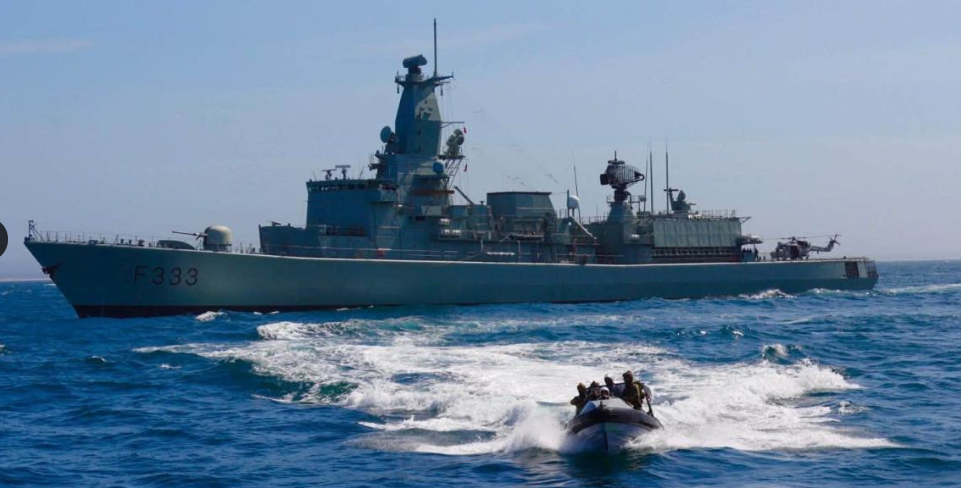
For centuries, maritime power was measured in ships.
The great naval powers built bigger fleets, larger guns, stronger armor, and faster vessels. Control of the sea depended on what could physically sail across it.
That logic is becoming obsolete.
The future of maritime power may depend less on what nations can put on the water and more on what they can see beneath it, above it, and across thousands of miles of interconnected networks.
That is why the recent demonstration of MARSUR during the REPMUS 2026 exercise off the Portuguese coast may represent something far more significant than a successful technology test.
It may be a glimpse of Europe's emerging digital fleet.
At REPMUS, Europe's largest unmanned maritime exercise, the European Defence Agency demonstrated that MARSUR, the European Union's maritime surveillance network, could exchange information in real time with national command systems and NATO networks.
On paper, this sounds technical.
In strategic terms, it is revolutionary.
Because modern maritime competition is increasingly becoming a contest between sensor networks rather than warships.
The Baltic Sea, Mediterranean, North Atlantic, Black Sea, and Arctic are no longer merely geographic spaces.
They are data environments.
Undersea cables carry global communications.
Pipelines transport energy.
Commercial shipping sustains economies.
Shadow fleets move sanctioned commodities.
Autonomous systems patrol above and below the waterline.
Every one of these activities generates data.
The challenge is transforming that data into situational awareness before a crisis occurs.
Historically, European countries monitored their maritime environments largely through national systems.
Each country saw part of the picture.
Few could see the whole picture.
MARSUR is attempting to change that.
By integrating naval data, satellite feeds, radar information, unmanned systems, and national reporting structures into a common operational framework, the network creates something strategically powerful:
shared awareness.
This is particularly important because the greatest maritime threats facing Europe today are not conventional naval invasions.
They are hybrid, ambiguous, and difficult to detect.
A suspicious vessel near critical infrastructure.
An unidentified underwater system.
A ship operating under false registration.
An unexplained disruption of communications.
A covert attack against subsea cables.
These threats frequently emerge gradually and across national boundaries.
No single nation possesses perfect visibility.
The strategic advantage belongs to those who can connect information faster than potential adversaries can exploit gaps.
This is where the REPMUS demonstration becomes highly significant.
For the first time, European officials describe a live integration of underwater, surface, aerial, satellite, national, and NATO data streams at this scale.
The achievement is not simply interoperability.
It is trust.
Military networks are built on technology.
Alliance networks are built on confidence.
The ability of European nations to share sensitive operational information in real time represents years of political, technical, and institutional development.
And that development points toward a wider strategic shift.
For decades, debates about European defense largely centered on military hardware.
More tanks.
More aircraft.
More ships.
More missiles.
Today, an equally important competition is emerging around information architecture.
Who can collect information fastest?
Who can distribute it fastest?
Who can convert data into decisions fastest?
The answer increasingly determines military effectiveness.
A modern frigate without situational awareness is vulnerable.
An entire fleet operating through a shared intelligence picture becomes exponentially more effective.
This is precisely why MARSUR matters.
It reflects a broader evolution in European defense thinking.
Strategic autonomy is often misunderstood as separation from NATO.
In reality, the REPMUS demonstration suggests a different model.
Europe is seeking the ability to generate its own situational awareness while remaining fully interoperable with allies.
Strategic autonomy and alliance integration are not competing concepts.
They are becoming complementary ones.
The planned transition to an EU Secret-level MARSUR network by 2028 strengthens that trajectory.
If successful, Europe will possess a surveillance architecture capable of supporting decision-making across an increasingly contested maritime domain.
And that may be essential.
Because future naval competition will rarely begin with missiles.
It will begin with information.
The first side to recognize an emerging threat gains the initiative.
The first side to connect scattered signals gains understanding.
The first side to create a complete picture gains options.
That is the deeper lesson from REPMUS.
Europe's maritime future may not be defined by the number of ships it launches.
It may be defined by the quality of the network connecting them.
The fleet remains important.
But increasingly, the network is becoming the fleet.