Luchs 2 from Rheinmetall - The Recon Vehicle That Turns Steel Into Intelligence
For decades, reconnaissance vehicles had a clear role:
Observe. Report. Avoid contact.
That era is over.
Modern battlefields don’t wait for information to travel back to command. They demand instant awareness, instant decisions, and immediate action. In this new reality, reconnaissance is no longer passive.
It is active. Networked. Armed.
Enter Luchs 2.
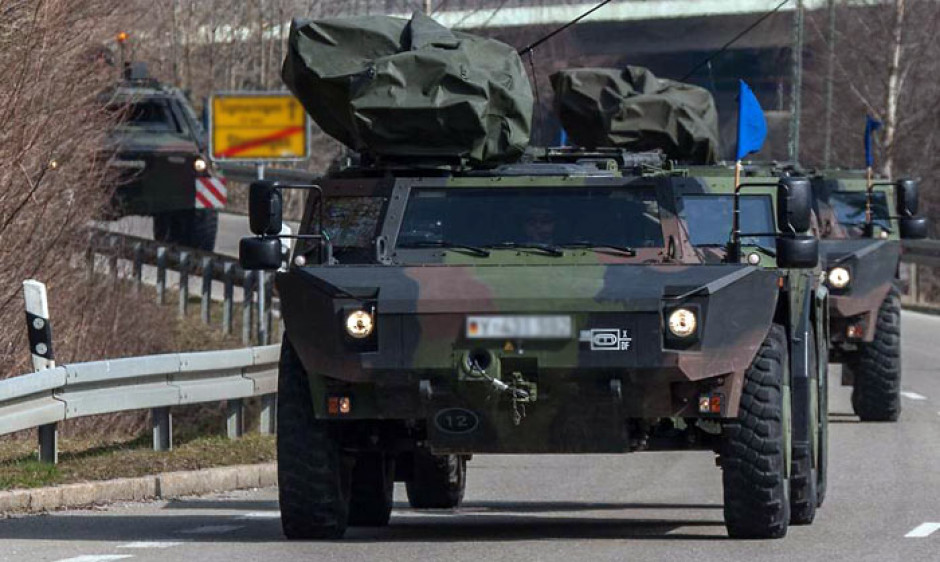
Developed under the leadership of General Dynamics European Land Systems with key systems supplied by Rheinmetall, Luchs 2 represents a fundamental shift in how military vehicles are designed—not as standalone platforms, but as nodes within a digital combat network.
And that changes everything.
At first glance, Luchs 2 is a modern 6×6 reconnaissance vehicle—mobile, amphibious, and built for flexibility. But its real innovation lies not in mobility.
It lies in integration.
At its core sits Rheinmetall’s CT-025 turret system, equipped with a 25 mm automatic cannon. Traditionally, this would define the vehicle’s combat capability.
Today, it’s just one layer.
Because the real power of Luchs 2 comes from how it connects sensors, weapons, and data into a single system.
Advanced stabilized optics provide continuous observation, even while moving at speed. Digital fire control systems process targeting data instantly. The vehicle can engage not only ground threats but also low-flying aerial targets—especially drones, which have become one of the most disruptive elements of modern warfare.
This is reconnaissance that can fight.
But more importantly—this is reconnaissance that can think.
Luchs 2 is designed to operate within modern military network architectures, sharing data in real time across units. What one vehicle sees, others know. What one system detects, the entire network can react to.
The battlefield becomes less about individual platforms—and more about connected intelligence.
And this is where the real transformation happens.
Because once vehicles are connected, the question is no longer:
“How good is this system?”
It becomes:
“How fast can the system learn and adapt?”
This is why Luchs 2 is built with modularity in mind.
Future upgrades won’t require redesigning the vehicle. Software updates, sensor integration, and AI-based enhancements can be added over time. The platform evolves—just like the threats it faces.
This approach reflects a broader shift across defense technology.
Hardware defines the limits.
Software defines the potential.
And in that equation, adaptability becomes more valuable than raw performance.
But there is another layer—one that is often overlooked.
Behind every sensor, every weapon, every digital system, there is something physical: structure, protection, precision engineering.
Luchs 2 must withstand extreme conditions—shock, vibration, electromagnetic interference, temperature extremes. Its systems must remain stable, aligned, and functional under stress.
This is where engineering meets reality.
No matter how advanced the software becomes, it still depends on a platform that can survive, move, and operate reliably.
Steel still matters.
Yet steel alone is no longer enough.
The future belongs to systems that merge mechanical strength with digital intelligence.
Luchs 2 is one of the clearest examples of this convergence.
It is not just a vehicle.
It is not just a sensor platform.
It is not just a weapons system.
It is all of these—combined into a single, adaptable, networked unit.
And that may be the most important shift of all.
Because modern warfare is no longer defined by who has the strongest platform.
It is defined by who has the most intelligent system.