Karlsruhe Institute of Technology - Metal Chains is the Best Counter UAV?
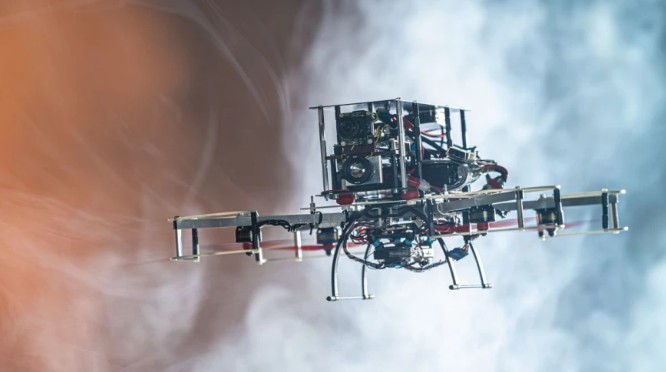
As drones become one of the defining security challenges of the modern era, engineers and defense specialists are searching for new ways to stop them. Most current counter-drone solutions rely on radar systems, electronic warfare, signal jamming, interceptor drones, or expensive missile-based defenses. But researchers at Germany's Karlsruhe Institute of Technology (KIT) are exploring a surprisingly simple alternative: metal chains.
At first glance, the idea sounds almost primitive. Yet the underlying concept could offer a practical and cost-effective solution for protecting critical infrastructure, airports, industrial facilities, military installations, and other sensitive locations from unauthorized UAV activity.
The concept is based on a straightforward physical principle. Instead of attempting to destroy a drone with a high-speed projectile, the system launches thin metallic chains toward an approaching UAV. When the chains strike the aircraft, they become entangled around the drone's body and, most importantly, its rotors. Once the rotors are blocked, the drone loses lift and falls in a controlled manner.
According to KIT researchers, the idea was inspired by the traditional South American bolas — a tool consisting of weighted cords used to entangle animals. Rather than using ropes and weights, however, the team adapted the concept for modern counter-UAV operations using specially designed metallic chains.
Professor Claus Mattheck, a senior researcher at KIT's Institute for Applied Materials, explained that the approach aims to provide a robust and rapidly deployable alternative to existing counter-drone technologies. The goal is not necessarily to destroy the drone, but to neutralize it safely and efficiently.
One of the most interesting aspects of the concept is its focus on reducing collateral damage. Conventional projectiles may miss their targets, create dangerous fragments, or continue traveling after impact. Metallic chains behave differently. Their large surface area and flexible structure rapidly dissipate energy after deployment. Researchers believe this could significantly reduce risks to nearby people, vehicles, or infrastructure.
To evaluate the concept, the KIT team conducted extensive computer simulations. The researchers analyzed the behavior of metallic chains measuring between three and four millimeters in diameter when impacting various drone configurations. Factors such as friction, geometry, rotational dynamics, impact angle, and kinetic behavior were incorporated into the models.
The simulation results were encouraging. According to the research team, the chains demonstrated strong entanglement capability while maintaining favorable safety characteristics compared with conventional projectile systems.
Importantly, the project has already moved beyond purely theoretical analysis. Experimental testing has also been carried out at a ballistic testing facility in Sternenfels, Germany. Real-world launches against test targets helped validate the feasibility of the concept and provided valuable data for future development.
The timing of the project reflects growing concern about drone activity near critical infrastructure. Across Europe, authorities have reported increasing numbers of UAV sightings near airports, prisons, energy facilities, industrial sites, and military installations. Many existing counter-drone systems remain expensive, technically complex, or difficult to deploy rapidly in large numbers.
This is where the KIT concept may find its niche. Rather than competing directly with sophisticated electronic warfare systems, it offers a simple kinetic solution for short-range defense scenarios where quick reaction times and low operational costs are critical.
Significant challenges remain before the technology becomes operational. Researchers will need to demonstrate effectiveness against different drone sizes, speeds, flight patterns, and environmental conditions. Questions regarding deployment mechanisms, range, accuracy, maintenance, and integration into existing security systems must also be addressed.
Nevertheless, the project highlights an important lesson in modern defense innovation: sometimes the most effective solutions are not the most technologically complex.
As drones continue to evolve, security professionals may discover that stopping advanced flying machines does not always require futuristic weapons. Sometimes, a carefully engineered chain may be enough.