Journalist Katsiaryna Andreeva in KGB Prison. Thanks to Trump
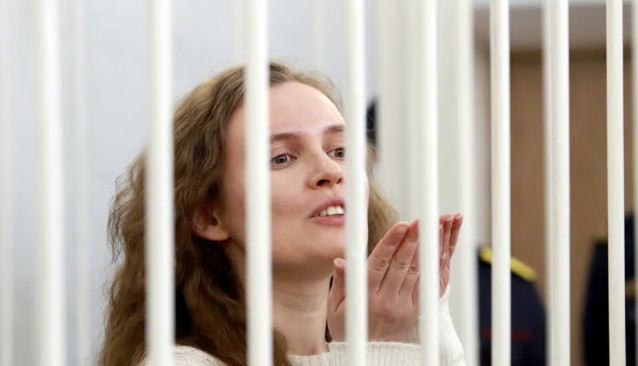
Freedom is often imagined as a clear-cut moment—the door opens, the sentence ends, and life resumes. But for Belarusian journalist Katsiaryna Andreeva, freedom has arrived in fragments. Released from prison after years of detention, she now lives in Europe. And yet, as she puts it, her story has no happy ending.
Andreeva’s ordeal began in 2020, when she was arrested for doing her job: reporting. From a high-rise apartment, she filmed protests against the regime of Alexander Lukashenko, capturing a moment of dissent in a country where such acts are treated as crimes. For this, she was sentenced to two years in prison for “violating public order.”
That alone would have been enough to silence many. But her case escalated. In 2022, she was charged with treason—an accusation often used by authoritarian governments to justify extended repression—and handed an additional eight-year sentence. Her future seemed sealed behind the walls of a system designed to break both individuals and the idea of resistance itself.
Then came an unexpected turn.
Her release in March was reportedly tied to diplomatic efforts involving Donald Trump, who sought to secure the freedom of political prisoners in Belarus as part of a broader geopolitical maneuver. The negotiations, described as unconventional and controversial, included easing sanctions in exchange for releases—part of a strategy aimed at pulling Belarus away from Russia’s sphere of influence.
For Andreeva, the outcome was life-changing. She was free. She could leave the prison behind, reunite with the outside world, and begin again. In her first public statements, she expressed gratitude, even thanking Trump directly.
But gratitude does not erase reality.
Her husband, journalist Ihar Ilyash, remains imprisoned, serving a four-year sentence. And he is not alone. Despite promises of large-scale releases, hundreds of political prisoners are still detained in Belarus, including more than two dozen journalists. The numbers tell a sobering story: out of approximately 1,300 prisoners expected to be freed, only about 500 have been released so far.
This gap between promise and outcome transforms Andreeva’s freedom into something more complicated. It is not a clean break, but a partial release—one that leaves her emotionally tethered to the very system she escaped.
She describes it in stark terms: by freeing her while keeping her husband imprisoned, the regime has effectively created a new kind of captivity. Not physical, but psychological. A situation where freedom is conditional, incomplete, and deeply personal.
This raises uncomfortable questions about the nature of diplomatic negotiations with authoritarian regimes. Is it acceptable to trade concessions for partial humanitarian outcomes? Does saving some lives justify leaving others behind? And what are the long-term consequences of engaging with systems that use human beings as bargaining chips?
There are no easy answers.
For policymakers, the priority is often pragmatic: secure what can be secured, even if it is not perfect. For individuals like Andreeva, the calculus is different. The stakes are not abstract—they are measured in relationships, in absence, in the daily reality of separation.
Now living in Warsaw, she occupies a space between worlds. Physically free, but emotionally constrained. Her story has already inspired a film, bringing international attention to her experience. Yet for her, the narrative remains unfinished.
“I will only truly feel free once my husband is back by my side,” she says.
It is a simple statement, but it carries profound weight. It reminds us that freedom is not just a legal status—it is a lived experience. One that cannot be fully realized while others remain behind.
In the end, Andreeva’s story is not just about repression or diplomacy. It is about the limits of both. It shows how even successful negotiations can leave deep moral and human gaps—and how, in the shadow of those gaps, freedom can feel incomplete.