Heavy-Lift Lastendrohnen Are Transforming Emergency Response in German Black Forest
High in the dense forests and steep valleys of Germany’s Black Forest, rescue operations have always been a race against time—and against geography. But now, a new player is changing the rules of that race.
It does not wear a uniform. It does not climb. It does not get tired.
Instead, it flies.
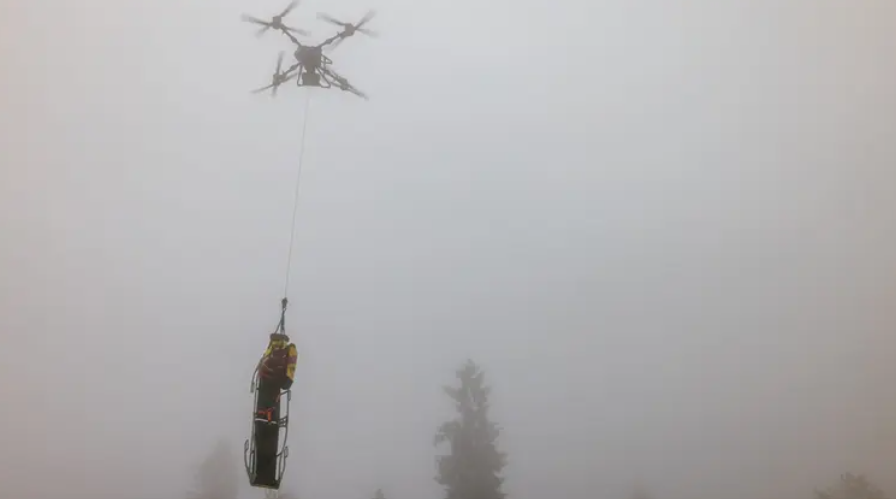
The Bergwacht Schwarzwald, one of Germany’s most experienced mountain rescue organizations, is introducing a heavy-lift drone that could fundamentally reshape how emergency teams operate in remote and hazardous terrain. Capable of carrying up to 100 kilograms—more than double the payload of similar systems currently used by other rescue teams—the drone is already being described by rescuers as a “small revolution.”
And the numbers tell the story.
With dimensions of 3.2 by 3.2 meters—nearly the size of a compact car—the drone is far from subtle. Yet its mission is precise: to deliver vital equipment quickly and directly to places where human access is slow, dangerous, or sometimes impossible.
Until now, that burden rested on people.
Rescue teams had to carry ropes, medical kits, stretchers, and technical gear across rugged terrain, often under extreme conditions. Minutes mattered—but reaching the site could take hours. The result was a constant tension between speed and safety.
The new drone shifts that equation.
Flying at speeds of over 50 km/h, it can transport heavy equipment rapidly to accident sites deep in forests or high in mountainous areas. Instead of exhausting teams before they even begin a rescue, the drone arrives first—bringing the tools needed to act immediately.
This is not just convenience. It is operational transformation.
“Reduced risk, increased awareness”—a phrase often used in defense contexts—applies seamlessly here. The drone reduces physical strain on rescuers while increasing their ability to respond quickly and effectively. It extends their reach, amplifies their capability, and buys something priceless in emergency response: time.
But the innovation comes with complexity.
Operating a machine of this size in mountainous terrain is a delicate process. Wind conditions, payload balance, and navigation require precision down to the smallest adjustment. Pilots describe it as “millimeter work,” where every movement must account for changing environmental factors.
Even though the drone is built to withstand rain and freezing temperatures, strong gusts of wind remain a critical challenge. This is why the Bergwacht teams are already deep into training, running simulations to ensure that, when real emergencies strike, the system performs flawlessly.
Because in rescue operations, there is no margin for error.
The implications extend beyond everyday missions.
While the drone will not be needed for most operations, its value becomes critical in complex scenarios—natural disasters, floods, forest fires—where infrastructure is disrupted and traditional logistics fail. In these situations, the ability to move heavy equipment quickly and independently of roads or terrain can be decisive.
And yet, even as the technology advances, some boundaries remain.
Transporting injured patients by drone is technically possible, but currently not permitted under existing aviation regulations. The strict certification requirements for carrying people highlight an important reality: innovation in rescue technology is moving faster than the regulatory frameworks that govern it.
Still, progress is accelerating.
With official deployment planned for late June during Germany’s national Civil Protection Day in Freiburg, and with a second drone expected to be stationed in Offenburg, the Bergwacht Schwarzwald is positioning itself at the forefront of a new era in emergency response.
This is not just about one drone.
It is about a broader shift toward integrating advanced technologies into life-saving operations. The same principles driving innovation in defense—automation, autonomy, system integration—are now finding their way into civilian applications, where the objective is not dominance, but survival.
And the impact is unmistakable.
Because when the next call for help comes from deep within the forest or high above the valley floor, the first responder may no longer arrive on foot.
It will arrive from the sky.

.jpg)
.png)