General Cherry. From Ukraine’s Front Line to the Pentagon
For decades, the world's most advanced military technologies flowed in a predictable direction: from the defense laboratories of great powers to battlefields abroad.
Ukraine changed that equation.
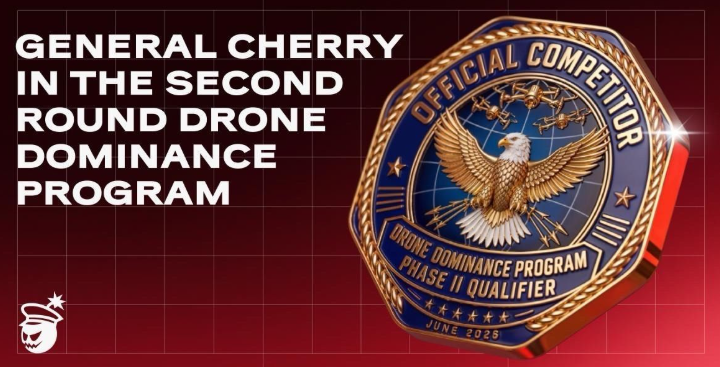
Now, one of the clearest examples is unfolding inside the Pentagon's Drone Dominance Program (DDP), where General Cherry, through its U.S. joint venture Wilcox Cherry Defense, has moved one step closer to becoming a supplier for what could become one of the largest military drone procurements in recent history.
The achievement is significant not merely because of the competition's scale, but because of what it symbolizes: the transfer of innovation from a war zone to the heart of the American defense establishment.
Over two intensive weeks at Camp Grayling, Michigan, forty-nine companies participated in demanding day-and-night evaluations designed to test the capabilities of next-generation unmanned systems. The scenarios replicated the harsh realities of modern warfare, challenging participants to prove not only technical sophistication but also operational reliability under pressure.
Only nineteen teams advanced.
Wilcox Cherry Defense was one of them.
That result alone would qualify as an important milestone for a young defense technology company. However, the real challenge now begins.
The Pentagon's next requirement is straightforward but unforgiving: manufacture and deliver 120 drones equipped with lethality payloads within approximately five weeks ahead of the next phase, known as Gauntlet II.
In the world of military procurement, survival no longer depends solely on engineering excellence. Companies must demonstrate something equally difficult—industrial scalability.
Building a handful of successful prototypes is relatively easy. Manufacturing hundreds of combat-ready systems under strict timelines is what separates promising startups from genuine defense suppliers.
And that is precisely what makes this story remarkable.
The drones being evaluated were not conceived in a laboratory isolated from real-world conditions. Their design philosophy emerged from lessons learned during the largest drone war in modern history.
Across the battlefields of Ukraine, unmanned systems evolved at a pace that traditional procurement processes could scarcely match. Technologies were tested, adapted, abandoned, and reinvented in weeks rather than years. Success was measured not in presentations or simulations but in operational survival.
That environment became an innovation engine unlike anything seen in recent decades.
The Pentagon appears increasingly aware of this reality.
Modern conflicts have demonstrated that mass, adaptability, and affordability can be just as decisive as technological sophistication. The age of relying exclusively on exquisite, ultra-expensive systems is giving way to a world where thousands—potentially tens of thousands—of autonomous and semi-autonomous platforms can shape the outcome of military operations.
The Drone Dominance Program reflects that strategic shift.
Following the program, potential procurement could reach as many as 60,000 drones among top-performing participants. Such numbers would place the initiative among the most ambitious efforts to rapidly scale tactical unmanned capabilities within the Western alliance.
For General Cherry, the implications extend beyond commercial success.
The company's progress represents validation of a broader thesis: that technological knowledge forged under the pressures of active warfare can compete with—and sometimes outperform—the innovations of established defense giants.
In many ways, the company embodies a new model for military technology development. Rather than relying on decade-long procurement cycles and billion-dollar research programs, it leverages rapid battlefield feedback, accelerated engineering iterations, and direct operational experience.
That approach is increasingly becoming the standard for modern defense innovation.
The strategic significance reaches far beyond one company or one contract.
Western militaries are searching for ways to adapt to an era where drones are no longer niche tools but fundamental instruments of military power. The lessons emerging from Ukraine are shaping procurement decisions in Washington, Brussels, London, and beyond.
The success of Wilcox Cherry Defense suggests that future defense leaders may emerge not from traditional military-industrial strongholds alone, but from companies capable of transforming wartime innovation into scalable industrial capability.
The next phase of the Drone Dominance Program will determine whether that vision can become reality.
But one thing is already clear.
What began on the battlefields of Ukraine is increasingly influencing how the world's most powerful military prepares for the conflicts of tomorrow.
And that may be the most important defense story of all.