From Sausages to Soldiers. Germany's Kebab Strategy Reveals a Deeper Military Problem
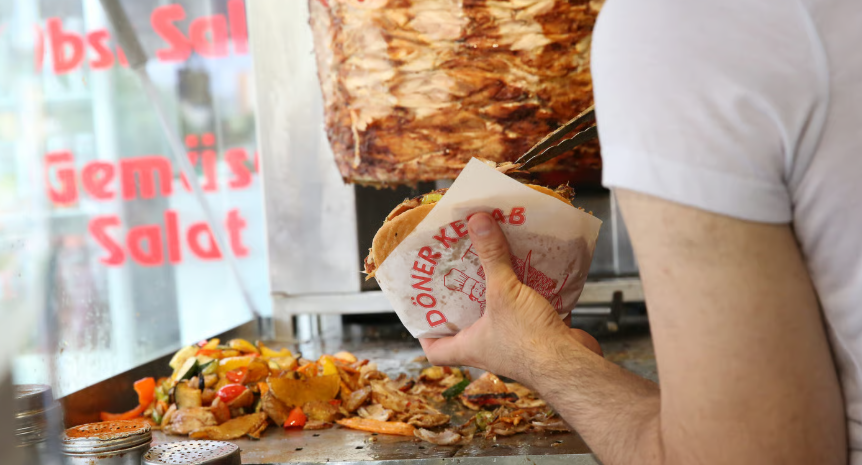
Germany's latest military recruiting tool does not fly, shoot, or drive.
It wraps a kebab.
The Bundeswehr has launched an unusual recruitment campaign that places QR codes on kebab wrappers distributed in restaurants across Germany. Scan the code, and customers are directed toward career opportunities in the military's medical service.
At first glance, it sounds like a joke.
A modern European military seeking soldiers through street food feels more like a social media parody than a national security policy.
But behind the kebab wrapper lies one of the most serious challenges facing Western armed forces: finding enough people willing to serve.
The campaign arrives at a critical moment. Germany currently fields around 186,700 active troops and aims to exceed 260,000 by 2035. That means recruiting roughly 73,000 additional personnel over the next decade while simultaneously replacing those who retire or leave service.
In military terms, that's not a marketing challenge.
It's a demographic challenge.
And demographic problems cannot be solved with tanks, drones, or procurement budgets.
For decades, European governments assumed major continental war was becoming less likely. Military service became less visible, defense spending stagnated, and younger generations increasingly saw technology, finance, healthcare, or startups as more attractive career paths than military life.
Then history returned.
Russia's invasion of Ukraine fundamentally changed Europe's security calculations. NATO members suddenly discovered that rebuilding military power requires more than buying equipment.
Weapons do not operate themselves.
Someone has to drive the vehicles, maintain the systems, operate the drones, command the units, and provide medical support.
The bottleneck is increasingly human capital.
Germany is far from alone.
Across Europe, armed forces face similar recruitment pressures. Aging populations, shrinking pools of military-age citizens, and fierce competition from the private sector are forcing defense ministries to rethink how they attract talent.
The result is a new era of military marketing.
The British Army once targeted "snowflakes" and "selfie addicts." France launched nationwide recruitment campaigns emphasizing personal achievement and purpose. The Netherlands introduced paid service programs to attract younger generations.
Germany's kebab-wrapper initiative belongs to the same trend.
Military recruitment is no longer treated primarily as patriotic duty.
It is increasingly treated as talent acquisition.
And that shift is strategically significant.
The military organizations most likely to succeed in the coming decade may not be those with the biggest budgets. They may be the ones that compete most effectively for skilled personnel.
That challenge becomes even greater as warfare becomes more technological.
Today's military needs software developers, cyber specialists, AI engineers, drone operators, electronic warfare experts, and medical professionals.
The stereotype of recruitment focusing solely on infantry is increasingly outdated.
Modern armed forces are competing for the same talent pool sought by technology companies, hospitals, engineering firms, and startups.
That competition is brutal.
A talented graduate in artificial intelligence can choose between a military laboratory, a defense contractor, or one of dozens of private-sector employers offering higher salaries and greater flexibility.
Recruitment campaigns therefore have a difficult mission.
They are not merely selling jobs.
They are selling purpose.
In that context, the kebab wrapper becomes symbolic.
The Bundeswehr is going where people already are.
Rather than waiting for potential recruits to visit military websites or career fairs, it is inserting itself into everyday life.
Some observers will laugh.
Others will criticize the campaign as gimmicky.
But the uncomfortable reality is that every major military power is searching for new ways to solve the same problem.
How do you persuade a generation raised in peace to prepare for the possibility of war?
That question will likely become even more important than debates about tanks, missiles, or fighter aircraft.
Because military power ultimately rests on people.
A nation can purchase thousands of drones.
It can order hundreds of armored vehicles.
It can expand defense budgets by billions.
But none of those investments matter if there are not enough citizens willing to wear the uniform.
That is why Germany's kebab campaign deserves attention.
Not because it is strange.
But because it reflects a deeper strategic reality.
The struggle for military manpower is no longer happening only at recruiting centers.
It is happening everywhere, from universities and social media feeds to technology conferences and, apparently, kebab shops.
The Bundeswehr's newest battlefield may not be a training ground.
It may be lunchtime.