Europe’s New Defense Factory Isn’t a Factory at All — It’s a Battlefield
For decades, defense innovation followed a familiar script.
A startup develops a promising technology. Investors fund it. Engineers perfect it in a laboratory. Military officials watch a demonstration. Procurement programs begin. Years pass.
Then reality arrives.
And reality has a habit of destroying assumptions.
That is exactly why Europe's newest defense innovation initiative may be one of the most important military experiments currently underway.
In June 2026, the first BraveTech EU DefTech Forges concluded in France and Estonia, bringing together 32 startups, scale-ups and SMEs with military end-users, technical experts and Ukrainian veterans of modern warfare.
The objective was brutally simple:
Stop talking about innovation. Start testing it.
And that may represent a bigger revolution than any individual technology showcased during the program.
The Death of the PowerPoint Warrior
For years, defense conferences have been filled with polished presentations promising to change the future of warfare.
AI.
Autonomy.
Robotics.
Advanced sensors.
Swarm systems.
Most look impressive on a screen.
Far fewer survive contact with reality.
The DefTech Forges challenge that dynamic by taking emerging companies out of conference halls and placing them directly in operational environments where their technologies face the uncomfortable questions soldiers ask.
Will it work in bad weather?
Will it work when GPS disappears?
Will it work after days of continuous operations?
Will it work when lives depend on it?
These questions cannot be answered in a laboratory.
They can only be answered in the field.
That is what makes the initiative different.
Instead of rewarding the best pitch deck, it rewards demonstrated capability.
The battlefield has become the ultimate product manager.
Ukraine's Invisible Role
Officially, the program focused on European defense innovation.
Unofficially, Ukraine was present in every lesson learned.
Across both testing locations, companies worked directly with European and Ukrainian military experts. This matters because Ukraine is currently generating more operational military innovation than perhaps any country in the world.
The war has fundamentally changed how militaries evaluate technology.
Equipment is no longer judged by specifications.
It is judged by survivability.
Adaptability.
Maintainability.
Cost-effectiveness.
Combat relevance.
A million-euro system destroyed in minutes is not innovation.
A low-cost platform that succeeds repeatedly under battlefield conditions is.
Ukrainian operators have become uniquely qualified judges of that distinction.
Their feedback can compress years of development into days.
The Rise of Fast Warfare
One of the biggest lessons emerging from the Ukraine war is that traditional defense procurement cycles are too slow.
Technology evolves faster than acquisition processes.
A drone that dominates today may become obsolete within months.
A sensor that works this year may become vulnerable after the next software update.
Military innovation is beginning to resemble software development rather than industrial manufacturing.
Rapid iteration.
Continuous testing.
Constant adaptation.
The DefTech Forge model embraces this reality.
Instead of spending years evaluating technologies from a distance, military organizations can observe performance directly and provide immediate operational feedback.
This dramatically shortens the path from concept to capability.
And in modern warfare, speed matters.
Six Winners — One Bigger Message
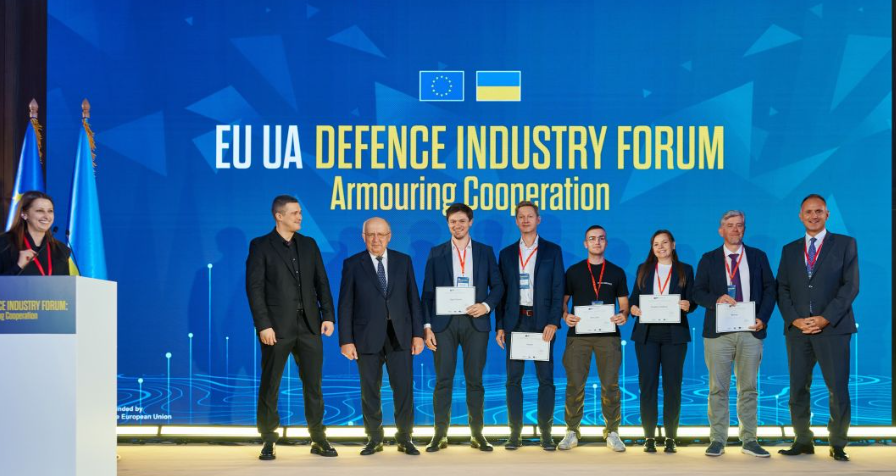
At the conclusion of the program, six companies were selected for Phase II Operational Experimentation with the European Defence Agency and received awards worth €120,000 each:
- EdgeX Robotics
- Soraccel
- SMAESH
- Tempterno Defence
- RANNON
- Kova Labs
The funding itself is significant.
But the real prize is validation.
Selection means that military stakeholders saw enough operational potential to justify further experimentation and development.
For young defense companies, there is no stronger signal.
Yet the broader lesson extends beyond these six winners.
The real success story is the creation of a framework where promising technologies can prove themselves before they are desperately needed.
The Future of Defense Innovation
Europe is entering a new era.
Security challenges are growing.
Military budgets are expanding.
Defense ministries are searching for solutions faster than ever.
The question is no longer whether innovation matters.
The question is how quickly useful innovations can reach operational units.
Programs like DefTech Forges offer a compelling answer.
Bring innovators into the field.
Place them alongside soldiers.
Let technology fight for its own relevance.
Because the future battlefield will not care about marketing claims.
It will not reward presentations.
It will not wait for procurement paperwork.
It will reward what works.
And Europe is beginning to build an innovation ecosystem designed around that simple truth.
The era of defense innovation by PowerPoint is ending.
The era of defense innovation by battlefield validation has begun.