Europe's Defence Awakening. Why the Era of Fragmentation May Be Coming to an End
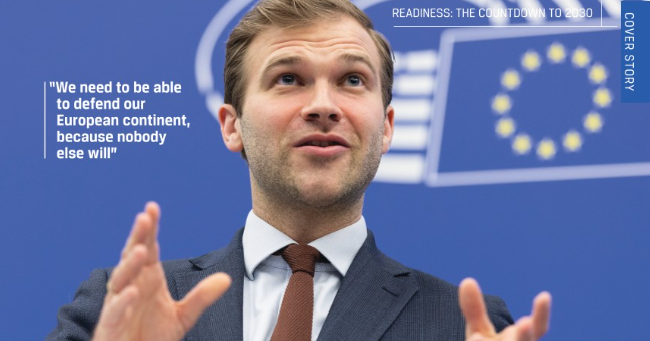
"We need to be able to defend our European continent, because nobody else will."
Those words, echoed in the growing debate inside the European Parliament, capture a reality that many European leaders would have found uncomfortable only a few years ago. Today, however, the question is no longer whether Europe needs greater defence autonomy. The question is whether Europe can afford to delay it any longer.
As geopolitical tensions rise, Russia's war against Ukraine enters another brutal phase, and global power competition intensifies, the European Union is confronting a difficult truth: despite spending hundreds of billions of euros on defence, Europe remains surprisingly fragmented in how it buys, develops, and maintains military capabilities.
That fragmentation comes with a price.
According to German MEP Tobias Cremer, a member of the European Parliament's Security and Defence Subcommittee (SEDE), the answer lies in creating a single European defence market. It is a proposal that could reshape Europe's military industry as profoundly as the single market transformed trade and commerce decades ago.
For supporters, the argument is remarkably simple.
Europe has military strength.
Europe has technological expertise.
Europe has industrial capacity.
What Europe lacks is integration.
Instead of acting as one defence ecosystem, European governments largely continue to purchase equipment nationally. Different standards, separate procurement systems, duplicated programs, and incompatible regulations increase costs while reducing efficiency. The result is a defence landscape in which taxpayers fund overlapping capabilities while industry struggles to achieve the scale necessary to compete globally.
The numbers are striking.
European nations collectively spend enormous sums on defence, yet often generate less military capability per euro than larger, more integrated competitors. Fragmentation creates inefficiencies that would be unacceptable in almost any other strategic sector.
Imagine if Europe's automotive industry operated through 27 separate regulatory frameworks.
Imagine if European airlines had no common market.
Imagine if every country designed its own digital standards.
The economic cost would be immense.
Supporters of a unified defence market argue the same logic applies to security.
The case for integration extends beyond budgets. Modern warfare increasingly depends on scale, speed, and technological innovation. Artificial intelligence, drone warfare, cyber defence, missile systems, satellite capabilities, and electronic warfare require research investments measured in billions.
Few individual European countries can sustain these investments alone.
Collectively, however, Europe can.
That is why advocates see defence integration not merely as an economic reform, but as a strategic necessity. Larger joint procurement programs could reduce costs, strengthen supply chains, accelerate innovation, and improve operational interoperability among European armed forces.
The implications extend beyond the European Union itself.
A stronger European defence industrial base would also reinforce NATO capabilities. For decades, European security has relied heavily on transatlantic cooperation, particularly American military power. While that partnership remains central, political developments in recent years have encouraged European policymakers to ask uncomfortable questions about long-term strategic dependence.
The message emerging from Brussels is increasingly clear:
Partnership is essential.
Dependency is dangerous.
This shift represents one of the most significant strategic transformations in Europe since the end of the Cold War.
The comparison frequently invoked by integration advocates is historical. In 1951, six nations established the European Coal and Steel Community, placing key war-making industries under shared governance. The project was not only economic. It was political. It aimed to make conflict between European states materially impossible.
Today, some policymakers see defence integration as the next logical chapter.
The objective is not preparing Europe for war.
The objective is preventing it.
A more integrated defence industry would strengthen deterrence, increase resilience, and ensure that Europe can respond effectively to crises without scrambling to coordinate fragmented capabilities in real time.
Yet challenges remain substantial.
National sovereignty concerns, industrial competition, domestic political interests, and differing strategic priorities continue to divide member states. Defence remains among the most sensitive areas of national authority.
But pressure is growing.
The security environment surrounding Europe has fundamentally changed.
And history suggests that major European integration projects often emerge during moments of strategic necessity.
The debate is no longer about creating a stronger European defence market someday.
It is about whether Europe can build one before the next crisis arrives.
The age of fragmentation may be ending.
The age of European defence integration may just be beginning.