EUROPA 400B. Europe’s AI Independence Declaration Against Silicon Valley
For years, the global artificial intelligence revolution has followed a predictable pattern.
The most powerful models were developed in California. The largest compute infrastructure belonged to American technology giants. And the overwhelming majority of AI innovation flowed through ecosystems controlled by a handful of U.S. companies.
Europe played an important role as a market, a regulator, and a consumer.
But not as a leader.
That may be about to change.
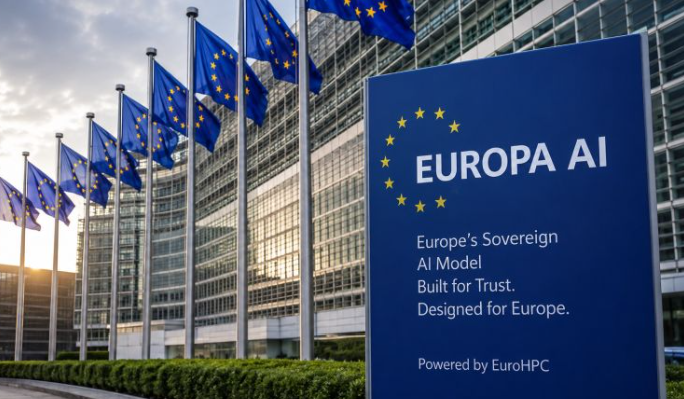
The European Union has launched one of its most ambitious technology initiatives ever: the development of a next-generation frontier AI model under the newly created EUROPA Consortium, led by technology company Domyn. More than just another large language model, the project represents a bold attempt to establish a sovereign European AI ecosystem capable of competing with the world's most advanced platforms.
The objective is not simply technological competitiveness.
It is strategic independence.
A 400-Billion-Parameter Giant
The numbers alone are remarkable.
The planned model is expected to exceed 400 billion parameters, placing it among the most powerful AI systems ever developed.
For Europe, this marks a significant shift.
Previous European AI initiatives often focused on research excellence and niche applications. EUROPA is different. It aims directly at the frontier of artificial intelligence, where the battle for technological leadership is being fought.
Yet the project's most important innovation is not its size.
It is its philosophy.
24 Languages. Equal From Day One.
Most leading AI systems today remain fundamentally English-first.
Other languages are often added later through fine-tuning or supplemental training, creating noticeable performance gaps for non-English users.
Europe wants to reverse that model.
The new AI system will be trained from the ground up across all 24 official European Union languages, with each language receiving substantial representation in the training process.
This is more than a technical choice.
It is a strategic one.
Language is economic power. Language is cultural influence. Language determines who benefits from digital transformation and who gets left behind.
Instead of forcing Europe to adapt to AI designed for English-speaking markets, EUROPA aims to build AI that reflects Europe's linguistic reality from the beginning.
For millions of users, businesses, public institutions, and researchers, that could be revolutionary.
The Real Battlefield: Data Ownership
The most controversial issue in artificial intelligence today is not computing power.
It is data.
Many of the world's leading AI models were trained using massive quantities of internet content, triggering legal disputes and growing criticism from authors, publishers, artists, and copyright holders.
Europe is attempting a radically different approach.
The project plans to leverage legal, high-quality multilingual data sources, including the vast archives of EU institutional documents and translations. These materials have been professionally created, reviewed, and translated over decades.
The result could be one of the highest-quality multilingual training datasets ever assembled.
While many AI companies are fighting courtroom battles over intellectual property, Europe is trying to eliminate the controversy before it begins.
AI Built on European Soil
The project's geopolitical significance may be even greater than its technical ambition.
Rather than relying on commercial cloud infrastructure from U.S. hyperscalers, EUROPA will be trained on Europe's own supercomputing network under the EuroHPC framework.
Training resources will include:
- Leonardo (Italy)
- MareNostrum 5 (Spain)
- MeluXina (Luxembourg)
Every major computing resource remains physically located within Europe.
That matters.
As governments increasingly view digital infrastructure as a strategic asset, dependence on foreign technology providers is becoming a national security concern.
Europe's response is straightforward: build its own infrastructure, train its own models, and keep critical capabilities under its own control.
Open Source Instead of Closed Empires
Perhaps the most disruptive element of the entire project is its commitment to openness.
The completed model is expected to be released as open source, allowing startups, enterprises, universities, public institutions, and developers to customize it freely.
That stands in sharp contrast to many proprietary AI ecosystems.
Rather than creating another digital monopoly, Europe is attempting to create an innovation platform that thousands of organizations can build upon.
For European businesses, this could unlock a new generation of AI-powered products without dependence on foreign providers.
For policymakers, it represents a chance to align technological progress with transparency and accountability.
The Hardest Part Starts Now
Despite the excitement, Europe's challenge remains enormous.
Building a world-class model is difficult.
Building an ecosystem that can compete with OpenAI, Google, Anthropic, Meta, and other global leaders is even harder.
The United States still enjoys huge advantages in capital, talent concentration, market scale, and product adoption.
Europe's true test will not be measured in parameters.
It will be measured in users, developers, enterprise adoption, and real-world impact.
A Turning Point for Europe
The EUROPA initiative is far more than a technology project.
It is a statement of intent.
For decades, Europe has debated digital sovereignty. Now it is attempting to build it.
Whether EUROPA ultimately becomes a genuine competitor to today's AI giants remains uncertain.
But one thing is already clear:
Europe is no longer content to watch the AI revolution from the sidelines.
For the first time, it is stepping onto the field with ambitions as large as the technology itself.
.png)