Eight Hours Over the Battlefield. Why Ukraine’s “Raid” Regiment Trusts the TEKEVER AR3
In defence technology, brochures describe capability.
Operators prove it.
The Ukrainian 413th Unmanned Systems Forces Regiment “Raid” has identified the TEKEVER AR3 as one of the most powerful reconnaissance assets available to its crews. That assessment carries particular weight because it comes from operators using unmanned systems in one of the world’s most demanding and electronically contested battlefields.
The AR3 is not a small quadcopter designed for short flights above the front line.
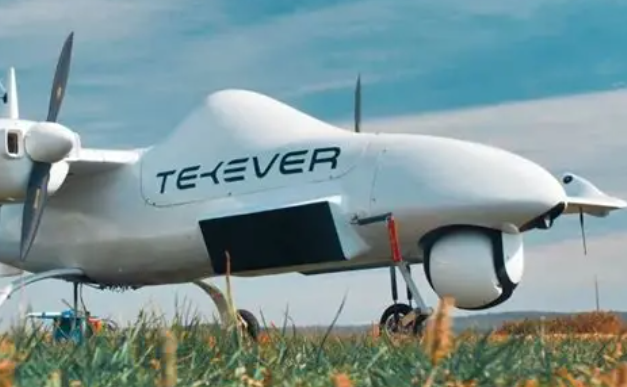
With a wingspan of approximately 3.5 metres and a length of around 1.7 metres, it is a fixed-wing reconnaissance platform built for longer missions, wider coverage, and persistent observation. The aircraft is launched by catapult, powered by a piston engine, and reportedly capable of remaining airborne for up to eight hours.
That endurance is strategically important.
Modern battlefield reconnaissance is no longer only about locating a target once. Military units need to observe routes, track movements, confirm changes, monitor artillery positions, and maintain awareness across large areas for extended periods.
A drone that can remain airborne for hours gives commanders more than imagery.
It gives them continuity.
Persistent surveillance helps reduce gaps in information and allows reconnaissance teams to follow developments as they happen. It can support target detection, battle-damage assessment, route monitoring, and broader intelligence gathering without constantly recovering and relaunching aircraft.
The 413th Regiment highlighted another major strength of the AR3: its modular architecture.
The aircraft’s payloads and communications equipment can be reconfigured quickly for specific missions. This allows the same basic platform to support different operational requirements rather than being permanently tied to one sensor, one communications system, or one task.
That flexibility is vital in Ukraine.
The electromagnetic environment can change rapidly. A communications setup that works in one sector may be ineffective in another. Different missions may require different observation sensors, data links, ranges, or methods of transmitting information back to operators.
A modular drone gives crews the ability to adapt the aircraft rather than replace it.
This can shorten preparation time, simplify logistics, and make the system more resilient as enemy countermeasures evolve.
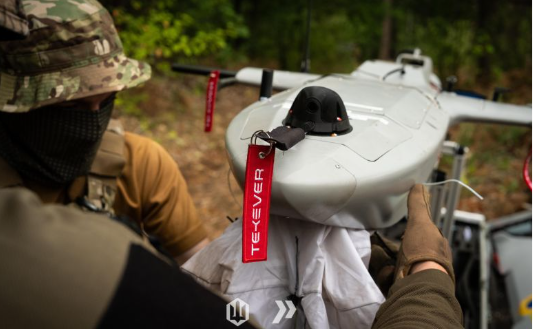
The unit’s public comments were accompanied by images of an experienced aerial reconnaissance crew from the regiment’s 4th Battalion deploying the AR3 in the field. According to the regiment, the operators began working with unmanned aircraft even before Ukraine formally established its Unmanned Systems Forces.
That experience matters.
Veteran drone crews understand the difference between a platform that performs well under ideal conditions and one that remains useful during real operations. They have dealt with signal interference, changing weather, difficult launch sites, equipment losses, and the pressure of providing accurate intelligence to units in combat.
Their endorsement suggests that the AR3’s value is not limited to technical specifications.
It is useful enough to earn a place in an operational reconnaissance arsenal.
The aircraft’s catapult launch system also provides practical advantages. It removes the need for a conventional runway and allows the drone to deploy from relatively austere locations. This can help crews operate closer to where intelligence is needed while remaining flexible about launch positions.
However, larger fixed-wing drones also face serious threats.
They can be targeted by air-defence systems, disrupted by electronic warfare, and detected through their communications or flight patterns. Their effectiveness depends not only on endurance and sensor quality, but also on mission planning, route selection, communications resilience, and the skill of the crew.
This is where modularity becomes more than an engineering feature.
It becomes part of survival.
The AR3 represents a wider evolution in unmanned warfare. Drones are no longer treated as single-purpose aircraft. Increasingly, they are designed as adaptable platforms that can change sensors, communications systems, and mission roles as operational demands shift.
For Ukraine’s reconnaissance units, that adaptability can determine whether intelligence reaches commanders in time.
The strongest validation of any military system does not come from a trade show, promotional video, or specification sheet.
It comes from experienced operators deploying it again—because they trust it to work when the mission matters.
For the 413th “Raid” Regiment, the TEKEVER AR3 appears to have earned that trust.