EASA “U‑space Light”. Europe’s Drone Dream Admits It’s Too Heavy to Fly
For years, Europe has been promising a seamless drone traffic management system. And for years, that promise has barely left the runway.
Now, in what may be the clearest admission yet that something went wrong, the European Commission and EASA are proposing a reset: “U‑space Light.” Stripped down, faster to deploy, and—crucially—less bureaucratically heavy, the concept aims to unlock what the current U‑space regulation has so far failed to deliver.
Because the reality is stark. Since the adoption of the U‑space regulation in January 2023, Europe has managed to establish just one limited U‑space area. Only a handful of service providers have been certified. For a continent that prides itself on regulatory leadership, the drone ecosystem has been stuck in slow motion.
“U‑space Light” is not an upgrade. It is a course correction.
At its core, the new concept acknowledges a fundamental mismatch: the existing framework is simply too complex for wide-scale implementation. Member States have struggled with the regulatory burden, certification requirements, and integration challenges. Operators, meanwhile, face lengthy approval processes that slow down innovation and deployment.
So EASA and the Commission are doing something unusual for regulators—they are simplifying.
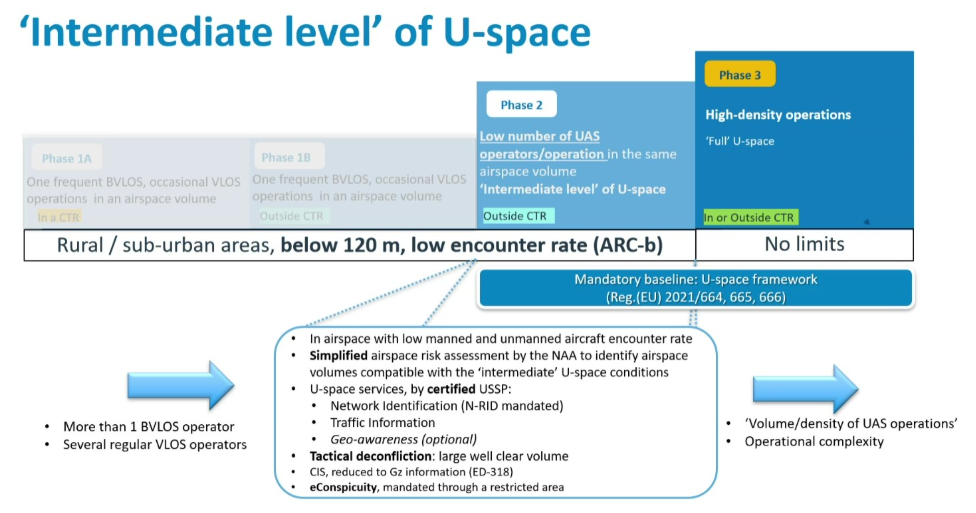
The proposal introduces a three-tier architecture: pre‑U‑space, intermediate, and full U‑space. This layered approach is designed to match regulation with operational reality, rather than forcing all drone operations into one heavy system.
The most disruptive piece is the “pre‑U‑space” level. Here, operations in rural and suburban environments could move forward without additional regulatory changes. In practice, this means systems already running in places like Dublin or the Port of Rotterdam could be effectively recognized within the U‑space framework—without waiting for a full regulatory rollout.
This is a quiet revolution.
For operators, the implications are immediate. Faster approvals. Lower costs. Less administrative friction. Perhaps most importantly, a realistic pathway to routine BVLOS (Beyond Visual Line of Sight) operations—the holy grail of the commercial drone industry.
And BVLOS changes everything.
From infrastructure inspection and logistics to security and emergency response, the ability to operate beyond the pilot’s line of sight is what turns drones from niche tools into scalable solutions. Europe has long had the technology—but not the regulatory speed. “U‑space Light” is designed to fix exactly that.
Another critical shift lies in how risk is handled. By integrating elements of the SORA 2.5 framework—particularly ground risk assessments—into U‑space architecture, parts of the operational approval process can be automated or absorbed by the system itself. In simple terms: the burden moves away from the operator and into the infrastructure.
Air risk, in some scenarios, may no longer be the operator’s problem.
But this is where the story becomes more complicated.
While simplifying regulation accelerates deployment, it also raises questions about consistency and safety. SORA itself is still evolving, with acknowledged gaps in areas such as navigation accuracy and collision risk assessment. The promise of reducing operator responsibility must be balanced against the reality that technical standards are still catching up.
In other words: Europe is removing friction—but also stepping into a moving target.
And yet, the urgency is undeniable. As one Commission representative put it, the question is no longer whether U‑space can be implemented—but how fast it can be deployed across Europe.
That shift—from “if” to “how fast”—is perhaps the most important takeaway.
Because globally, the race is already on. Other regions are experimenting, deploying, and scaling drone traffic systems at a pace Europe cannot ignore. The risk is no longer just technological lag—it is strategic irrelevance.
“U‑space Light” is Europe’s attempt to re-enter that race.
It is pragmatic. It is overdue. And it is slightly provocative in its own way—because it admits that the original vision, however well-intentioned, was too ambitious to implement as designed.
Now, the focus is different. Less perfection, more execution.
If it works, Europe could finally unlock the commercial drone economy it has been designing for years. If it fails, it won’t be for lack of vision—but for underestimating the complexity of turning regulation into reality.
Either way, one thing is clear: the future of European airspace will not be decided in policy papers—but in how quickly systems can move from concept to operation.
“U‑space Light” is the first real attempt to make that happen.