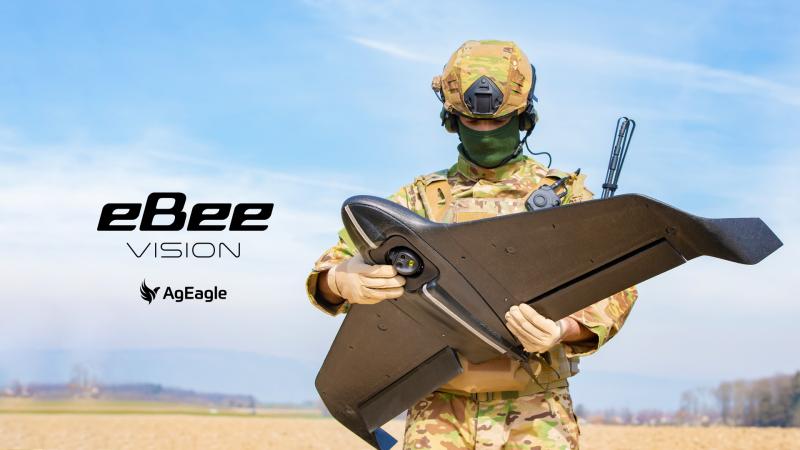
EagleNXT in Texas. Huge production of eBee Vision and MicaSense

The next battlefield might not start overseas.
It might start in Texas.
In a move that looks like another routine corporate relocation on the surface, EagleNXT—a drone manufacturer supplying the U.S. Army—has officially opened its new production hub in Allen, North Texas. But behind the press releases and economic development language, something far bigger is happening.
Texas isn’t just attracting tech companies anymore.
It’s becoming a strategic hub for autonomous warfare infrastructure.
From Agriculture to Autonomy
EagleNXT’s story follows a familiar trajectory in the drone industry.
Founded in 2010 as AgEagle Aerial Systems in Wichita, Kansas, the company began with agricultural drones—tools for monitoring crops, improving yields, and optimizing farmland operations.
Today, it’s a different game.
EagleNXT now builds drones for multiple sectors, including defense, and its portfolio is no longer limited to observation. Its expansion into counter-drone systems and loitering munitions marks a decisive shift toward military-grade capabilities.
This is not a pivot.
This is an evolution of the entire drone industry.
Why Texas, Why Now
The company announced the move earlier this year, positioning Allen as its “central hub”—a strategic anchor point supported by an additional facility in Switzerland.
The reasoning was straightforward: access to talent, infrastructure, and economic opportunity.
But that explanation, while true, is incomplete.
Because Texas is no longer just a favorable business environment—it is rapidly becoming a convergence point for three critical technologies:
- Defense manufacturing
- AI and data infrastructure
- Autonomous systems
In recent years, the Dallas-Fort Worth metroplex has seen a surge in AI data centers, semiconductor facilities, and advanced tech campuses. The result is not just economic growth—it is capability concentration.
And capability concentration is exactly what defines strategic advantage.
The New Industrial Stack
At the heart of EagleNXT’s Texas expansion is production of systems that reflect the new reality of warfare.
Among them: ThirdEye USA counter-drone technologies, designed to detect and track unmanned aerial systems.
That alone tells you something important.
The future of conflict is not just about deploying drones.
It’s about defending against them.
And EagleNXT is positioning itself on both sides of that equation.
Earlier moves reinforce this strategy:
- A $10 million investment into an Israeli counter-drone company
- A partnership with a developer of loitering munitions—drones that are designed to self-destruct on target
These are not experimental technologies.
They are operational tools shaping modern battlefields—from Ukraine to the Middle East.
The Geography of Power Is Changing
For decades, defense manufacturing in the U.S. has been tied to traditional industrial hubs—California, Virginia, the Northeast.
But that map is shifting.
Texas offers something different:
- Space to scale manufacturing
- Regulatory flexibility
- Proximity to a rapidly growing tech ecosystem
- Political alignment with defense priorities
As more companies follow EagleNXT, Texas risks becoming something it hasn’t historically been:
the center of gravity for autonomous defense systems.
That has implications beyond economics.
Because where systems are built often determines
where capabilities are developed,
where talent migrates,
and ultimately,
where strategic decisions are influenced.
More Than Just a Company Move
EagleNXT’s relocation is not an isolated event.
It’s a signal.
A signal that the drone industry is maturing—moving from fragmented innovation to integrated industrial ecosystems.
A signal that autonomy is no longer a niche capability—it is becoming core defense infrastructure.
And perhaps most importantly, a signal that geography still matters in a digital age.
Because even in an era of AI and software-defined warfare,
hardware still has to be built somewhere.
And increasingly, that “somewhere” is Texas.
The Bigger Question
The question is no longer whether drones will define the future of warfare.
They will.
The real question is:
👉 Who will control the ecosystem behind them?
Companies like EagleNXT are part of the answer.
But Texas may be the bigger story.
Because while the world is watching drones in the sky,
the real shift is happening on the ground—
in factories, supply chains, and strategic relocations that will define the next phase of global competition.