CHASING X. The Compact ROV Challenging Offshore Inspection Giants
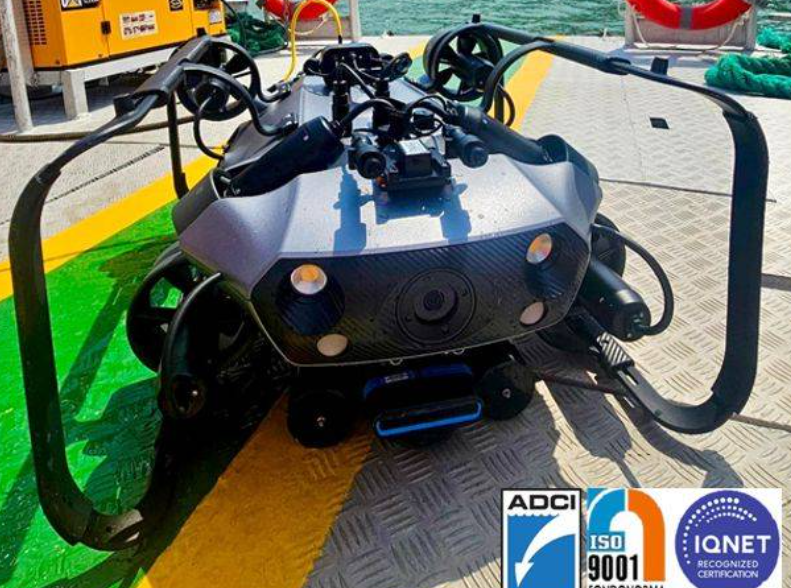
Complex underwater surveys demanded large work-class remotely operated vehicles (ROVs), specialized vessels, extensive crews, and logistics budgets that could quickly climb into six figures. Whether inspecting oil platforms, underwater pipelines, or critical infrastructure, operators accepted that serious subsea work came with serious overhead.
CHASING X is challenging that assumption.
The industrial ROV, developed by underwater robotics manufacturer CHASING, represents a growing shift in offshore operations: delivering engineering-grade inspection data without the footprint traditionally associated with subsea intervention.
As offshore industries face increasing pressure to reduce costs while gathering more actionable information, platforms like CHASING X are emerging as a compelling alternative.
More Than an Underwater Camera
The biggest misconception about modern lightweight ROVs is that they are simply cameras underwater.
CHASING X was designed around a different philosophy.
Rather than serving as a video platform, it functions as a subsea data collection system capable of integrating multiple inspection technologies within a single mission.
Equipped with a 4K low-light camera, 12,000-lumen illumination, and an open payload architecture, the system can support multibeam sonar, Doppler Velocity Log (DVL) navigation, USBL positioning systems, ultrasonic thickness measurement tools, cathodic protection probes, and advanced 3D scanning equipment.
The result is a platform capable of collecting far more than visual evidence.
It can deliver measurable engineering intelligence.
For asset owners managing aging offshore infrastructure, that distinction is critical.
Built for the Realities of Offshore Operations
Offshore inspections rarely happen in ideal conditions.
Currents, low visibility, marine growth, confined structures, and long linear assets create challenges that demand stability and precision.
CHASING X was developed specifically for these environments.
Rated to depths of 350 meters and capable of operating in currents up to 4.5 knots, the platform can maintain position while carrying mission-specific payloads.
This capability allows operators to adapt the ROV to the inspection objective rather than adapting the inspection to the limitations of the vehicle.
That flexibility is becoming increasingly valuable as offshore projects become more diverse.
A pipeline survey, platform inspection, and wind-energy assessment require different datasets, different sensors, and different workflows.
CHASING X was built to accommodate all three.
Proven in the Field
Recent deployments demonstrate how the platform is moving beyond theory into operational reality.
In Venezuela, marine engineering company INMARVENCO C.A. deployed CHASING X for offshore platform inspections. The project combined 4K optical imaging, multibeam sonar, ultrasonic thickness measurements, cathodic protection analysis, and 3D structural scanning into a single inspection workflow.
Instead of relying on separate campaigns and multiple technologies deployed independently, engineers were able to collect multiple data layers simultaneously.
The result was a richer understanding of asset condition and a stronger foundation for future comparison.
A second deployment in Lake Maracaibo highlighted another strength of the platform.
Tasked with inspecting more than four kilometers of nearshore gas pipeline in low-visibility conditions, CHASING X combined sonar imaging, acoustic positioning systems, and nondestructive testing tools to maintain accurate asset tracking while collecting structural integrity data.
In environments where visibility alone cannot guarantee inspection quality, sensor fusion becomes the key to success.
The Economics of Smaller Systems
Perhaps the most disruptive aspect of CHASING X is not its technology.
It is its economics.
Traditional work-class ROV operations often require large mobilizations, dedicated support vessels, launch-and-recovery systems, and sizable technical teams.
CHASING X offers a different operating model.
Its compact footprint enables deployment from smaller vessels while reducing logistical complexity. This creates opportunities for more frequent inspections, faster project execution, and lower operational costs.
For offshore operators facing growing infrastructure maintenance demands, this approach can fundamentally change inspection planning.
Instead of waiting for major campaigns, inspections become more accessible, repeatable, and data-driven.
A New Generation of Offshore Robotics
CHASING X arrives at a time when the offshore sector is demanding more information than ever before.
Asset owners want measurable data, digital records, predictive maintenance insights, and repeatable inspection methodologies.
The future belongs not to systems that simply observe underwater structures but to those that transform observations into actionable intelligence.
That is where CHASING X is carving out its niche.
It does not aim to replace every diver or every work-class ROV.
Instead, it is proving that a compact industrial robot can deliver high-value inspection data once associated only with far larger and more expensive offshore systems.
In an industry traditionally dominated by scale, CHASING X is demonstrating a powerful new idea:
Sometimes the most disruptive technology isn't bigger. It's smarter.
%20(1)%20(1).jpg)