Blue UAS - The Quiet List Redrawing America’s Drone Industry

For drone pilots, buyers, and manufacturers, Blue UAS has become one of the most misunderstood—and most powerful—phrases in U.S. aviation. Some treat it like a government blacklist. Others assume it’s a mandatory gateway to sell anything to Washington.
It’s neither. And that confusion matters.
At its core, the Blue UAS Cleared List is a procurement accelerator: a catalog of drones and components that have already cleared U.S. Department of Defense (DoD) security, cybersecurity, and supply‑chain scrutiny. It exists to save time in a system that normally moves at bureaucratic speed.
But in practice, Blue UAS is doing something much bigger. It’s reshaping the U.S. drone market by quietly deciding which companies scale—and which ones stall.
What Blue UAS actually is (and isn’t)
Blue UAS began as a Defense Innovation Unit (DIU) effort and officially transitioned to the Defense Contract Management Agency (DCMA) in late 2025. Today, it functions as a trusted marketplace of National Defense Authorization Act (NDAA)–compliant systems that DoD units can buy without filing case‑by‑case exceptions.
Importantly:
Blue UAS is not a legal requirement to sell to the U.S. government.
Any DoD organization can still buy a non‑Blue drone if it completes its own internal compliance checks. Blue UAS simply removes friction—and in government procurement, friction is often the real enemy.
That’s why being “Blue‑cleared” is less about permission and more about velocity.
What’s on the list—and why it signals the future
As of early 2026, the Cleared List includes 50+ platforms across reconnaissance, FPV, VTOL fixed‑wing, and heavy‑lift categories. Skydio, Teal, Freefly, Parrot, Shield AI, Anduril, AeroVironment, and Quantum Systems are all present—alongside smaller, highly specialized manufacturers.
As of early 2026, the Blue UAS Cleared List includes more than 50 platforms from a wide range of U.S. and allied manufacturers. Many (though not all) come from American drone companies. Here’s a sampling of notable entries (note this is not a complete list):
- ACSL has earned a spot on the list with its ACSL-PF2.
- AeroVironment appears with the Red Dragon.
- Anduril Industries appears with its Ghost/Ghost-X platform.
- Eagle NXT (agEagle Aerial Systems) is listed with the eBee TAC and eBee Vision.
- Freefly Systems has multiple platforms on the list, including the Alta X Blue Package and the Astro/Max.
- Inspired Flight Technologies has two entries: the IF800 and the IF1200A.
- ModalAI has a strong presence with the Seeker Vision FPV (in 7-inch, 10-inch, and standard configurations) as well as the Stinger Vision FPV.
- Parrot, the French drone maker, has a few approved variants, including drones in its ANAFI USA line.
- Shield AI is listed with the V-BAT, a vertical takeoff and landing fixed-wing drone.
- Skydio holds arguably the most entries on the Select List, with the Skydio X2D EO/IR (multiple frequency variants), the X10D, and the X2D all earning approval. Skydio is an American manufacturer and has positioned itself as a DJI alternative for government and enterprise.
- Teal (a Red Cat company) has three entries: Teal 2, Teal Golden Eagle at 1.8 GHz, and Teal Golden Eagle at 2.4 GHz.
- Vantage Robotics has two platforms on the list: the Trace and the Vesper.
- Wingtra appears with the WingtraRay.
Other manufacturers with cleared platforms include Auterion, Ascent AeroSystems, Quantum Systems and FlightWave Aerospace .
This diversity isn’t accidental. Blue UAS is no longer optimizing for one “perfect drone.” It’s optimizing for resilience, scale, and mission fit, informed heavily by real‑world lessons from Ukraine and other modern conflicts.
If a category matters on today’s battlefield—FPV, denied‑GPS navigation, rapid attrition—it’s increasingly showing up on Blue.
- ARK Electronics (multiple flight controllers, GNSS modules, data transmission devices)
- CubePilot (Cube Blue, Cube Orange, Cube Orange+, and others)
- ModalAI (VOXL 2, VOXL 2 Mini, flight controllers, radios, cameras)
- Silvus Technologies (StreamCaster radio series)
- Teledyne FLIR (thermal cameras including Boson+ 640, FLIR BOSON 640, Hadron 640R)
- NVIDIA (Jetson Xavier NX, Jetson Orin NX, Jetson AGX Orin — approved as companion computers)
- Raspberry Pi (CM4, Pi 4 Model B, Pi 5 in 4GB and 8GB variants)
- Doodle Labs (Embedded Mesh Rider, mini-OEM variants, Nimble and Long-Range transceivers)
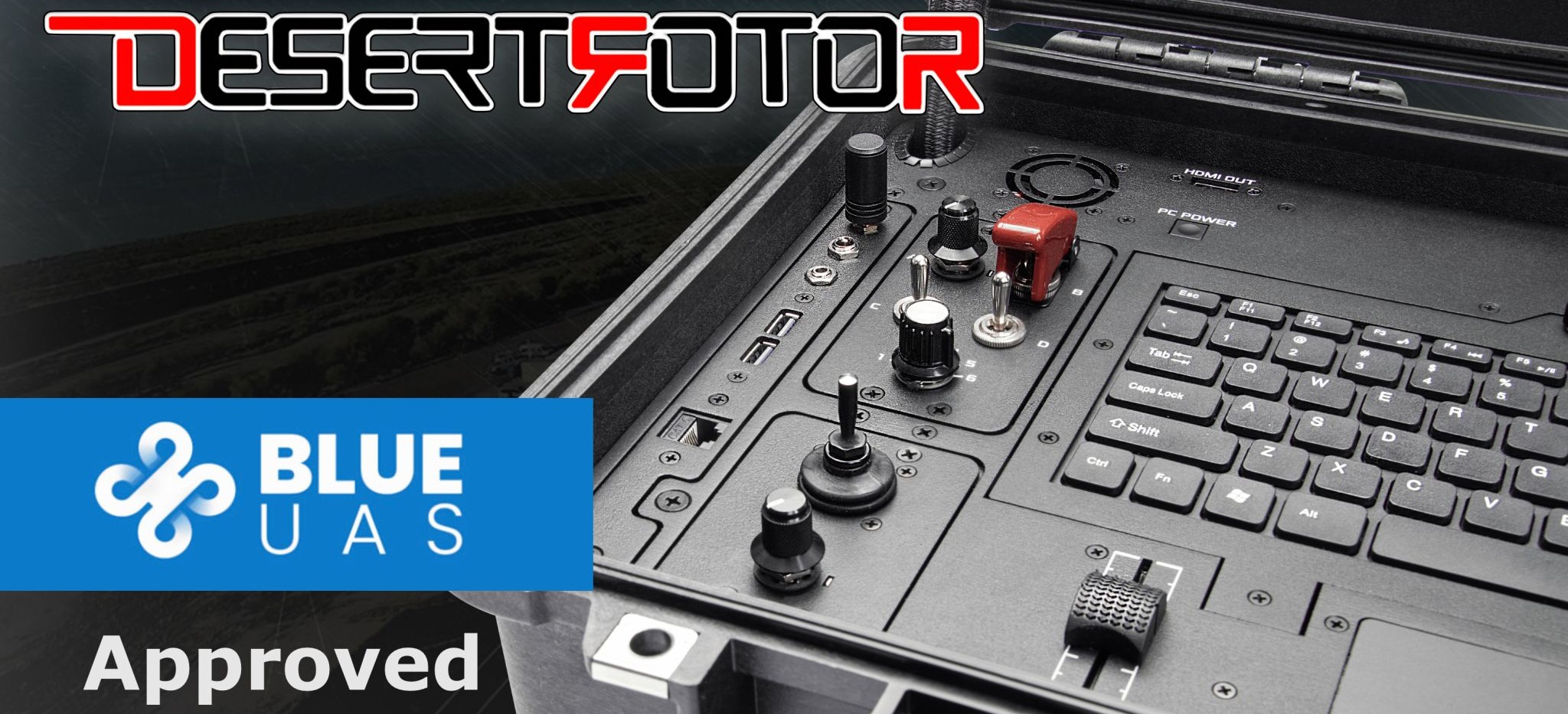
- Panasonic (TOUGHBOOK 55 and TOUGHBOOK G2 as approved ground control systems)
The Framework: where the real leverage lives
The most overlooked part of the program isn’t the aircraft—it’s the Blue UAS Framework.
The Framework is a vetted catalog of individual components: flight controllers, radios, cameras, GNSS modules, companion computers, and ground control systems. NVIDIA Jetson modules, Teledyne FLIR sensors, CubePilot controllers, ModalAI VOXL computers, Silvus radios, even Raspberry Pi variants all appear—when properly configured.
This matters because Blue UAS isn’t pushing a single national drone champion. It’s enabling a modular, Lego‑style defense ecosystem, where trusted parts can be assembled into mission‑specific systems faster than traditional programs of record ever could.
In other words: Blue UAS doesn’t just approve drones.
It approves building blocks.
How companies get “Blue”
There are three main paths:
- DoD sponsorship by an operational customer
- Competitive DIU processes (CSOs, prize challenges, refresh events)
- Recognized third‑party assessors verifying NDAA compliance
Any meaningful change to hardware, software, or supply chain? Back to review. Blue clearance applies only to the exact configuration listed.
That strictness is deliberate. Trust, in this system, is granular.
The 2025 memo that changed the tone
In July 2025, the Secretary of Defense issued a blunt memo: Unleashing U.S. Military Drone Dominance. Its message was clear—speed over paperwork, scale over perfection.
In response, DCMA simplified pathways onto the Blue List, expanded assessor coverage, and reframed Blue UAS not as a gatekeeper—but as an enabler. The gloves came off. The backlog started shrinking.
Why this matters—even if you’re not military
If you fly for public safety, infrastructure, or enterprise clients that touch federal contracts, Blue UAS is a market signal. If you build drones, it’s a roadmap for what architectures, components, and supply chains will survive policy gravity.
And if someone tells you, “Your drone must be Blue to sell to government”?
They’re wrong.
But if they tell you Blue UAS is shaping who wins the next decade of U.S. drone manufacturing?
They’re absolutely right.
.png)