200 Kilometers, 20 Kilograms, Zero Runway. Has Dufour Aerospace Just Solved the Drone Logistics Equation?
The drone industry has spent years making promises about the future of logistics. Autonomous deliveries. Remote supply chains. Flying cargo that bypasses congested roads and inaccessible terrain. Yet despite billions invested across the sector, one challenge has remained stubbornly difficult to overcome:
Can a drone carry a meaningful payload over a commercially relevant distance while operating without a runway?
Dufour Aerospace believes the answer is now yes.
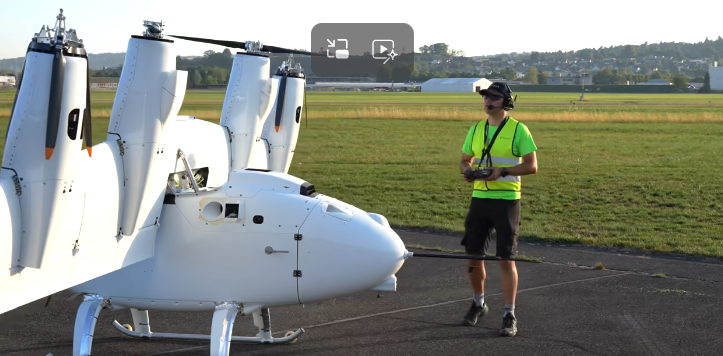
The Swiss aerospace company has announced the successful completion of a flight campaign demonstrating a 20-kilogram payload transported over 200 kilometers with its Aero-200 platform. While those numbers may not sound revolutionary at first glance, industry experts know they represent one of the most difficult combinations to achieve in unmanned aviation.
Payload, range, and vertical takeoff capability rarely coexist in harmony.
Increase payload and range suffers.
Increase range and payload shrinks.
Add VTOL capability and efficiency often takes another hit.
The Aero-200 appears to challenge that equation.
Developed as a hybrid-electric tilt-wing eVTOL, the aircraft combines helicopter-like vertical takeoff and landing with the aerodynamic efficiency of fixed-wing flight. This approach aims to offer operators the best of both worlds: runway-independent operations and long-range endurance.
The latest campaign, conducted from Dübendorf Airfield near Zurich, demonstrated the platform's ability to transport a 20 kg payload over 200 km while operating in temperatures reaching 33°C at sea level. More importantly, the tests validated improvements to both the propulsion system and aircraft structure, moving the platform closer to production configuration.
For an industry increasingly focused on real-world utility rather than record-breaking demonstrations, this distinction matters.
Many drone achievements generate headlines but fail to translate into commercial value. Flying long distances without payload is relatively easy. Flying heavy payloads over short distances is also achievable. Commercial logistics, however, demands both simultaneously.
That is where the Aero-200 is positioning itself.
The aircraft has been designed for missions where traditional transport solutions are constrained by geography, infrastructure, or urgency. Potential applications include medical resupply, emergency response, industrial spare-parts delivery, transportation of high-value sensors, and logistics support for remote communities.
Imagine a hospital needing critical medical supplies delivered immediately.
Or an industrial facility waiting for a replacement component that could prevent a costly production shutdown.
Or emergency responders requiring rapid deployment of equipment into disaster zones where roads have become inaccessible.
These are the scenarios where long-range VTOL cargo drones could create genuine economic value.
According to Dufour Aerospace Chief Engineer Timon Wehmann, the latest campaign demonstrated not only distance and payload capability but also operational stability throughout the mission profile.
Yet hardware performance alone will not determine industry success.
One of the most interesting aspects of the Aero-200 program is Dufour Aerospace's focus on operational infrastructure. The company appears to understand that commercial drone logistics requires far more than building a capable aircraft.
It requires an ecosystem.
Remote operations, flight management, contingency handling, regulatory compliance, operational robustness, and scalable deployment frameworks are increasingly becoming as important as the aircraft itself.
Earlier this year, Dufour Aerospace demonstrated guidance flights in Sweden while controlling the aircraft entirely from its Remote Control Room in Switzerland. This achievement showcased a critical future capability: separating the location of the operator from the location of the aircraft.
That may sound simple, but it represents a foundational building block for routine Beyond Visual Line of Sight (BVLOS) operations.
Without BVLOS capability, large-scale drone logistics remains impossible.
With it, entirely new logistics networks become feasible.
CEO Sascha Hardegger emphasizes that the company is now approaching the Aero-200's production configuration. That statement may be even more significant than the latest flight campaign itself.
The drone industry has no shortage of prototypes.
What it needs are certified, scalable, commercially deployed systems that solve real customer problems.
Dufour Aerospace appears determined to cross that bridge.
The successful demonstration of a 20 kg payload over 200 km does not mean drone logistics has arrived overnight. Regulatory challenges remain. Infrastructure must continue to evolve. Market adoption still has to be earned.
But the Aero-200 milestone sends a clear signal.
The conversation is no longer about whether long-range cargo drones are technically possible.
The conversation is increasingly about how soon they will become routine.
And for an industry chasing commercial relevance, that may be the most important milestone of all.