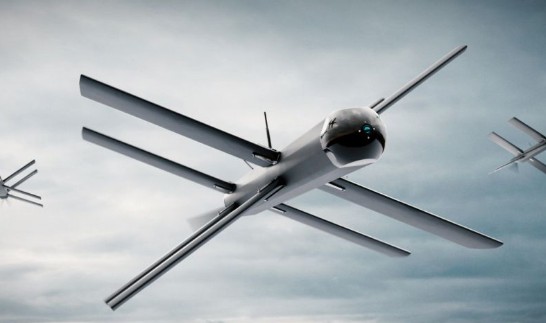
Why the Arctic Is Becoming a Drone Battlespace - And Why Europe Is Falling Behind

For decades, the Arctic was treated as a remote periphery. A frozen buffer zone. A geographic afterthought.
That era is over.
The High North and the Arctic are rapidly emerging as one of the most strategically decisive regions for NATO’s future defense posture. At the center of this shift sits Greenland – not just a massive island of ice, but a geostrategic hinge connecting North America, Europe, and Eurasia.
What makes this region different from past flashpoints is not only geography. It is the way modern technology – especially unmanned systems, sensors, and space-linked networks – is reshaping how power is projected and contested.
The Arctic is quietly becoming a drone battlespace.
Greenland: The Silent Backbone of Missile and Air Defense
Greenland occupies the shortest flight and missile route between North America and Russia. That alone gives it enormous importance for early warning, air defense, and missile interception.
Any system designed to detect, track, and classify ballistic missiles or strategic bombers benefits from sensors positioned in this corridor. Radar installations, satellite uplinks, and increasingly unmanned airborne ISR platforms form a layered architecture.
Long-endurance drones are particularly well-suited for this environment.
They can:
- Maintain persistent wide-area surveillance
- Fill gaps between satellite passes
- Track air and maritime movements
- Provide early cueing for air defense networks
In an Arctic environment where building large permanent infrastructure is costly and slow, unmanned systems offer a flexible alternative.
Instead of building more bases, you deploy more sensors.
The GIUK Gap and the Rise of Maritime Drones
Greenland, Iceland, and the United Kingdom form the so-called GIUK gap – the most important maritime and subsea passage between the Arctic Ocean and the North Atlantic.
This corridor determines whether Russian surface vessels and strategic submarines can access the Atlantic.
Traditionally, this mission relied on manned patrol aircraft, frigates, and fixed sonar arrays.
Today, unmanned systems are increasingly central:
- Long-endurance maritime drones
- Autonomous surface vessels
- Uncrewed underwater vehicles
- Networked sonobuoy fields
These platforms create persistent, layered maritime awareness at a fraction of the cost of continuous manned patrols.
Whoever controls the data picture in the GIUK gap controls the tempo of any future transatlantic conflict.
Climate Change Is Expanding the Battlespace
Melting ice is opening new sea routes and extending the seasonal operating window in the Arctic.
This has two consequences.
First, commercial traffic will increase.
Second, military access will expand.
More traffic means more opportunities for concealment, intelligence collection, and grey-zone operations.
Drones thrive in these conditions.
They can loiter, observe, and classify activity without escalating tensions the way manned patrols often do.
The Arctic’s future security architecture will be sensor-heavy, networked, and increasingly unmanned.
Europe’s Strategic Problem: No Long-Term Design
One of the most striking conclusions of the source article is not about hardware.
It is about mindset.
The United States continues to operate with long-term geopolitical concepts that link territory, resources, technology, and autonomy. Historical ideas such as continental self-sufficiency and hemispheric control still shape American strategic thinking.
Europe, by contrast, lacks a comparable long-term geopolitical blueprint.
Policy remains reactive.
Procurement remains slow.
Technological adoption is fragmented.
This matters deeply in a domain like the Arctic, where advantage is built gradually through infrastructure, data networks, and persistent presence.
Drones do not deliver strategic impact by themselves.
They deliver it when embedded into a coherent architecture.
European Presence in Greenland Is About More Than Troops
A European NATO presence in Greenland would not only signal political solidarity.
It would enable experimentation.
Joint Arctic drone units.
Forward ISR detachments.
Persistent sensor trials.
Cold-weather autonomy testing.
Greenland could become a live laboratory for:
- Extreme-weather drone operations
- Satellite-denied navigation
- Long-endurance ISR concepts
- Hybrid space-air-sea sensor fusion
Instead, Europe largely observes while others build.
The Shadow War in Space and the Implications for Drones
The article references recent demonstrations of satellite jamming capabilities, including interference with Starlink systems.
This is not a side issue.
Drones depend heavily on satellite navigation, timing, and communications.
Arctic operations amplify this dependence.
A future Arctic fight will include:
- GPS denial
- Satellite jamming
- Cyber interference
- Data link disruption
This pushes drone design toward:
- Resilient navigation
- Autonomy-first architectures
- Local decision-making
- Mesh networking
Nations that cannot field drones capable of operating in degraded space environments will lose relevance fast.
The Real Message
Greenland is not just about territory.
It is about control of sensor geometry, data flows, and decision timelines.
The Arctic is becoming a testbed for how modern military power works:
Distributed sensors.
Persistent ISR.
Autonomous platforms.
Software-defined defense.
Europe’s choice is simple.
Either it helps shape this architecture – including through serious investment in Arctic-capable unmanned systems – or it accepts a future where others define it.
The Arctic is no longer a frozen backwater.
It is becoming one of the world’s most important drone frontiers.
And the race has already begun.