The Last 25 Meters. How Ukraine Is Turning a Pocket-Sized Device Into a Drone Killer
The future of warfare may not be decided by billion-dollar weapons systems.
It may be decided by 365 grams.
As drone warfare reshapes battlefields from Eastern Europe to the Middle East, one of the deadliest threats facing soldiers today isn't a fighter jet, a tank, or a missile. It's an FPV drone: small, cheap, fast, and often carrying enough explosives to kill a soldier or destroy a vehicle.
For years, militaries have searched for ways to stop them. Electronic warfare systems jam signals. Air-defense systems try to detect them. Specialized anti-drone weapons attempt to shoot them down.
But what happens when all of that fails?
What happens when the drone is already there?
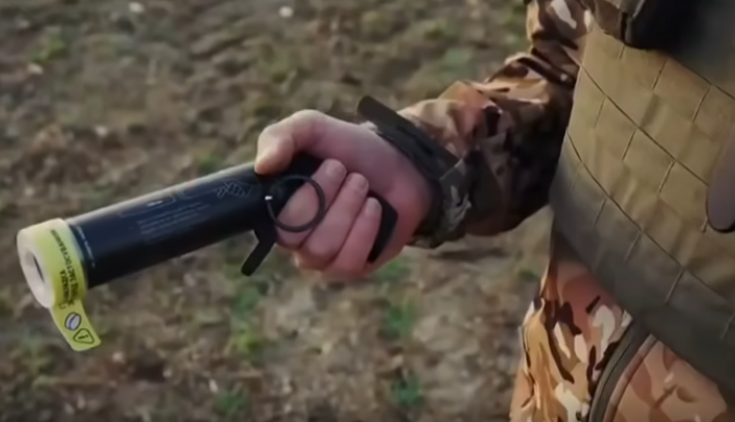
That's the problem Ukrainian defense company TENETA set out to solve with MITLA, a disposable pocket-sized anti-drone device designed for the most terrifying moment in modern combat: the last few seconds before impact.
A New Kind of Battlefield Problem
FPV drones have changed the economics of war.
For a few hundred dollars, an attacker can field a weapon capable of threatening equipment worth millions. More importantly, FPV drones bring danger directly to individual soldiers. The battlefield is no longer measured in kilometers. It's measured in seconds.
Traditional defenses were never designed for this reality.
A radar can detect a drone.
A jammer can interfere with it.
A rifle might hit it.
But none of these solutions guarantee survival when an FPV drone suddenly appears at close range and races toward its target.
This is where MITLA enters the picture.
Designed for the Last Chance
MITLA is astonishingly simple.
Weighing only 365 grams, it is small enough to fit into a pocket or magazine pouch. Instead of attempting to destroy the drone with bullets or explosives, the device launches a specially designed net.
Inside the launcher, a 7.62 mm cartridge provides the energy needed for deployment. Once activated, the net expands to approximately 3.5 by 3.5 meters in only 0.2 seconds.
The concept is elegantly brutal.
Rather than trying to hit a rapidly moving drone with pinpoint accuracy, MITLA creates a temporary airborne trap. If the drone enters that space, the net tangles its propellers and immediately neutralizes its ability to fly.
According to the published specifications, the system is effective at distances of up to 25 meters.
In combat terms, that's not long range.
It's the moment when a soldier can already hear the drone.
The moment when there is almost no time left to think.
The Beauty of Simple Innovation
Military innovation is often associated with complexity.
Artificial intelligence.
Hypersonic missiles.
Satellite networks.
Yet history repeatedly demonstrates that some of the most influential battlefield inventions are remarkably simple.
Barbed wire.
The jerrycan.
The tourniquet.
MITLA belongs to this tradition.
Its brilliance lies not in advanced software or expensive components, but in its understanding of a basic reality: soldiers need something they can carry everywhere, deploy instantly, and trust under extreme stress.
A solution that costs less than the threat it is intended to defeat makes strategic sense.
A solution that fits in a pocket may ultimately prove even more valuable.
Ukraine's Innovation Laboratory
The war in Ukraine has effectively become the world's most intense defense innovation laboratory.
Faced with evolving threats and limited resources, Ukrainian engineers and manufacturers have developed systems at a pace that many larger defense industries struggle to match.
MITLA reflects that approach.
It is not trying to win the entire drone war.
It is trying to solve a single problem exceptionally well.
The final 25 meters.
The final two seconds.
The final opportunity.
And in modern warfare, that may be enough.
Because when a drone is already on top of you, nobody cares about elegant PowerPoint presentations, procurement strategies, or defense budgets.
You care about survival.
Sometimes survival comes from cutting-edge technology.
Sometimes it comes from a net.
And sometimes that net fits in your pocket.