Spain’s drone boom with ECUAS
Spain’s drone economy looks like a success story—until you ask a brutally simple question: where are the scaled operations? The country closed 2025 with 150,332 registered UAS operators, a figure boosted by tens of thousands of new registrations in a single year. But behind that headline sits an uncomfortable reality the sector has been saying out loud for a while: growth in registrations hasn’t translated into growth in real, repeatable, high‑value missions.
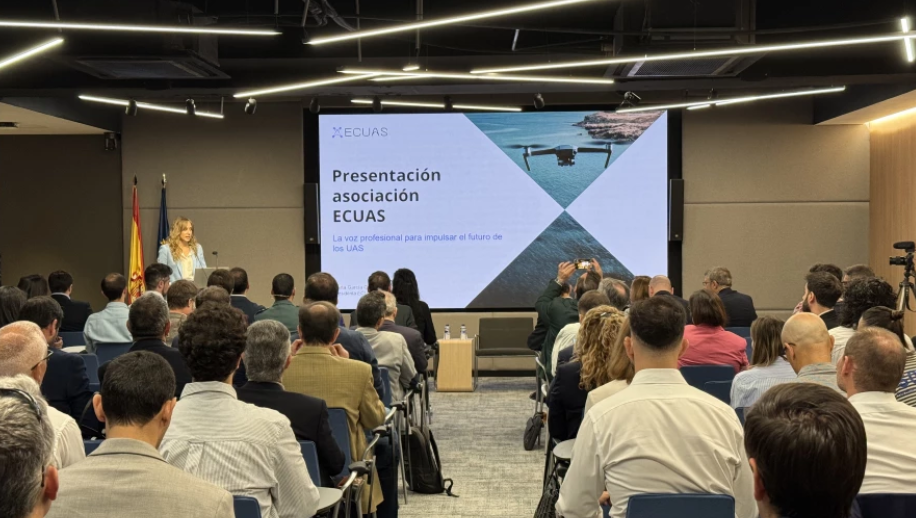
That mismatch is exactly why ECUAS has been launched—an industry association formed by operators, manufacturers, and flight‑test centers with an explicit mission: push regulation and operations forward, in Spain and across Europe.
It’s a telling moment. Drone technology has matured. Use cases are everywhere—infrastructure inspection, precision agriculture, environmental monitoring, logistics, security, defense, and Earth observation. And yet the sector keeps running into the same invisible wall: operational permissioning and regulatory inconsistency.
The real bottleneck isn’t tech. It’s “permission to operate.”
ECUAS is betting that the next leap won’t come from another sensor or another airframe. It will come from a cleaner, faster, more harmonized path through the rules—especially the rules that govern BVLOS (Beyond Visual Line of Sight), the gateway to missions that actually scale.
That’s the core fight: BVLOS is where drones stop being “cool gadgets” and become infrastructure—the kind of capability that can underpin recurring revenue in logistics corridors, long linear inspections, emergency response, and wide‑area monitoring. ECUAS is openly positioning BVLOS as the unlock for “higher value‑added” operations.
But the industry’s frustration is also distinctly European: the regulatory framework exists, yet implementation differs by country, making cross‑border operations slower, more complex, and often inconsistent. In practice, a company cleared in Spain may still face additional hurdles elsewhere—hardly the frictionless single market the drone sector was promised.
A “single voice” strategy—because fragmentation is expensive
ECUAS describes itself as the professional voice of the UAS ecosystem in Spain, explicitly representing manufacturers, operators, and flight‑test centers and aiming to connect industry, regulation, and technology. That “single voice” goal is not PR fluff; it’s a power play.
Because today’s drone industry is still too fragmented: platforms here, operators there, test centers elsewhere—each lobbying independently, each translating regulatory updates differently, each rebuilding compliance playbooks in parallel. ECUAS is trying to turn that chaos into a coordinated agenda: simplify procedures, raise technical standards, and enable expansion across Europe.
Reports around the launch put ECUAS at around 17 founding entities, with growth expected. The message is clear: this is meant to be a serious interlocutor—especially with AESA and EASA—at a time when simplification and operational scaling are the industry’s obsession.
The uncomfortable truth: drones are regulated like prototypes, but expected to behave like utilities
AESA’s own figures show a booming operator base and major regulatory developments (including progress on risk methodologies and compliance paths). Yet the “market reality” gap remains—and ECUAS is essentially calling it out: the sector has technology and infrastructure, but getting from capability to commercial operations is still not simple.
And that is the provocation ECUAS brings to the table: Spain doesn’t need more drones. It needs more permissioned, repeatable, scalable operations. If ECUAS succeeds, the drone conversation shifts from “innovation” to industrialization—and from “pilots” to systems.
In short: the Spanish drone sector is done waiting for the future. It’s forming a trade association to force the future to become operational.