Small Payload, Big Intelligence: Gremsy’s KESTREL Gives Compact Drones a Tactical Edge
In the drone industry, bigger is not always better.
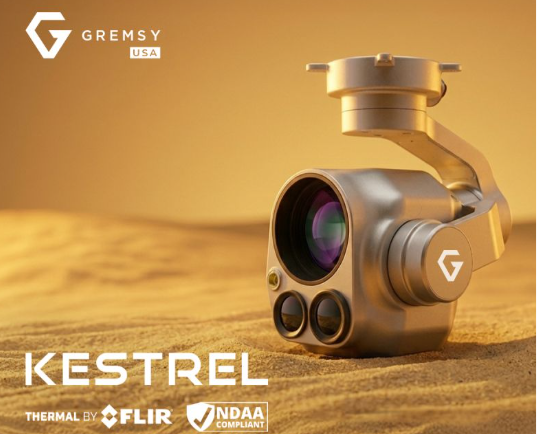
For many public-safety, border-security and government missions, the real advantage comes from fitting more sensing power onto a smaller aircraft. That is the idea behind KESTREL, Gremsy USA’s ultra-compact EO/IR payload designed for UAV platforms where size, weight and power are tightly limited.
Gremsy has now launched a dedicated KESTREL product page following strong interest at major UAV events across North America, Europe and the Asia-Pacific region. The new page is intended to give operators, manufacturers and system integrators a clearer view of the platform’s capabilities and integration potential.
At the centre of KESTREL’s appeal is its balance between compact size and mission performance.
The payload combines electro-optical and infrared imaging with 52x total zoom, allowing small unmanned aircraft to provide detailed aerial observation in fast-moving situations. This makes it relevant for intelligence, surveillance and reconnaissance missions, drone-as-first-responder operations, public safety, border monitoring and infrastructure inspection.
These are environments where speed matters.
Police, firefighters, security teams and emergency operators often need an aerial view within minutes, not after a large aircraft has been prepared and deployed. Smaller drones can launch quickly, operate from confined spaces and move with greater flexibility than larger UAV systems.
However, small aircraft create a difficult engineering problem.
Every additional gram reduces endurance. Every extra watt places more pressure on the battery. Larger payloads can affect flight stability, range and operational time.
This is why SWaP efficiency—size, weight and power—has become one of the most important factors in UAV payload design.
KESTREL is built specifically for SWaP-constrained platforms. Its ultra-light form factor is intended to allow manufacturers and operators to integrate advanced ISR functions without turning a compact drone into an overloaded and inefficient system.
That could significantly expand the missions available to smaller UAVs.
A lightweight observation drone could monitor critical infrastructure, support search-and-rescue teams, follow a developing incident or provide real-time awareness along a border. In a drone-as-first-responder role, it could arrive before ground units and transmit useful visual information directly to decision-makers.
The 52x zoom capability is particularly important.
A drone may need to remain at a safe or legally compliant distance while still identifying objects, vehicles, damage or possible threats. Strong zoom performance can provide that reach without forcing the aircraft to fly dangerously close to the target.
The EO/IR combination also gives operators more flexibility across different lighting conditions. Standard visual sensors are useful during daylight, while infrared imaging can support low-light operations, heat detection and night-time observation.
Another key feature is NDAA compliance.
For government agencies and contractors, supply-chain requirements can be as important as optical performance. NDAA-compliant equipment may be necessary for certain public-sector, defence-adjacent or federally funded applications in the United States.
By combining compliance with compact size, KESTREL could become attractive not only to end users, but also to UAV manufacturers looking for a payload that can be integrated into platforms aimed at government and public-safety markets.
The dedicated product page is therefore more than a marketing update.
It signals Gremsy’s effort to position KESTREL as a platform-level solution for system integrators. The company is not simply selling a camera. It is offering a compact mission payload that could help small drones perform tasks previously associated with larger and more expensive aircraft.
Of course, real-world performance will depend on more than headline specifications.
Operators will want to know how the payload performs in vibration, wind, poor weather and low-visibility conditions. System integrators will also evaluate data links, software compatibility, stabilisation, thermal performance and ease of installation.
But the strategic direction is already clear.
The UAV market is moving toward smaller platforms with more capable sensors, faster deployment and lower operating costs. The value of a drone is no longer defined mainly by its size. It is defined by the quality of information it can deliver.
KESTREL reflects that shift.
Its promise is simple: give compact UAVs the eyes of a much larger system.
And in missions where information must arrive quickly, that may be the tactical advantage that matters most.
.jpg)