Signav Pro from Acecore. Why Drone Warfare Is Becoming a Controller War
For years, the drone industry focused on the aircraft.
More endurance.
More sensors.
More autonomy.
More payload.
Yet a quiet reality is emerging across defense, security, mapping, inspection, and industrial operations.
The most important component may not be flying at all.
It may be sitting in the operator's hands.
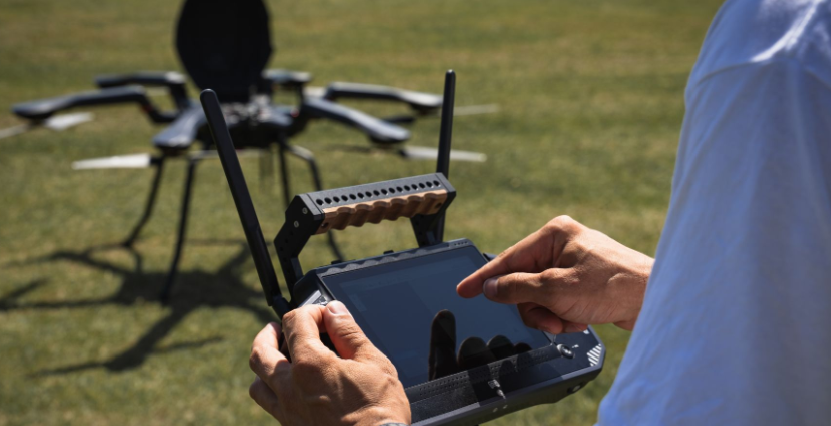
Acecore Technologies recently introduced the Signav Pro, a redesigned ground control station featuring a larger display, expanded control options, programmable buttons and switches, and versions targeting different operational environments, including an NDAA-compliant variant and a military-focused configuration. According to the company, the system is designed to increase operator flexibility while supporting different mission profiles and payload configurations.
At first glance, a controller launch hardly sounds revolutionary.
That perception reflects an outdated understanding of unmanned systems.
Modern drone missions are no longer about keeping an aircraft airborne.
They are about managing information.
Today's operators simultaneously monitor flight status, payload data, mapping outputs, video feeds, airspace restrictions, autonomous behaviors, communications links, and mission objectives.
The drone has become a flying computer.
The controller has become a command center.
This shift is transforming how organizations think about unmanned operations.
Historically, control stations were treated as accessories.
The aircraft mattered.
The camera mattered.
The data link mattered.
The controller simply connected them.
That separation is disappearing rapidly.
As drones become more autonomous, operators paradoxically need better interfaces rather than fewer interfaces.
Why?
Because autonomous systems generate more decisions, not fewer.
A pilot flying manually focuses on controlling the aircraft.
An operator managing an autonomous mission must supervise the aircraft, validate system choices, monitor mission progress, adjust objectives, and intervene when conditions change.
That requires situational awareness.
Situational awareness requires information.
Information requires interface design.
In other words, usability is becoming a strategic capability.
The military already understands this lesson.
A combat aircraft is not judged solely by thrust or speed. Human-machine interaction is a decisive factor. The same logic increasingly applies to drones operating in crowded airspace, contested environments, or complex commercial missions.
A poorly designed control station creates friction.
Friction creates mistakes.
Mistakes create mission failure.
The consequences range from inefficient inspections to operational losses on the battlefield.
This is why programmable controls matter.
It is why larger displays matter.
It is why mission-specific configurations matter.
A mapping team, a critical infrastructure inspection crew, and a military operator all interact with unmanned systems differently. The most effective control station is not necessarily the one with the most features. It is the one that allows users to execute tasks with the least cognitive effort.
That principle is becoming increasingly important as drone fleets expand.
The next evolution of unmanned systems will not involve one operator controlling one aircraft.
It will involve operators managing multiple autonomous platforms simultaneously.
When that future arrives, interface design will become a force multiplier.
The organizations that optimize operator efficiency will gain advantages in productivity, mission success, training speed, and operational resilience.
This trend extends well beyond drones.
Robotics, autonomous vehicles, ground robots, maritime drones, and space systems are all moving toward similar architectures. The machine performs more tasks independently, while the human focuses on supervision and decision-making.
The challenge therefore shifts from flight engineering to human-machine collaboration.
This is where future competition will increasingly take place.
Not only between aircraft.
Not only between sensors.
But between ecosystems.
The companies that build the most intuitive, adaptable, and operationally effective interfaces may ultimately generate greater value than those chasing marginal gains in raw platform performance.
Because the uncomfortable truth about autonomy is that humans remain essential.
Not as pilots.
Not as drivers.
Not as joystick operators.
But as commanders of increasingly intelligent systems.
The future of unmanned technology will therefore depend on something surprisingly simple.
How effectively people can control complexity.
And in that future, the most powerful component may not be the drone.
It may be the screen in front of the operator.
.jpg)