Plan Colombia 2.0? Washington’s Next Security Gamble Could Reshape Latin America
The most important geopolitical development in Latin America may not be happening in public.
There is no presidential announcement.
No billion-dollar appropriation bill.
No official strategy document.
Yet behind closed doors in Washington and Bogotá, a phrase is increasingly appearing in conversations among defense officials and policymakers:
"Plan Colombia 2.0."
Whether that ultimately becomes its official name is almost irrelevant.
The signal matters more than the label.
Because after years in which Colombia gradually drifted away from the center of Washington's security agenda, the relationship appears to be moving back toward strategic significance.
And this time, the challenge looks very different from the one that defined the original Plan Colombia.
The Return of a Strategic Partnership
The first Plan Colombia was born in an era dominated by insurgency.
The objective was relatively clear: weaken guerrilla organizations, combat narcotrafficking, strengthen state institutions, and stabilize one of America's most important regional partners.
The results remain debated.
What is not debated is the scale.
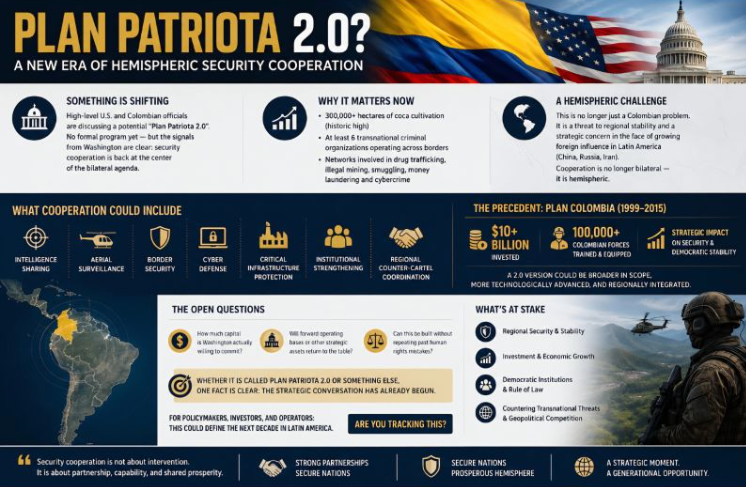
More than $10 billion flowed into security cooperation over two decades, transforming Colombia's military capabilities and redefining regional security dynamics.
Today, policymakers face a radically different threat landscape.
The enemy is no longer a single insurgent movement.
It is an ecosystem.
Drug trafficking.
Illegal mining.
Human smuggling.
Money laundering.
Cyber-enabled criminal networks.
Transnational armed groups.
These organizations operate across borders, adapt rapidly, and increasingly function like multinational enterprises.
The challenge is no longer defeating an insurgency.
The challenge is managing an interconnected security economy.
Venezuela Changes the Entire Equation
Every discussion about regional security eventually arrives at the same place:
Venezuela.
Criminal networks do not recognize national boundaries.
Neither do migration flows, illicit financial channels, or smuggling routes.
For Washington, Colombia's security concerns are increasingly linked to a broader regional picture stretching across northern South America and the Caribbean.
That changes how policymakers think.
This is no longer merely a Colombian issue.
It has become a regional stability issue.
And in Washington, regional stability is increasingly viewed through the lens of great-power competition.
The China Question Lurking in the Background
Officially, discussions focus on crime, narcotics, border security, and institutional capacity.
Unofficially, another topic continues to grow in importance.
China.
Alongside concerns about Russian and Iranian influence, Latin America has become an increasingly competitive geopolitical arena.
Ports.
Telecommunications.
Mining.
Energy infrastructure.
Critical supply chains.
All have become strategic assets.
For U.S. planners, strengthening security partnerships is increasingly connected to maintaining political and economic influence.
That means any future "Plan Colombia 2.0" would likely be about more than drugs and crime.
It would also be about shaping the strategic balance of the Western Hemisphere.
Where the Money Could Flow
If a renewed security framework emerges, investors and industry leaders should watch where funding goes.
The priorities likely differ from those of twenty years ago.
Instead of large-scale counterinsurgency campaigns, future investments may focus on:
- Intelligence sharing
- Border surveillance
- Drone and aerial monitoring
- Counter-narcotics interdiction
- Cybersecurity
- Critical infrastructure protection
- Maritime security
- Institutional modernization
- Data and intelligence platforms
That shift could create opportunities across defense technology, aerospace, surveillance systems, cybersecurity, secure communications, and infrastructure resilience.
The winners may not be traditional defense contractors alone.
Technology firms could become equally important players.
The Human Rights Test
Every discussion of a potential Plan Colombia revival carries an unavoidable question.
Can policymakers replicate the security gains of the original program without repeating its controversies?
Past security operations generated significant debate regarding human rights, accountability, and civilian impact.
Any modern framework would face immediate scrutiny from governments, civil society organizations, investors, and international institutions.
The political environment of the 2020s is very different from that of the early 2000s.
Transparency is no longer optional.
It is a condition for legitimacy.
The Moment Before the Moment
The most fascinating aspect of the current situation is that nothing has officially happened yet.
No treaty.
No funding package.
No launch event.
Only meetings.
Conversations.
Signals.
But history shows that strategic shifts often begin this way.
Quietly.
Long before the headlines arrive.
The phrase "Plan Colombia 2.0" may ultimately disappear.
Or it may become the framework that defines security cooperation across Latin America for the next decade.
Either way, the underlying trend is becoming difficult to ignore.
Washington appears to be looking south again.
And when Washington's strategic attention moves, capital, policy, and security priorities tend to move with it.
The pieces may not yet be assembled.
But they are already on the board.