Juan Alberto Leiva Garcia. His Name Was Spanish. He Was Ukrainian. His Russian Captors Said That Made Him Guilty.
What does a Ukrainian look like?
For decades, propagandists, politicians, and imperial dreamers have tried to answer that question on behalf of Ukrainians themselves.
Juan Alberto Leiva Garcia's story delivers a devastating response.
His father was Cuban.
His name was Spanish.
He studied in the United States.
And when Russia captured him, those three facts reportedly became evidence against him.
Not because he had committed a crime.
But because his existence contradicted a worldview.
https://youtube.com/shorts/btqTPjGrncQ
The Ukrainian They Could Not Process
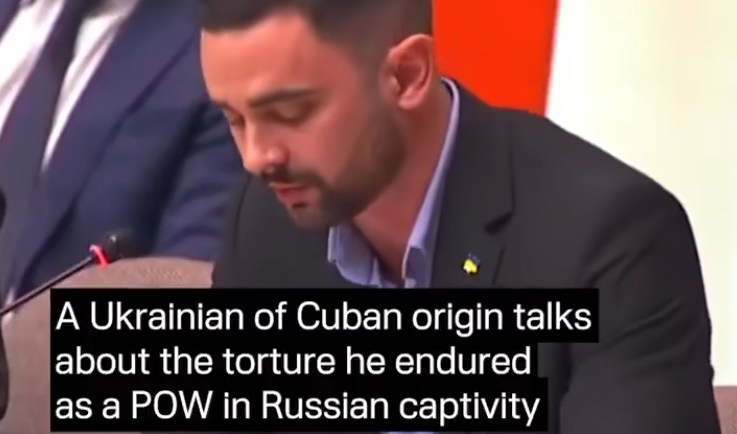
Juan Alberto Leiva Garcia was born in Mariupol to a Ukrainian mother and a Cuban father.
Years later, after studying in the United States, he returned to Ukraine and joined the military. He became a Ukrainian Marine and eventually participated in the defense of Azovstal, one of the defining battles of the war.
Then came captivity.
According to testimony he delivered this week at an Arria-formula meeting connected to the United Nations Security Council, he spent 1,183 days in Russian captivity.
What followed was not merely imprisonment.
It was an attempt to force him into a narrative.
Garcia said his interrogators repeatedly struggled to understand how a man with a Spanish name and Cuban heritage could simply be Ukrainian.
Instead, they allegedly demanded that he confess he was a foreign mercenary.
His years studying in America supposedly provided another explanation in their minds:
Spy.
When he refused those accusations, he stated that he was beaten and subjected to electric shocks.
The accusation was never really about evidence.
It was about identity.
When Reality Breaks the Propaganda
Authoritarian systems often struggle with complexity.
People are easier to categorize than to understand.
Garcia's story appears to have challenged multiple assumptions at once.
A Cuban connection.
An American education.
A Ukrainian military uniform.
For his captors, these facts reportedly did not fit together.
So they tried to force them into a simpler story.
Foreign fighter.
Western agent.
Anything except what he claimed to be.
A Ukrainian defending Ukraine.
The irony is striking.
For years, Russian narratives surrounding Ukraine have often revolved around language, ethnicity, ancestry, and questions of who supposedly belongs.
Yet here was a man whose family roots stretched across continents and whose answer to those questions was expressed through action rather than ancestry.
When war arrived, he chose Ukraine.
That was apparently the part they could not accept.
Three Years Without a Voice
The physical consequences were severe.
Garcia told the meeting that during his captivity he weighed approximately 52 kilograms at one point.
For more than three years, he had no contact with his family.
Think about that for a moment.
Not three days.
Not three weeks.
Not three months.
Three years and three months.
A period long enough for children to grow up, families to relocate, cities to change, and entire chapters of life to disappear.
Yet perhaps the most chilling element of his testimony was not what he said happened to him.
It was what he said about everyone else.
The Most Damning Sentence
The most important sentence of his testimony may have been the simplest:
He was not an exception.
At the same meeting, representatives of the Office of the United Nations High Commissioner for Human Rights reportedly stated that more than 95% of released Ukrainian prisoners of war interviewed by the organization described torture or ill-treatment during captivity.
That transforms Garcia's account from an individual tragedy into something larger.
The story stops being about one prisoner.
It becomes a window into a system.
And systems are harder to dismiss.
Who Gets to Be Ukrainian?
In the end, Garcia's story asks a question that extends far beyond one prison cell.
Who gets to define a nation?
Is nationality determined by a surname?
By bloodline?
By language?
By birthplace?
Or by choice?
A Ukrainian with a Cuban father.
A Spanish name.
An American education.
A defender of Mariupol.
A survivor of 1,183 days in captivity.
His life appears to provide a clear answer.
Nations are not built by ancestry alone.
They are built by people willing to stand for them when standing becomes dangerous.
Perhaps that is why his captors reportedly spent so much effort trying to convince him he was something else.
Because if identity can be chosen rather than assigned, then propaganda loses one of its most powerful weapons.
And if Juan Alberto Leiva Garcia's testimony proves anything, it is that the idea of Ukraine is larger than any surname, language, or family tree.
That may be the very thing his captors never understood.