HHLA Sky UTM Control Center and Skycharge Drone Hanger Prove 24/7 Drone Operations
At the sprawling docks of the Hamburger Hafen und Logistik AG (HHLA) in Hamburg, a quiet revolution is underway: drones taking off, flying missions, docking and charging — fully autonomously, around the clock. No operators standing in the wind and rain. Instead, fleets are being flown from secure control rooms many kilometers away. The driving force behind this shift is a strategic collaboration between HHLA Sky and drone-infrastructure innovator Skycharge.
The key challenge they are tackling: How do you scale drone operations from test flights to full-day industrial use? The answer is not only better drones — but a robust ground-side charging and docking infrastructure combined with a unified UTM/command platform capable of managing fleets 24/7.
Real-world validation at Hamburg Port
Skycharge installed and tested its new HANGAR docking & charging station directly inside the port — one of the harshest environments for electronics. Exposed to salt-laden air, rain, humidity, temperature swings and unstable industrial power, the HANGAR proved weather-resistant and operationally reliable throughout testing. It enabled autonomous land-dock-charge cycles, keeping drones ready for missions at any hour.
This isn’t just a lab setup — it’s proof-of-concept under real port logistics conditions, a decisive step towards scalable automated drone operations.
Why infrastructure matters: not just drones, but the system behind them
The bottleneck in drone deployment isn’t flight capability anymore — it’s logistics:
Where do drones rest? Charge? Securely store data? Who monitors airspace, safety and compliance?
With Skycharge providing the physical layer, HHLA Sky provides the digital nerve center.
Inside the UTM: an Integrated Drone Control Center built for scale
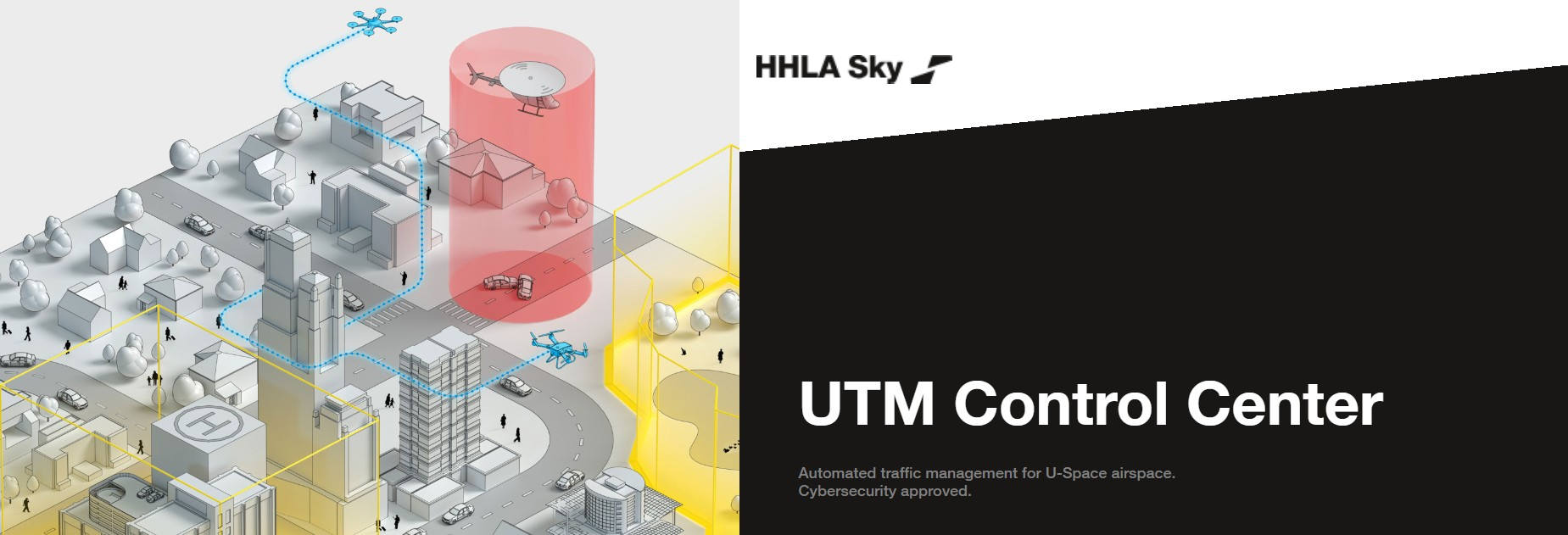
At the core of 24/7 operations is HHLA Sky’s UTM-based Integrated Control Center (ICC) — a command platform designed to coordinate hundreds of drones and ground robots simultaneously, across multiple sites, even BVLOS and over public space.
The ICC acts as both fleet supervisor and air-traffic management layer for drones. Its architecture offers:
🔹 Real-time tracking of drones, routes, payloads & mission status
🔹 Airspace and safety management with geofencing & conflict prevention
🔹 Encrypted command links and high cyber-security standards
🔹 Automated flight execution based on predefined mission protocols
🔹 Full data integration: video streams, sensor telemetry, logs & maintenance status
🔹 Centralized control room for remote pilots & fleet managers
This is a true UTM environment — not just a dashboard. The system handles automated route planning, flight approval workflows, redundancy checks and emergency overrides. Operators supervise multiple drones at once, intervening only when necessary.
Where Skycharge provides a place for drones to rest + recharge, the UTM gives them purpose + safe corridors to fly.
Together, they create an end-to-end autonomous drone ecosystem:
Mission → Take-off → Flight → Landing → Docking → Charging → Next mission
A loop previously requiring people — now fully automated.
Interoperability = scalability
A central feature of Skycharge infrastructure is multi-platform compatibility: one HANGAR can support quadcopters, heavy-lift drones, coaxial designs and even VTOL aircraft. No proprietary docking for each drone model, no fragmenting infrastructure.
When paired with UTM integration, this interoperability unlocks something new: infrastructure that scales like Wi-Fi. Install a hangar, connect to ICC/UTM, add drones. Repeat at multiple sites. Fleets can expand without redesigning the tech stack every time.
Beyond the port: a blueprint for future cities
Once drones fly, land, charge and relaunch autonomously — and airspace is centrally managed — use cases multiply:
• Infrastructure inspection & powerline monitoring
• Container yard surveillance & perimeter security
• Offshore/port logistics & emergency deliveries
• Industrial site monitoring and emissions checks
• First-response support & hazardous-area reconnaissance
The Hamburg deployment demonstrates not only what drones can do — but what infrastructure + UTM coordination can sustain continuously.
A step from experimentation to deployment
With Skycharge’s robust hangar entering production and HHLA Sky’s UTM ICC proving scalable, we’re witnessing the shift from piloted drone operations to infrastructure-anchored, automated air services.
What airports were to aviation, hangars + UTM will become to autonomous drones.
Hamburg may soon stand as one of the first real examples of a city port prepared for persistent aerial robotics at enterprise scale — and perhaps, a template for ports worldwide.
.jpg)