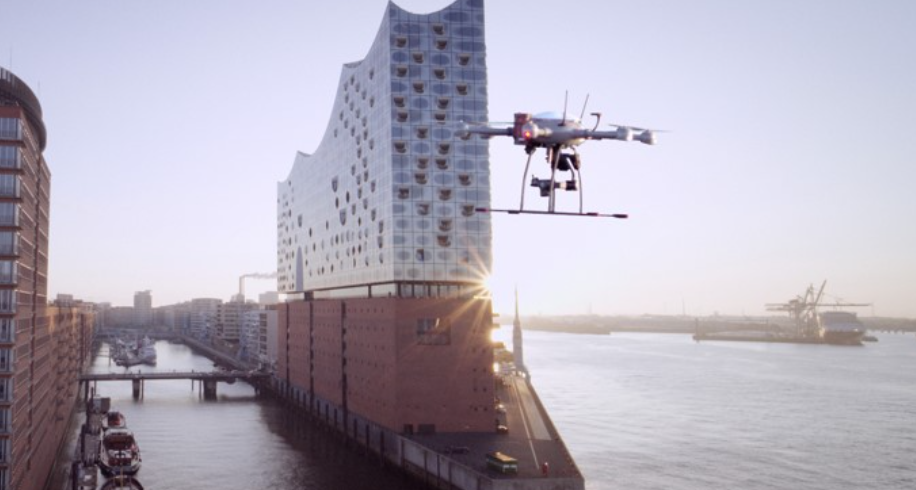
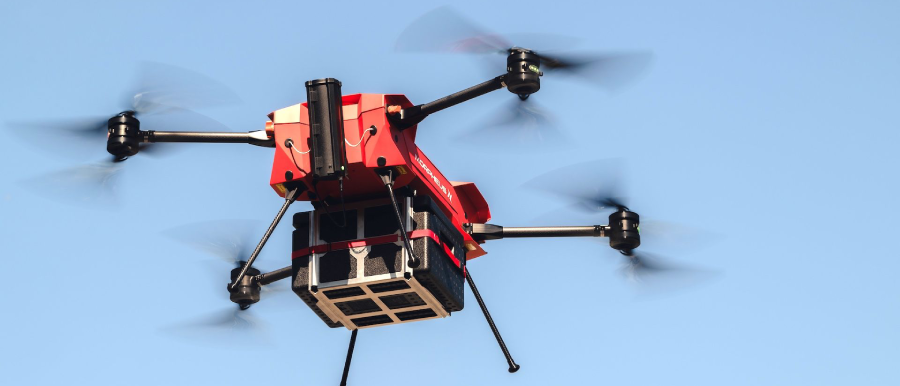
From Hamburg’s Port to the Security Business: Why the Sale of HHLA Sky to CONDOR Matters

A German port company created a drone business.
Now a German security group is buying it.
That sounds like a relatively small corporate transaction. In reality, the sale of HHLA Sky GmbH offers a glimpse into a much larger transformation taking place inside Europe's drone industry.
CONDOR Schutz- und Sicherheitsdienst GmbH, UAV-Solutions is acquiring the company, with Saxenhammer acting as exclusive M&A adviser to the seller.
Forget the deal mechanics for a moment.
The strategically interesting part is what is being combined: autonomous systems, centralized control software and security expertise.
Because the future of the drone market may not belong simply to companies capable of building excellent aircraft.
It may belong to those capable of operating fleets of autonomous machines as part of critical infrastructure and security systems.
The drone is becoming the least interesting part
HHLA Sky GmbH was founded in 2018 and developed hardware and software for automated operation of drones and mobile robots.
The key phrase is not “drone manufacturer.”
It is automated operation.
At the center of the company's offering sits its Integrated Control Center, or ICC, a platform designed to centrally control and monitor large fleets of drones.
That shifts the commercial proposition significantly.
Selling a drone means selling an aircraft.
Operating a fleet means selling a capability.
Imagine dozens of autonomous systems spread across ports, industrial sites, energy facilities or logistics hubs.
One machine inspects a perimeter.
Another checks infrastructure.
Another responds to an alarm.
Another performs a scheduled inspection.
Operators do not want twenty independent screens and twenty separate workflows. They need a layer above the hardware that tells them what is happening, where the machines are, what they are observing and what requires human attention.
The valuable asset therefore begins migrating upward.
From airframe to sensor.
From sensor to software.
From software to fleet orchestration.
The drone becomes a node. The platform becomes the business.
Enter the security industry
That makes the acquisition by CONDOR Schutz- und Sicherheitsdienst GmbH, UAV-Solutions particularly interesting.
The stated strategic logic is to combine HHLA Sky GmbH's technology with CONDOR's drone and security offering, opening opportunities in drone logistics, industrial inspection and protection of critical infrastructure.
Those markets may sound separate.
Increasingly, they are not.
Consider an industrial complex.
The same drone capable of inspecting a roof can observe a perimeter.
The same thermal sensor detecting an overloaded electrical component can potentially identify suspicious activity.
The same autonomous flight capability that monitors a pipeline can investigate an alarm.
The same software that dispatches an inspection drone can potentially coordinate unmanned systems across a much larger security operation.
Once drones become autonomous enough, the separation between “inspection platform” and “security platform” begins to blur.
Critical infrastructure is the real battlefield for commercial autonomy
Europe's enormous installed base of critical infrastructure creates a natural market.
Ports.
Railways.
Power grids.
Factories.
Chemical plants.
Data centers.
Pipelines.
Warehouses.
Telecommunications facilities.
These are geographically large environments where conventional monitoring can be expensive and labor-intensive.
They also contain repetitive tasks perfectly suited to machines.
A human guard cannot continuously inspect every meter of a giant industrial site.
A network of sensors combined with autonomous drones potentially can.
The equation becomes even more interesting when drones are integrated with fixed cameras, alarms, access-control systems and centralized command software.
Then the drone stops being a flying camera.
It becomes a mobile sensor inside a larger security network.
Thread enough of those sensors together and you begin creating something much more valuable than an aircraft fleet:
a physical-world operating system.
Europe is discovering the dual-use economy
There is another reason this transaction deserves attention.
The border between civilian and security drone technology is becoming increasingly porous.
That does not mean every commercial drone company becomes a defence contractor.
But many underlying technologies overlap.
Autonomous navigation.
Fleet management.
Secure communications.
Sensor integration.
Computer vision.
Remote operations.
Resilient positioning.
Mission planning.
Edge computing.
A technology originally optimized for inspecting infrastructure may also have security applications. Software used to coordinate commercial robots can contain concepts relevant to public-safety or defence environments.
That is why Europe's drone ecosystem should no longer be measured simply by counting aircraft manufacturers.
The strategically important companies may increasingly sit elsewhere in the stack.
Software.
Autonomy.
Sensors.
Communications.
Counter-drone technology.
Command systems.
Fleet orchestration.
Cybersecurity.
The security guard is getting a digital wingman
The acquisition also points toward a broader transformation of private security.
Traditional security is intensely human.
Guards patrol.
Operators watch cameras.
Personnel respond to alarms.
Automation does not necessarily remove the human from that system. More plausibly, it changes what each person can supervise.
If a remote operator can manage several autonomous systems, one person potentially monitors an area previously requiring multiple physical patrols.
If a drone can automatically investigate a triggered sensor, security personnel can receive information before entering an uncertain situation.
If an aircraft can repeatedly perform the same inspection trajectory, organizations can compare data over time instead of relying purely on visual spot checks.
The economics start changing.
Security becomes less about putting another pair of eyes at every location and more about increasing what each pair of human eyes can see.
The difficult part comes after the acquisition
Of course, combining two companies on paper is easier than integrating their technologies and commercial models.
Autonomous security operations face substantial practical requirements.
Reliability matters.
Communications matter.
Cybersecurity matters.
Regulatory compliance matters.
False alarms matter.
The ability to integrate with existing security systems matters enormously.
Customers protecting sensitive industrial infrastructure do not want impressive drone demonstrations.
They want systems that work at 3 a.m. in bad weather when something has actually gone wrong.
That creates a significant gulf between a clever technology product and operationally trusted security infrastructure.
Closing that gulf will determine how strategically important this acquisition ultimately becomes.
Why this small deal deserves attention
M&A announcements are usually full of familiar language.
Synergies.
Growth markets.
Strategic buyers.
Excellent cooperation.
And the statement accompanying this transaction follows some of that traditional vocabulary. Matthias Grau, Partner at Saxenhammer, described the combination of innovative drone technology and extensive security expertise as making the deal particularly interesting in a dynamic global market.
But underneath the corporate language sits a genuinely significant industrial trend.
Europe's drone market is beginning to mature.
The first chapter was about whether drones worked.
The second was about finding commercial applications.
The next may be about consolidation and integration.
Drone companies will connect with security providers.
Software platforms will connect with sensors.
Autonomous vehicles will connect with control centers.
Robots in the air will increasingly communicate with robots on the ground.
And the companies controlling that orchestration layer may capture a growing share of the value.
In that sense, the most important part of HHLA Sky GmbH may ultimately not be what flies.
It may be what controls everything that flies.
The sale to CONDOR Schutz- und Sicherheitsdienst GmbH, UAV-Solutions therefore deserves to be watched not simply as another German mid-market acquisition, but as an experiment in what the security company of the future might look like.
The uniform will remain.
The security officer will remain.
But increasingly, there will be autonomous machines around them.
And somebody will need software to command the fleet.
The next battle in Europe's drone market may not be about who builds the best drone. It may be about who controls the swarm.