Europe’s Mars Rover Gets Its Second Chance
For nearly two decades, Europe’s Mars ambitions have been defined by delay.
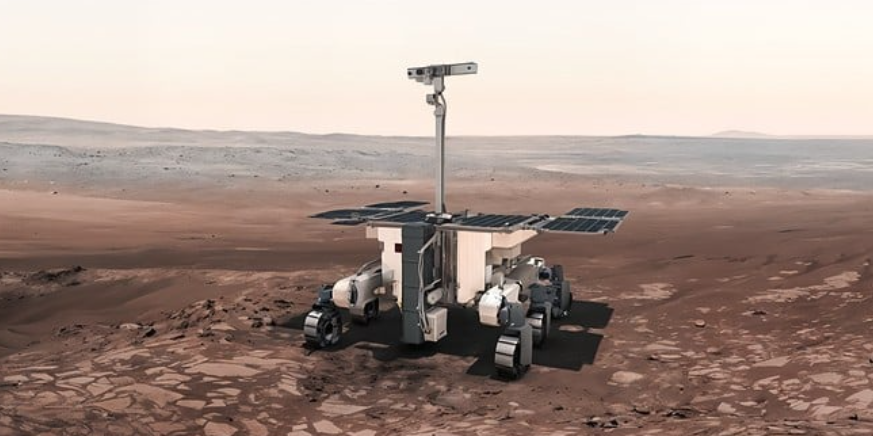
Now, at last, the Rosalind Franklin rover has a confirmed launch window—and a rocket powerful enough to get it there. NASA has selected SpaceX’s Falcon Heavy to carry ESA’s first Mars rover toward the Red Planet in late 2028, a decision that brings closure to one of the longest-running sagas in planetary exploration.
This is more than a logistics milestone. It is a geopolitical reset.
Rosalind Franklin was originally conceived as part of ExoMars, a joint European‑Russian mission. That partnership collapsed in 2022, when ESA severed ties with Roscosmos following Russia’s invasion of Ukraine. Overnight, Europe lost not only its launch vehicle, but also key elements of its landing system. The rover—complete and flight‑ready—was forced into indefinite storage.
What followed was a quiet scramble.
ESA committed to rebuilding missing components internally and turned to the United States for help. The result is the ROSA program, under which NASA is supplying launch services, descent braking engines, radioisotope heater units, and scientific instrumentation support—including a mass spectrometer integrated into the Mars Organic Molecule Analyzer.
The science, however, has never lost its relevance.
Rosalind Franklin is designed to answer one of planetary science’s most persistent questions: did life ever exist on Mars? Unlike previous rovers, which sample only the surface, Rosalind Franklin can drill down two meters, reaching material that may have remained chemically intact for billions of years.
That capability alone sets it apart.
Mars’ surface is relentlessly hostile—bathed in radiation, hammered by oxidizing chemistry, and stripped of atmospheric protection. Any biological signatures left exposed are likely long gone. But beneath the surface, scientists believe the story could be very different.
The target site, Oxia Planum, is rich in ancient clay deposits formed in the presence of water. If Mars ever hosted microbial life, this is where traces are most likely to survive.
Still, the mission carries risk.
Years of delay mean the rover’s technology is no longer cutting‑edge by 2028 standards. Budget pressures in the United States have also created uncertainty; despite repeated attempts by the U.S. administration to cut NASA’s contribution, Congress has intervened to keep the program alive.
Yet the symbolism of this mission matters as much as the data.
Rosalind Franklin represents Europe’s determination to remain a first‑rank planetary science power—even when partnerships collapse and geopolitics intrude. Choosing Falcon Heavy reflects a pragmatic embrace of commercial space at a time when national launch options are increasingly constrained.
If the rover launches in 2028 and lands safely in 2030, it will mark Europe’s first successful rover mission to Mars—and possibly humanity’s best chance yet of finding evidence that life once existed beyond Earth.
It has taken far longer than planned. But science, like exploration, rarely follows a straight line.