EOGS Vision 2040 - Europe’s Orbiting Eyes Prepare for a Borderless Battlefield
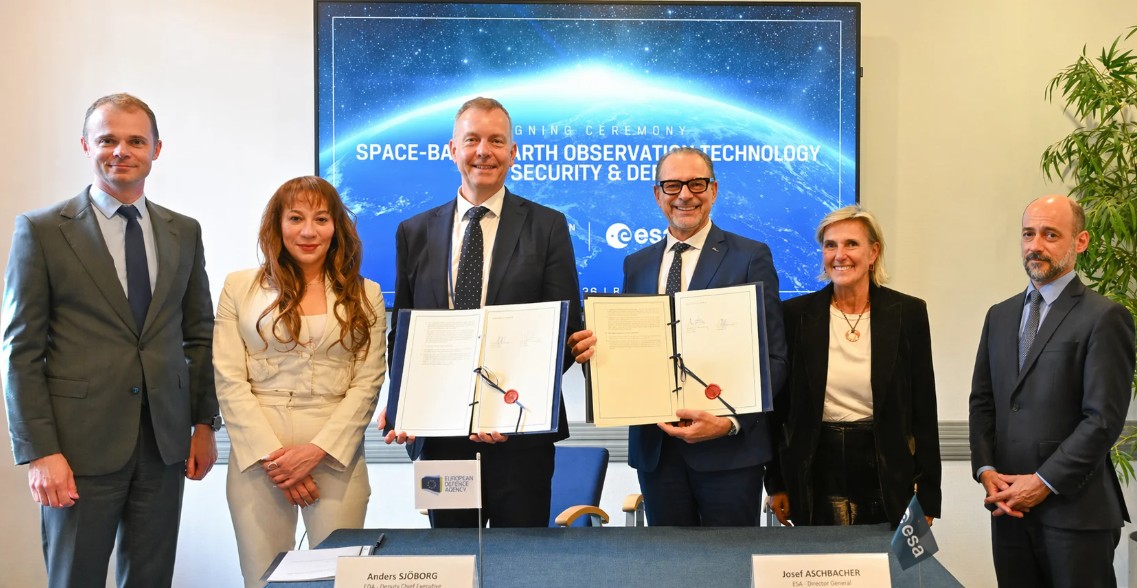
Europe is quietly preparing for a future where the most decisive advantage in defense may come not from the ground—but from orbit. In a significant step toward that future, the European Defence Agency and the European Space Agency have deepened their long-standing partnership to focus on next-generation Earth observation technologies for security and defense.
At the center of this initiative is a forward-looking study extending to 2040 and beyond, built around a strategic concept informally framed as “EOGS Vision 2040.” This effort aims to identify critical technology gaps, define research priorities, and ensure that Europe retains autonomous and resilient space-based intelligence capabilities in an increasingly volatile geopolitical landscape.
Earth observation has long been a cornerstone of modern defense systems. Satellites provide real-time intelligence, surveillance, and reconnaissance (ISR), enabling everything from battlefield awareness to disaster response coordination. But as threats evolve—ranging from hybrid warfare to infrastructure sabotage—the demands on these systems are intensifying.
The new EDA-ESA study acknowledges that the next generation of space-based capabilities must go far beyond traditional imaging. Among the key focus areas are advanced optical systems capable of higher resolution and faster revisit times, as well as next-generation radar technologies that can operate in all weather conditions and through complex environments.
Equally critical is the expansion of signal intelligence (SIGINT) capabilities. Future systems will need to detect, classify, and interpret a growing volume of electromagnetic activity, from communications signals to radar emissions. In an era where information dominance is paramount, the ability to “listen” from space may be just as important as the ability to “see.”
However, the real game-changer lies in data. Modern Earth observation platforms generate enormous volumes of information—far more than human analysts can process manually. This is where advanced data analytics and AI-driven processing come into play. The study places strong emphasis on developing architectures that can rapidly process, fuse, and exploit data from multiple sources, turning raw information into actionable intelligence in near real time.
This aligns closely with broader European initiatives such as the Earth Observation Governmental Service and the European Resilience from Space programme. Together, these efforts aim to strengthen Europe’s strategic autonomy in space—a goal that has become increasingly urgent as reliance on external capabilities is seen as a vulnerability.
What makes this collaboration particularly noteworthy is its maturity. The EDA and ESA have been working together for over 15 years, building a foundation of trust, shared governance, and coordinated investment. This new study builds on that legacy, but with a sharper focus on operational impact and long-term resilience.
Statements from leadership underscore the strategic importance of the initiative. EDA Chief Executive André Denk emphasized that “knowledge is power” in defense—and that space-based observation provides a unique, borderless perspective. ESA Director General Josef Aschbacher highlighted the shift from ambition to execution, noting that the agency is increasingly stepping into a more active role in security and defense.
The implications extend beyond military applications. Enhanced Earth observation capabilities can support critical infrastructure protection, environmental monitoring, and crisis management. In a world where natural disasters, cyber threats, and geopolitical tensions are often interconnected, the ability to maintain continuous, reliable situational awareness is invaluable.
Ultimately, EOGS Vision 2040 represents more than a technology roadmap—it is a strategic statement. Europe is investing not just in satellites, but in sovereignty, resilience, and the ability to act independently in an uncertain world.
As the space domain becomes more contested and congested, the race is no longer just about الوصول to orbit—it’s about what you can see, understand, and act upon once you’re there.